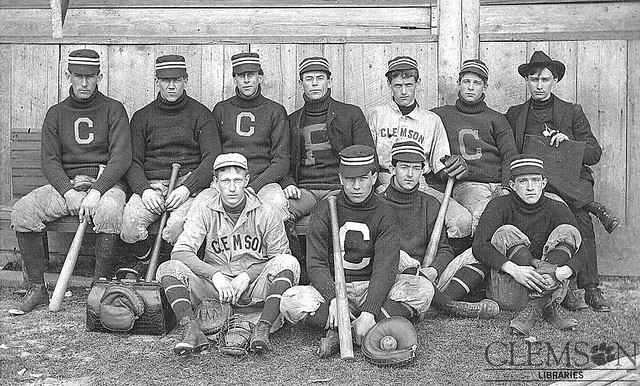
It’s World Cup season again, which brings to mind some thoughts I thought many years ago about the differences between soccer and other sports in relation to the societies that revere them. That train of thought first left the station twenty-some years ago when I was traveling on temporary duty in Europe (either France or Russia, I don’t recall) and was exposed to nearly constant “futbol” coverage. Years later (and still five years ago) the thoughts resurfaced when I was watching my Clemson Tigers men’s soccer team play win the national championship.
Basically: The differences between soccer and football — or between “metric football” (as former WSJ columnist James Taranto referred to it) and American football — and even between soccer and other beloved U.S. sports like baseball and basketball — can give us some insight into the differences between other world societies and the United States of America. More precisely, our “USonian” culture (yes, I cribbed the name from Frank Lloyd Wright’s architectural philosophy) seems better fit to our brand of football than the international brand. By extension, it seems our love of (or, in some cases, obsession with) football and baseball and basketball gives us different outlooks, different approaches to life, from the rest of the world that emphasizes soccer.
What differences, in particular?

(Image from the Rocky Top Sports World blog.)
One of the first that came to mind is the fact that soccer is a free-flowing game — more akin to basketball (and hockey, field hockey, lacrosse, etc.) in this respect than to football and baseball and softball, which are more set pieces and move along in increments. Soccer and basketball players move nearly constantly, looking for openings and opportunities; in contrast, football and baseball players come to stops in play, and set up offenses and defenses in anticipation both of what they think they can accomplish and what they anticipate the other team doing. That said, soccer and basketball players do stop from time to time as they feint, maneuver, and react to changes in possession, and they must change directions and tempo throughout their time on the pitch or the court, but their set plays and executions come primarily in relation to game events (corner kicks, free and penalty kicks, inbounds, free throws) as opposed to being built in to the structure of the sport.
I may be making more of this than warranted, but hear me out: Perhaps the free flow of soccer and basketball might fit our lives as individuals — certainly in life the clock keeps running, as in soccer, as much as we might appreciate a timeout — but often group interactions require a bit more structure and even precision. This may particularly be true if we work with others in a company and depend on the company’s success for our livelihood. I recall quality improvement sage Dr. W. Edwards Deming talking about the different levels of interaction between the members of a bowling team and the members of an orchestra, and how the interactions of an effective production unit must work more like an orchestra: not just playing their parts correctly, but ensuring that all the parts work together at once in pursuit of the common aim. With that in mind, it seems the set piece approach of football and baseball may fit more of our lives than does the free flow of the other sports.
If that’s true, it may seem a little odd, even counterintuitive, that the society that enshrines individual rights might prefer structured sports while societies which seems less concerned with individual rights prefer a free-flowing — dare we say laissez-faire? — sport. But one thing we as Americans seem to appreciate is that we can join together in cooperative ventures without abrogating our individual rights, and even temporarily set aside part of our individuality when we find a cause, or a team, worth supporting.
Speaking of cooperative ventures, one thing that holds true for all team sports — soccer, football, basketball, and so forth — is simply that each player must do their part in light of the team’s aim to score points. We may have the opportunity to score ourselves, or to assist others, but we all share the aim even if we play different roles in achieving it. And one obvious difference between soccer and football — and indeed between soccer (and also hockey, lacrosse, etc.) and other sports — is the vast difference in scoring potential.
In soccer, only single points are scored at a time; no matter who does what in soccer the score will only increment by one point. Players have no opportunities for multiple goals at any one time, which is vastly different from other sports popular in the U.S.A. In baseball and softball, we can score up to four runs at a time with a grand slam. In basketball, the standard scoring was always two points until the three-point rule was adopted, so now scoring can increment much faster than it used to. Football, of course, grew from rugby to the point that a touchdown is now worth six points. Even cricket allows for multiple runs at a time.
I recall watching a soccer match in which one team went down two to nothing. They continued to take shot after shot, but it was always evident that the only way to win would be to crawl back through the tie-game situation, to first play to tie and then to win. At the risk of speaking for my fellow Americans, this does not sit well fundamentally with those of us born and raised in the U.S.A. In our favorite games, football, baseball, and basketball, teams have a greater chance to rally than would any team in soccer, such that close games are much more precarious — and often more exciting.
We seem to believe, more than soccer-loving societies and cultures, that we can get ahead in giant leaps. We are brought up believing that it is possible to dare and to do great things, that we do not have to score in small increments but have it within ourselves to achieve more in one shot than other people might. We believe in breakthroughs, in extraordinary performances that produce significant differences in the real world and in the games we play. Perhaps fans of cricket can say the same.
From my perspective, the possibility of scoring a touchdown when down by a field goal, or scoring big in an inning, may be likened to our quest for innovation and our penchant for inventiveness. The possibility that the other team may make a comeback can lead us to run up the score to prevent it, because something in our American psyche prefers that we not only win but win decisively — which may be reflected even in what military historian Russell Weigley called “the American way of war,” which has historically been to win by annihilation.
What was it Conan, as portrayed by Arnold Schwarzenegger, said was among the best things in life? “To crush your enemies.” Yes; yes, indeed. And what better way, in sports, than by scoring a lot of points at once?
Penalties and timekeeping are also quite different among the various sports, and may perforce speak to other differences between cultures. I have not played soccer in a long time, and therefore am a little fuzzy on what warrants an indirect kick versus a direct kick, or a yellow card versus a red card, but one thing I do remember is that the clock keeps running in soccer while a penalty is assessed. In contrast, the clock stops in a football or basketball game while the penalty is enforced.
Another interesting difference is that in football the coach of the aggrieved team often has the option of declining the penalty if the result of the play would be more advantageous. That speaks to the situational aspect of the sport, but so does the fact that many penalties affect the distance to be covered but not the number of attempts: A first-and-ten can turn into a first-and-five or a first-and-fifteen if minor penalties are assessed against either the defense or the offense, respectively, but it is still first down. That makes me wonder if one of the things we in the U.S.A. appreciate culturally, that perhaps others appreciate less, is the do-over. The second chance.
Sticking to the subject of penalties, I wonder about the significance of the fact that, in soccer, one of the most dependable ways to score is the penalty kick. As with the pitcher in baseball, the advantage lies mostly with the kicker: Delivering the kick, like delivering a pitch to a batter, places a huge strain on the goalie. Anticipation, vision, perception, reaction — the margin for error is tiny, and it seems success for the goalie is a fine line between doing all the right things and simply not doing something wrong: the avoidance of error, as opposed to the achievement of success.
But, again, I may be reading more into this than I should. It’s all fun and games, right? Many say we take our sports too seriously, especially if we are spectating rather than participating. (And writing this many words on the subject must fall into the “taking it too seriously” category.)
This breakdown, of course, says nothing about individual contests. All sports require discipline and effort and so have value for life lessons as well as for health and fitness. It may be that some are more games (even athletic games) than sports, but that’s a distinction we need not belabor. Suffice it to say that, as with the example of the bowling team and the orchestra above, individual sports such as tennis, golf, swimming, martial arts, etc., teach excellent lessons about concentration, preparation, determination, and endurance, but less perhaps about leadership and cooperation than team sports. And different team sports such as soccer, football, baseball, and basketball emphasize different cooperative skills. Not necessarily better or worse skills, but different, so the more we can obtain at least a passing familiarity with these endeavors — from the pitch to the field to the diamond to the court, and even to the orchestra pit — the better we can understand and relate to the concepts needed for effective cooperation.
In conclusion, and by way of full disclosure: I’ve played most of these sports, and often enjoyed them though I may not have been very good at them. This includes soccer, so please do not conclude that I dislike the sport at all. Soccer spectators blowing vuvuzelas are another matter; those horns are damn annoying, but soccer itself is fine for what it is. But as a red-blooded USonian American, I relate more to sports where sudden breakthroughs and dramatic lead changes make the outcomes far from certain, and where the action is strategically guided, tactically coordinated — and potentially devastating.




 by
by