Societies and Sports — Soccer, Football, & More

It’s World Cup season again, which brings to mind some thoughts I thought many years ago about the differences between soccer and other sports in relation to the societies that revere them. That train of thought first left the station twenty-some years ago when I was traveling on temporary duty in Europe (either France or Russia, I don’t recall) and was exposed to nearly constant “futbol” coverage. Years later (and still five years ago) the thoughts resurfaced when I was watching my Clemson Tigers men’s soccer team play win the national championship.

Basically: The differences between soccer and football — or between “metric football” (as former WSJ columnist James Taranto referred to it) and American football — and even between soccer and other beloved U.S. sports like baseball and basketball — can give us some insight into the differences between other world societies and the United States of America. More precisely, our “USonian” culture (yes, I cribbed the name from Frank Lloyd Wright’s architectural philosophy) seems better fit to our brand of football than the international brand. By extension, it seems our love of (or, in some cases, obsession with) football and baseball and basketball gives us different outlooks, different approaches to life, from the rest of the world that emphasizes soccer.

What differences, in particular?


(Image from the Rocky Top Sports World blog.)

One of the first that came to mind is the fact that soccer is a free-flowing game — more akin to basketball (and hockey, field hockey, lacrosse, etc.) in this respect than to football and baseball and softball, which are more set pieces and move along in increments. Soccer and basketball players move nearly constantly, looking for openings and opportunities; in contrast, football and baseball players come to stops in play, and set up offenses and defenses in anticipation both of what they think they can accomplish and what they anticipate the other team doing. That said, soccer and basketball players do stop from time to time as they feint, maneuver, and react to changes in possession, and they must change directions and tempo throughout their time on the pitch or the court, but their set plays and executions come primarily in relation to game events (corner kicks, free and penalty kicks, inbounds, free throws) as opposed to being built in to the structure of the sport.

I may be making more of this than warranted, but hear me out: Perhaps the free flow of soccer and basketball might fit our lives as individuals — certainly in life the clock keeps running, as in soccer, as much as we might appreciate a timeout — but often group interactions require a bit more structure and even precision. This may particularly be true if we work with others in a company and depend on the company’s success for our livelihood. I recall quality improvement sage Dr. W. Edwards Deming talking about the different levels of interaction between the members of a bowling team and the members of an orchestra, and how the interactions of an effective production unit must work more like an orchestra: not just playing their parts correctly, but ensuring that all the parts work together at once in pursuit of the common aim. With that in mind, it seems the set piece approach of football and baseball may fit more of our lives than does the free flow of the other sports.

If that’s true, it may seem a little odd, even counterintuitive, that the society that enshrines individual rights might prefer structured sports while societies which seems less concerned with individual rights prefer a free-flowing — dare we say laissez-faire? — sport. But one thing we as Americans seem to appreciate is that we can join together in cooperative ventures without abrogating our individual rights, and even temporarily set aside part of our individuality when we find a cause, or a team, worth supporting.

Speaking of cooperative ventures, one thing that holds true for all team sports — soccer, football, basketball, and so forth — is simply that each player must do their part in light of the team’s aim to score points. We may have the opportunity to score ourselves, or to assist others, but we all share the aim even if we play different roles in achieving it. And one obvious difference between soccer and football — and indeed between soccer (and also hockey, lacrosse, etc.) and other sports — is the vast difference in scoring potential.

In soccer, only single points are scored at a time; no matter who does what in soccer the score will only increment by one point. Players have no opportunities for multiple goals at any one time, which is vastly different from other sports popular in the U.S.A. In baseball and softball, we can score up to four runs at a time with a grand slam. In basketball, the standard scoring was always two points until the three-point rule was adopted, so now scoring can increment much faster than it used to. Football, of course, grew from rugby to the point that a touchdown is now worth six points. Even cricket allows for multiple runs at a time.

I recall watching a soccer match in which one team went down two to nothing. They continued to take shot after shot, but it was always evident that the only way to win would be to crawl back through the tie-game situation, to first play to tie and then to win. At the risk of speaking for my fellow Americans, this does not sit well fundamentally with those of us born and raised in the U.S.A. In our favorite games, football, baseball, and basketball, teams have a greater chance to rally than would any team in soccer, such that close games are much more precarious — and often more exciting.

We seem to believe, more than soccer-loving societies and cultures, that we can get ahead in giant leaps. We are brought up believing that it is possible to dare and to do great things, that we do not have to score in small increments but have it within ourselves to achieve more in one shot than other people might. We believe in breakthroughs, in extraordinary performances that produce significant differences in the real world and in the games we play. Perhaps fans of cricket can say the same.

From my perspective, the possibility of scoring a touchdown when down by a field goal, or scoring big in an inning, may be likened to our quest for innovation and our penchant for inventiveness. The possibility that the other team may make a comeback can lead us to run up the score to prevent it, because something in our American psyche prefers that we not only win but win decisively — which may be reflected even in what military historian Russell Weigley called “the American way of war,” which has historically been to win by annihilation.

What was it Conan, as portrayed by Arnold Schwarzenegger, said was among the best things in life? “To crush your enemies.” Yes; yes, indeed. And what better way, in sports, than by scoring a lot of points at once?

Penalties and timekeeping are also quite different among the various sports, and may perforce speak to other differences between cultures. I have not played soccer in a long time, and therefore am a little fuzzy on what warrants an indirect kick versus a direct kick, or a yellow card versus a red card, but one thing I do remember is that the clock keeps running in soccer while a penalty is assessed. In contrast, the clock stops in a football or basketball game while the penalty is enforced.

Another interesting difference is that in football the coach of the aggrieved team often has the option of declining the penalty if the result of the play would be more advantageous. That speaks to the situational aspect of the sport, but so does the fact that many penalties affect the distance to be covered but not the number of attempts: A first-and-ten can turn into a first-and-five or a first-and-fifteen if minor penalties are assessed against either the defense or the offense, respectively, but it is still first down. That makes me wonder if one of the things we in the U.S.A. appreciate culturally, that perhaps others appreciate less, is the do-over. The second chance.

Sticking to the subject of penalties, I wonder about the significance of the fact that, in soccer, one of the most dependable ways to score is the penalty kick. As with the pitcher in baseball, the advantage lies mostly with the kicker: Delivering the kick, like delivering a pitch to a batter, places a huge strain on the goalie. Anticipation, vision, perception, reaction — the margin for error is tiny, and it seems success for the goalie is a fine line between doing all the right things and simply not doing something wrong: the avoidance of error, as opposed to the achievement of success.

But, again, I may be reading more into this than I should. It’s all fun and games, right? Many say we take our sports too seriously, especially if we are spectating rather than participating. (And writing this many words on the subject must fall into the “taking it too seriously” category.)

This breakdown, of course, says nothing about individual contests. All sports require discipline and effort and so have value for life lessons as well as for health and fitness. It may be that some are more games (even athletic games) than sports, but that’s a distinction we need not belabor. Suffice it to say that, as with the example of the bowling team and the orchestra above, individual sports such as tennis, golf, swimming, martial arts, etc., teach excellent lessons about concentration, preparation, determination, and endurance, but less perhaps about leadership and cooperation than team sports. And different team sports such as soccer, football, baseball, and basketball emphasize different cooperative skills. Not necessarily better or worse skills, but different, so the more we can obtain at least a passing familiarity with these endeavors — from the pitch to the field to the diamond to the court, and even to the orchestra pit — the better we can understand and relate to the concepts needed for effective cooperation.

In conclusion, and by way of full disclosure: I’ve played most of these sports, and often enjoyed them though I may not have been very good at them. This includes soccer, so please do not conclude that I dislike the sport at all. Soccer spectators blowing vuvuzelas are another matter; those horns are damn annoying, but soccer itself is fine for what it is. But as a red-blooded USonian American, I relate more to sports where sudden breakthroughs and dramatic lead changes make the outcomes far from certain, and where the action is strategically guided, tactically coordinated — and potentially devastating.


Facebooktwitterpinterestlinkedinmailby feather

Social Media Proliferation … and, Bridging the Gap

So, how many social media sites are you on these days?

I ask because I’ve been watching with some amusement the mass exodus from X/Twitter to Bluesky. A great many folks on Facebook have announced their transition from the one with the blue bird logo to the one with the blue butterfly logo, often with snarky commentary about Mr. Musk’s management of the former and/or the results of recent election. (Alas, some of the commentary is more hateful than snarky.)

I’m still on X/Twitter, but the other day I set up a Bluesky account to see what it’s all about. As my first post, I submitted some verse:

Bluesky Beckoning

I see blue sky outside my window
Behind the few remaining leaves
Shaking as the autumn wind blows
And the smiling sun deceives me
Into thinking that it’s warm out
Despite the trees becoming bare–
Still, I’ll go stumbling down the scenic route
In the invigorating air

This makes the sixth social media site I’m on, which is probably three too many. In rough order of how much time I spend on them, I’m on Facebook, Instagram, Twitter, LinkedIn, MeWe, and Bluesky. I was on Google+ while it lasted, though I didn’t use it much, and still have a Gab account which I haven’t looked at in ages. That’s in addition to bulletin boards like Baen’s Bar and Discord; sites that are considered social media but I don’t use as such, like YouTube; and things I’m not sure how to categorize, like Substack. Imagine if I were also on TikTok and Threads and Reddit and Snapchat and Pinterest and Tumblr and … what did I miss? I’m sure I missed some.

It makes me long for a treaty on the nonproliferation of social media.

Social Media Icons With Paint Splash Effect
(Image: “Social Media Icons With Paint Splash Effect,” by Lewis Ogden, on Flickr under Creative Commons.)

Which brings me back to the X/Twitter-to-Bluesky exodus.

From what I’ve seen, the majority of people posting about moving completely from one site to the other seem wistful, as if remembering X/Twitter as some idyllic playground where they waltzed carefree among sweet-smelling flowers of approval and likemindedness. And perhaps for them it was just so! Now that others have gained verbal ground on them, though, with arguments they consider distasteful and attitudes and opinions of which they disapprove, they have packed up their toys and moved to another playground.

Now, I’m all for spending time with friendly people rather than enduring hostility. But that Bluesky playground has its own unsavoriness. Much of the posting — and this may be because it’s still so new to so many people — expresses relief that they found a new playground, albeit often with no small amount of disdain for those who would choose to stay behind. Some of the sneering and condescension is amusing, though not when it seems to slide from simple dislike into snobbery and hatefulness.

I don’t know how comfortable all the Bluesky immigrants should be. One day, something may spark an exodus from Bluesky to some new platform yet to be imagined. Sites come and go — MySpace, anyone? — and some people will always be looking for the next, better thing.

I expect the end result will be more societal fragmentation, as the echo chambers resound in chorus and the political bubbles thicken and calcify by us-versus-them rhetoric, rather than minds meeting in ways that help us understand one another — even if we choose not to appreciate one another. But because I can be a glutton for punishment and believe that bridging gaps between people is important, I will stand in the middle, dipping my toes into each pond now and again, ready to engage with anyone on either side who is willing to discuss, debate, or even argue in good faith and civility.

Let me know if you’d like to stand with me.

___

For other musings and oddball ideas, see
– My latest release, also with some gap-bridging implications, A Church More Like Christ
– My other recent release! Elements of War
– My Amazon Page or Bandcamp Page, or subscribe to my newsletter

Facebooktwitterpinterestlinkedinmailby feather

History is Not on Our Side

That title may be a bit uncharitable, because history surely is full of people accomplishing great things, making monumental discoveries, and generally advancing the human race from savagery to civilization. History is also, unfortunately, rife with examples of people being terrible to one another.

Some of that “being terrible” began as “being natural,” because the natural world is a frightful place — the phrase “red in tooth and claw” is literally the natural state of things for most creatures on the planet. Seriously, that’s why our ancestors worked so hard to rise out of savagery and to tame the world around them.

By the time Ogg the caveman decided to brain his fellow caveman Uldarr with a rock because he wanted Uldarr’s share (or Uldarr had stolen Ogg’s share) of the wooly mammoth they’d killed, their ancestors had scratched and clawed — literally clawed, in the days before tools — their way up to a point of some sophistication compared to where the human race started. Fast forward to any point in history, anywhere on Earth, and you’ll see the same things: scarce resources driving people to eliminate rivals; slights and insults provoking people to wrath; and personal conflicts growing into family feuds, tribal battles, and even global wars. Aggravation, escalation, devastation.

Because of all that shared history, and the animosity that pervades human life and culture, it’s a wonder we get along with as many people as we do, as well as we do. Here in the U.S., a lot of that shared history has to do with race, and racial tension is one of the most persistent and pernicious ways these conflicts have manifested.

What, then, does history offer to help us?

History tells us a great deal about what happened in the past: who did what, how they did it, when and where it took place, the kinds of things we can document and present as facts. Some aspects may be disputed, from major elements of events to minor details, and subsequent research may turn up new facts that change our understanding of what happened.

Why things happened, however, and especially why the people involved did the things they did, can be a lot harder to determine.


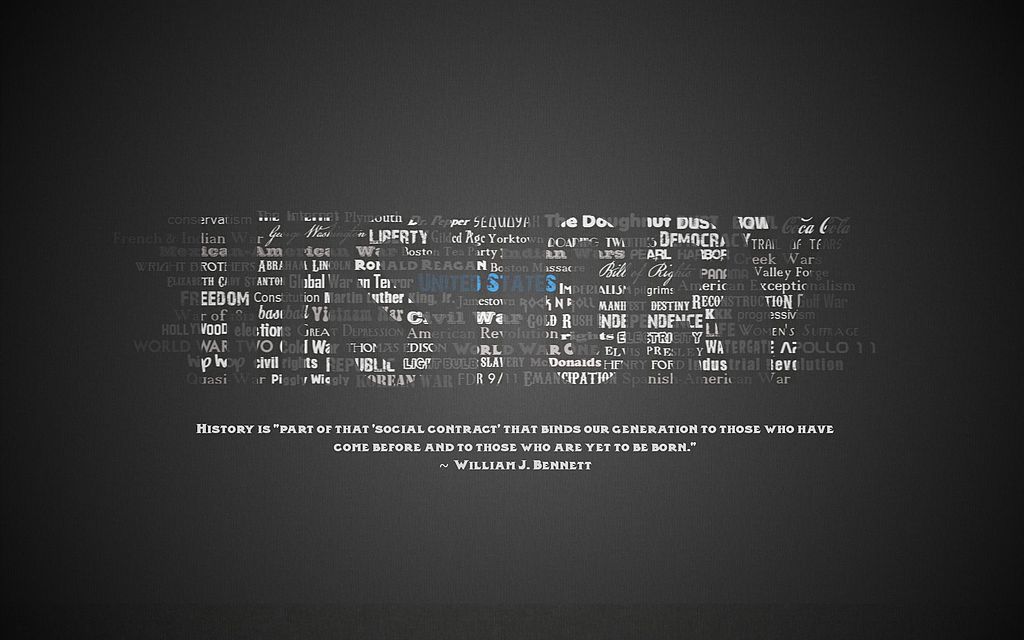
(Image: “History wallpaper/desktop image,” by Eric Turner, on Wikimedia Commons.)

Why something happened in history may seem evident, in the way that why a hurricane forms is evidently because an area of low pressure developed over warm ocean water; but the cause(s) we ascribe to human events may be too simplistic and may not tell the whole story. Why an historical event happened the way it did is more akin to figuring out why a particular hurricane hit a particular place on a particular date — or, to use a more erratic weather metaphor, to postulate why a tornado (perhaps spawned by a hurricane) destroyed one house and left the house next to it undamaged. It’s much more difficult to explain, and the reasons we come up with are usually not as precise as we would wish. And because such things are erratic, the reasons we put forth don’t lead us to being able to predict future “storms” with great precision.

Unlike hurricanes and tornados, of course, sometimes the people involved in historical events leave records — diaries, reports, memoirs; letters, articles, perhaps blog posts these days — which are subject to scrutiny and interpretation. But those records can be considered tainted by inaccurate observation or unclear memory, or even corrupted by agenda or ideology or passion. All of which combines to make historical analysis difficult, and history-based speculation sometimes unreliable.

Therefore, history is not on our side. It does not offer us a trustworthy guide to the future, and the marks it’s left on the present are often indelible and ugly.

But we don’t need history to be on our side. In fact, having now written all this, it seems silly to think it ever would be. To say that history could be on our side is like the terribly imprecise saying from a few decades ago, “Information wants to be free.” It’s nonsense. Information doesn’t want anything — it is noncorporeal, and has no needs or desires to satisfy. Some people want information to be free, but that’s another matter.

Likewise, some people want history to be on our (i.e., their) side, but that’s another matter.

History isn’t on anybody’s side, and the most we can hope for is that our historical record is as complete and accurate, as accessible and permanent, as possible. Because if we let aggravation lead to escalation and then to devastation, if we find ourselves in a broken society (hopefully not reduced as far as Ogg the caveman’s), it would be good to be able to relearn whatever lessons we can from history, in hopes of not repeating too many of the same mistakes.

But, what do you think?

Facebooktwitterpinterestlinkedinmailby feather

Unprepared for Regret, Part VIII: Independence is Overrated

Today we observe Independence Day — the day our Founders signed the Declaration they had voted approval of two days prior, claiming for themselves and for us “certain unalienable Rights, that among these are Life, Liberty and the pursuit of Happiness.”

This year, however, I think perhaps independence (and particularly personal independence) is overrated. Not unimportant, certainly, but not all-important. So I will observe the day — put out the flag, sing some patriotic songs, fire up the grill — but I doubt that I will celebrate it as eagerly, as deeply, as I once did.

(Before we go further, a reminder: This post is another in a series that has been a tribute to my late wife, Jill Rinehart, and a record of the grief I’ve struggled with since she died last October. The previous installment was on my birthday. All the entries so far are linked below.)

In the spirit of the day, here’s a picture of Jill and me on the 4th of July in 2017, touring the Chickamauga Battlefield after a pleasant visit (and lunch!) at my boss’s house:


(With Jill at the Chickamauga Battlefield, 4 July 2017.)

Can you guess why I might think independence is overrated?

Because, having lost my life partner with whom I had spent over 34 years of marriage, I haven’t found myĀ resultant “independence” to be all that enriching. As Scripture says,

And the Lord God said, “It is not good for the human to be alone. I shall make him a sustainer beside him.” (Genesis 2:18, translated by Robert Alter)

Better than independence, for me, was interdependence. Mutual support, mutual respect, individual freedom within the structure of our relationship. We were each independent to a certain degree: Jill had her teaching and her art and her plants, and I had my work and my writing and my music. But we also worked together as a team.Ā We planned, set goals, and accomplished things together. And I miss our togetherness, our partnership.

As a result, finding myself personally independent has been a struggle. I suppose in some respect it’s been frightening, but in a much deeper respect it’s just been lonely. I’ve said before that I don’tĀ always like who I am without her, because she made me a better person — or, if she didn’t exactly make me better, at least she inspired me to work to be better.

Speaking of being better: Before I close, will you permit me a brief digression in these politically tumultuous times? (If not, you can just skip the next paragraph.)

Our society is pretty fractured at the moment. I’m disappointed that we haven’t been able to develop and sustain the kind of friendly, supportive social interdependence that a strong political union should manifest. Some people seem to believe that’s become impossible. They may be right; but I hope for better. So with that in mind, let me say: Black lives do matter. If you are black, don’t ever let anyone tell you differently. But, more to the point of personal independence and interdependence: Your life matters. You, reading these words right now. Your life matters. Not because you may be black or white or some shade in between; not because you’re of the Zulu tribe or the Celtic tribe or the Navajo tribe; not because you are from the North or the South or the East or the West; but simply because you are unique in the world, a rarity in the boundless expanse of creation, made (so I believe) with the image of God stamped upon your soul. Your life matters — to me, at this moment. I wish that message would catch on, and that more people would feel comfortable sharing it.

In the end, I think it’s important to maintain a degree of independence, but more important to cultivate interdependence with those we love and trust. It may be hard if there is little (or no) love or trust, and maybe those three things — love and interdependence and trust — are related and build on one another. That’s probably a topic for another day.

For today, though, in keeping with the series theme, I regret any and every time that I have squandered love or trust — because they are difficult to regain.

And I wish you love and trust, and a high degree of interdependence that helps you be better than you might be otherwise. Because, I say again, your life matters.

___

Previously in the series:
Unprepared for Regret
Unprepared for Regret, Part II: Valentine’s Day
Unprepared for Regret, Part III: Jill’s Last Day
Unprepared for Regret, Part IV: The Day Jill Died
Unprepared for Regret, Part V: Six Months Gone
Unprepared for Regret, Part VI: Our Anniversary
Unprepared for Regret, Part VII: Hollow Birthday to Me

Facebooktwitterpinterestlinkedinmailby feather

The Respect Question

A few weeks ago I asked my newsletter subscribers* to chime in on this question: “What is respect, to you?”

I asked the question because the topic of respect had been much on my mind based on some newsworthy events. In particular, I wanted to find out if very many people would agree with me that our society seems to be lacking in respect these days.

I was pleased to receive some very thoughtful responses. I don’t know if “pleased” is the right way to describe my feeling about the fact that nearly everyone who responded agreed that respect is in short supply in our current society.

Several friends (everyone who gets my newsletter is a friend, in my book) presented ideas for why respect has fallen out of fashion. We discussed it back and forth (I always try to reply when subscribers take the time to write back), and in general we thought the observed level of disrespect generally didn’t have to do with people being less respectable than they used to be. That is, everyone is still worthy of being respected. Instead, we discussed whether it might be a combination of two things: parents not teaching their children how to display respect, and adults in general not modeling respectful behavior for young people. Since respect seems to be something we learn (like manners, which themselves are indicators of respect), that led to the question of whether respect is something we need to practice lest we forget about it or start to ignore it.

One friend made an excellent distinction between “simple” respect and what he called “high” respect — the difference between the most basic respect we pay to someone as a fellow human being (or even that we pay to the uniform they wear or the office they hold), and the higher respect that they earn by … well, by acting respectable. I contend that we do people a terrible disservice if their failure to earn (or keep) our high respect leads us to deny them even simple respect. Furthermore, I think it’s possible to withhold a measure of respect without blatantly disrespecting someone — though it may be difficult, and uncomfortable.

Unfortunately, as another friend pointed out, some people have used respect as a shield — or perhaps a bludgeon — by demanding or expecting it rather than actually working to be respectable. She suggested that “the whole concept has been cheapened” as a result. I find that idea just as sad as the generally high level of disrespect I see every day.

I was interested in one friend’s equating respect with trust, and he’s right: it is very difficult to respect someone if we don’t trust them. That’s quite a contrast with respect as the foundation of manners, which can be thought of as the way we ensure that people are comfortable being around us: as one friend wrote, displaying good manners demonstrates that you respect someone. (One of the things I learned long ago about manners — in a talk given by Tony Campolo at a National Youthworkers Convention — is that they may be most needed when we least want to use them.Ā When thought of that way, showing manners to people we may not respect very much demonstrates the difference between simple respect and high respect.)

As another friend wrote, “You don’t treat someone else with respect so that they treat you with respect, or even because you think they are ‘worthy’ of respectĀ — you do it because YOU are worthy of respect, worthy of self-respect, able to meet your own eyes in the mirror.”

respect
(Image: “Respect,” by Martin Abegglen, on Flickr under Creative Commons.)

I deeply appreciate everyone who offered their opinions and ideas. The more I think about it, the more I’m not sure we can overstate the hazard to society from being unwilling to treat people with simple, basic respect regardless of whether they have earned or squandered any deeper respect. That’s how debates boil over into arguments, arguments boil over into disputes, and disputes boil over into violence. The issue reminds me of an old Robert A. Heinlein quote about the loss of politeness (again, coming back to the question of manners, which themselves demonstrate respect), and how it’s “more significant than a riot” in identifying a dying culture.

I wish I knew how to fix it. I hope it can be fixed.

Do you have any insights? I’d love to hear them.

Thanks, as always, for your time!

___
*If you’re not on the list already, you can subscribe to my newsletter at this link.

Facebooktwitterpinterestlinkedinmailby feather

What If No One Wanted to Be a Doctor?

A thought experiment: What if literally no one — not you, not anyone — had any desire whatsoever to be a doctor, nurse, emergency medical technician, or any other healthcare worker?

Imagine, for the purpose of this thought experiment, that no one had any interest in anatomy, physiology, or the like; and no one studied fields like radiology, oncology, pharmacology, or whatnot; such that the entire medical profession was unknown and therefore unavailable.

Then, under those conditions, you get sick or injured.

How would you obtain care? Upon whom would you rely?

If you were alone, you would have to treat yourself as best you could; or, even if you weren’t alone you could make the attempt if your symptoms or wounds were slight. Maybe you remember some First Aid from the Boy Scout Handbook, or some folk remedies from one of the Foxfire books, or maybe your parents “doctored” you when you were young and you recall what they did. (In this modern era, you might even try to pull up a YouTube video in hopes that someone had documented their own ordeal.)

If that failed, or your case was beyond your (or the Net’s) abilities, you wouldĀ likely try to find someone else to help you. You might first ask someone you know, who you know cares about you, to treat you as best they can. If they couldn’t help, you would have to venture further afield and ask someone outside your immediate circle if they might deign to treat you.

Does that sound about right?

How would you ask them? What would you offer in exchange for their trying to help you? Would you promise? Would you plead? Would you threaten?

Doctor
(Image: “Doctor,” by Matt Madd, on Flickr under Creative Commons.)

If asking didn’t get you the help you sought, would you demand it? Would you — could you — force someone to help you? Would you recruit others to do so? How far would you go, if you had the power?

Thankfully, we don’t live in the world of this thought experiment. We can be grateful that so many people choose the caring professions and study the medical sciences, so that we don’t have to treat ourselves when we’re in distress.

Their numbers, alas, are relatively small; and whenever limited supply meets significant demand, economics can deal heavy blows with its invisible hand. But even though their numbers are small, their impacts are tremendous. How we show our gratitude for their knowledge, skill, and dedication, of course, is up to us.

___

Apropos of nothing, other than the fact that this is my blog: If you missed the announcement, I’m running a series of giveaways for Audible downloads of the Walking on the Sea of Clouds audiobook, which includes what I’ve been told are rather realistic emergency response and medical scenes.Ā Sign up at this link!

Facebooktwitterpinterestlinkedinmailby feather

Whatever Happened to ‘Women and Children First’?

I understand that, in the interest of enforced equality, a judge with an unfortunate first name has ruled that selective service registration is unconstitutional if it applies only to men. The reasoning is that since weĀ now allow women to operate in combat roles, we should require women to register for the draft, and if we don’t register women then we should not be able to register men for the draft.

This has been billed as an “equality” thing, but that’s garbage. Equality of opportunity is not the same as equality of responsibility or requirement. It’s one thing to have opened up combat roles to women who have the ability to fill them (both the physical attributes and the requisite viciousness), but it’s another thing entirely to require women who would never willingly choose such roles to have to sign up for them.

Imagine the difficulty of training drafted women — conscripted, non-volunteer women — for combat roles. But that in and of itself is not my primary concern. Nor is my concern that the proportion of women who can effectively fill combat roles — by dint of either physicality or temperament — is likely a good deal lower than the proportion of men who can do so.

My concern is what forcing women into combat, into life-threatening danger, when there are capable men who could serve in that capacity, may mean for our society.

Used to be, if a ship was sinking and the passengers were directed to lifeboats, women and children would be given the first spots. Any man who took a seat when there were still women and children waiting to board would open himself to general condemnation and charges of cowardice. Given the state of our society these days, I’m not sure that holds true anymore —Ā especially since the court case that resulted in the ruling mentioned above “was brought by the National Coalition for Men, a men’s rights group, and two men who argued an all-male draft was unfair.”

Boo-freaking-hoo. Life’s unfair, cupcakes. If this is representative of their approach to life, that group may as well be named the national coalition for poltroons.

Thank God I still know people other than myself who believe, like Robert A. Heinlein, that

All societies are based on rules to protect pregnant women and young children. All else is surplusage, excrescence, adornment, luxury, or folly which can — and must — be dumped in emergency to preserve this prime function. As racial survival is the only universal morality, no other basic is possible. Attempts to formulate a “perfect society” on any foundation other than “Women and children first!” is not only witless, it is automatically genocidal.

Unfortunately, some people these days seem as if they would welcome genocide.Ā A philosophy professor from my own alma mater not long ago published an op-ed in which he pondered the question of human extinction — and whether it would be all that bad for our race to go extinct since we’ve been so bad for the planet. I confess that I’m selfish enough to say that genocide and human extinction would be bad for me and the people I care about, so I’m not in favor.

RNLI statue
The sculpture, “When I Grow Up” by Darren Jackson, depicts a boy who wants to save lives — a noble calling, and one in which “women and children first” remains an important consideration. (Image: “RNLI Statue,” by Phil Parker, on Flickr under Creative Commons.)

Along less drastic lines, I’ve heard plenty of people declare in triumphant tones that “chivalry is dead,” because after all wasn’t it just a tool of the nebulous but hated patriarchy, meant to keep women in their place? Notwithstanding that any good thing can be misused, modern chivalry couldn’t possibly be an indicator of how highly men value women, and the lengths to which men would go to protect women and ensure their safety, security, and comfort — could it? It certainly couldn’t be an unconscious (but in the end perhaps effective) instinct to preserve the race, could it?

Some people have gone so far as to point out that modern chivalry bears little resemblance to the medieval codes governing knightly combat, and so, even if it’s not exactly dead, it should be. How utterly barbarous. Remove that muzzle very carefully, zookeeper: the bear has teeth, even if you’ve filed down his claws.

Perhaps this historic period of peace and plenty has something to do with these new societal mores. We are not in extremis, so as a culture maybe we have the luxury of devaluing those people among us who are most precious. The emergency will come, however — emergencies always do, and most of us are caught unawares — and holding to these modern sensibilities in the confusion and chaos may spell our societal doom. Not only witless, as Heinlein said, but genocidal. Or, to coin a phrase, genosuicidal.

I hope I’m right that most people, deep down, are fully in favor of “women and children first” — even if they won’t admit it. I certainly am. And I think (and hope) most people would still look askance at any man who intentionally saved his own life knowing that in doing so he was placing his wife or child, or any woman or child, in jeopardy.

But, “call me a relic,” as Bob Seger sang. Please, observe my actions and accuse me of being chivalrous. I will take it as a compliment.

Facebooktwitterpinterestlinkedinmailby feather

Immigrants Are Like Salt

(Third in a series.)

With the ongoing governmental brouhaha over whether a fence or a wall is better for securing a border, it occurred to me that immigrants are like salt.

For context, in the initial post of this series I wrote,

A little bit of salt enhances a dish. Too much salt ruins a dish: It no longer tastes like the dish it was meant to be; it only tastes like salt. When it comes to salt, moderation makes it more effective and saturation makes it unpalatable.

Metaphorically, the dish is culture. The dish is social solidarity. The dish is commonality in terms of language, values, beliefs. Immigrants, like salt, improve the dish by enhancing its starting flavor — whether it’s a local delicacy, a regional specialty, or a national favorite — when applied in moderate amounts.

salt
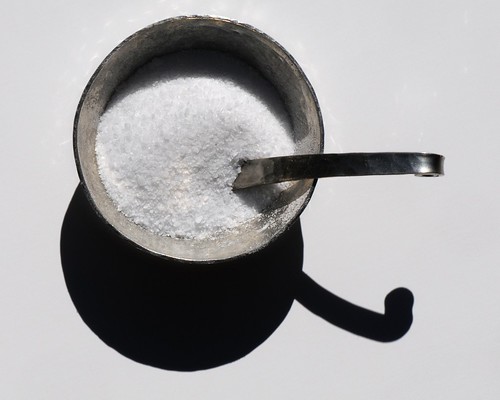
Sprinkle the salt with the spoon, or even with your fingers; don’t pour out the whole bowl into the dish you’re about to eat. (Image: “salt,” by theilr, on Flickr under Creative Commons.)

Extending the metaphor: In the same way that salt is not automatically bad, unless you’ve got a condition which salt may exacerbate, immigrants are not automatically bad. Limiting salt does not mean never using it,Ā it means using it sparingly, in the right amount to make the best dish. So, too, with immigration.

Limiting immigration is meant to keep from ruining the societal dish. Or, to borrow a phrase, to keep from turning the “melting pot” into an unappetizing mess.

If only the chefs in the governmental kitchen had discerning palates, and could agree on the menu.

___
Previous Entries in the Series:
A Little Less Salt, Please
Then There’s ‘Salty’ Language

Facebooktwitterpinterestlinkedinmailby feather

Our Permanent, Intangible Enemies

It seems pretty evident to me that sometimes you choose your enemy, but sometimes the enemy chooses you. And sometimes things act as enemies that we may not usually think of in those terms. Those enemies are nebulous, incorporeal. Not nations, nor people, but ideas, concepts, for which the terminology of battle may be ill-suited.

When it comes to things like that, I think of permanent as opposed to temporary enemies. Permanent or abiding enemies may not hold our attention as much as temporary foes that spring up and must be dealt with ad-hoc. A short-term enemy attacks; a long-term enemy infiltrates. Perennial enemies operate at lower levels and over longer timelines, it seems, than do enemies that charge us with sudden ferocity.

Charles Dickens identified two such eternal enemies in A Christmas Carol. In one memorable scene Scrooge is surprised to learn that the Ghost of Christmas Present stands upon two dirty, emaciated children he names as Ignorance and Want. The human race may face other timeless and shadowy enemies, but these two must be included on the list.

Are they brother and sister, as intimated by Dickens, or are they partners of some sort? Do they feed one another, help one another, keep one another alive? Is one dominant? Is one the forcing function of the other?

Are they related to what may be considered another perennial and sinister enemy of mankind: injustice? Is our political or ideological outlook based (at least in part) on which of these, Ignorance or Want, we consider cause and which effect? This may be something of a chicken-and-egg argument, but we often differ over which problem is worse and deserves the most (and the most immediate) attention.

We have met the enemy...
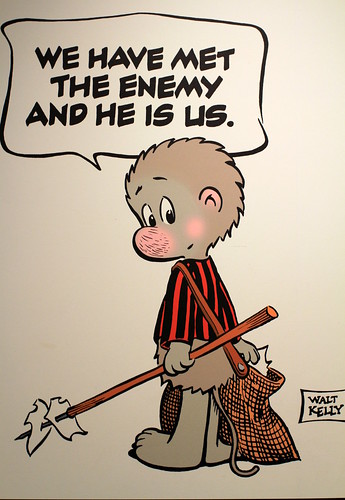
(Image: “We have met the enemy…,” by Thad Zajdowicz, on Flickr under Creative Commons.)

Unfortunately, these permanent, intangible enemies do not arouse as high a degree of fervorĀ as more acute and palpable enemies. Even if they did, in the long run we have to include Ignorance in the same category as Want in terms of Christ’s observation, to wit: that just as we will always have some poor with us, so too we will always have some dimwitted. We cannot eliminate either, but we would do well as a society if we could minimize both.

Facebooktwitterpinterestlinkedinmailby feather

Then There’s ‘Salty’ Language

Yesterday I wrote a post about salt, and today I’m making it a series. The main point of yesterday’s post is that

A little bit of salt enhances a dish. Too much salt ruins a dish: It no longer tastes like the dish it was meant to be; it only tastes like salt. When it comes to salt, moderation makes it more effective and saturation makes it unpalatable.

So let’s talk about salty language.

On the one hand, we may mean the kind of gracious speech that Saint Paul directed the Christians at Colossi to use: “seasoned with salt,” rather than overloaded with it, when giving an answer to anyone who might inquire about Christ and why they followed Him. We who follow Christ today would do well to bear that in mind as we do our best to speak the truth in love, not in anger or bitterness.

On the other hand, and in my experience more frequently, salty language means something quite different. Foul language. Crude language, whether profane or vulgar. Here, too, the point remains the same: A little goes a very long way.

"Salt?"
(Image: “Salt?,” by Stefan Powell, on Flickr under Creative Commons.)

I know quite a few people who make such a habit of vulgarity or profanity that I cringe whenever I sense they’re getting ready to speak. I confess that in the service I developed some bad habits along those lines myself, that I have not overcome: Very frequently, my first inward expression of frustration or anger is an obscenity, even if I successfully chisel off the hard edges of my language most of the time when other people are around.

As our culture has coarsened, though, I’ve observed more and more people who interpret “freedom of speech” to mean “freedom to express anything in any way,” and they frequently employ vulgar or profane language on social media posts or in other ways: on bumper stickers or T-shirts or even tattooed into their flesh. Maybe they’re right to do so, and would be justified in scoffing at me for even suggesting that they could exercise a bit more self-control. Maybe they’re expressing the kind of deep rage and dissatisfaction that can only be captured by obscenities, rather than just being lazy or trying to be edgy. But as with salt itself, so with salty language: moderation makes it more effective — its relative rarity calls attention to it and it bears more emotional weight — while saturation just makes it unpalatable.

___
Previous Entry: A Little Less Salt, Please

Facebooktwitterpinterestlinkedinmailby feather