Societies and Sports — Soccer, Football, & More

It’s World Cup season again, which brings to mind some thoughts I thought many years ago about the differences between soccer and other sports in relation to the societies that revere them. That train of thought first left the station twenty-some years ago when I was traveling on temporary duty in Europe (either France or Russia, I don’t recall) and was exposed to nearly constant “futbol” coverage. Years later (and still five years ago) the thoughts resurfaced when I was watching my Clemson Tigers men’s soccer team play win the national championship.

Basically: The differences between soccer and football — or between “metric football” (as former WSJ columnist James Taranto referred to it) and American football — and even between soccer and other beloved U.S. sports like baseball and basketball — can give us some insight into the differences between other world societies and the United States of America. More precisely, our “USonian” culture (yes, I cribbed the name from Frank Lloyd Wright’s architectural philosophy) seems better fit to our brand of football than the international brand. By extension, it seems our love of (or, in some cases, obsession with) football and baseball and basketball gives us different outlooks, different approaches to life, from the rest of the world that emphasizes soccer.

What differences, in particular?


(Image from the Rocky Top Sports World blog.)

One of the first that came to mind is the fact that soccer is a free-flowing game — more akin to basketball (and hockey, field hockey, lacrosse, etc.) in this respect than to football and baseball and softball, which are more set pieces and move along in increments. Soccer and basketball players move nearly constantly, looking for openings and opportunities; in contrast, football and baseball players come to stops in play, and set up offenses and defenses in anticipation both of what they think they can accomplish and what they anticipate the other team doing. That said, soccer and basketball players do stop from time to time as they feint, maneuver, and react to changes in possession, and they must change directions and tempo throughout their time on the pitch or the court, but their set plays and executions come primarily in relation to game events (corner kicks, free and penalty kicks, inbounds, free throws) as opposed to being built in to the structure of the sport.

I may be making more of this than warranted, but hear me out: Perhaps the free flow of soccer and basketball might fit our lives as individuals — certainly in life the clock keeps running, as in soccer, as much as we might appreciate a timeout — but often group interactions require a bit more structure and even precision. This may particularly be true if we work with others in a company and depend on the company’s success for our livelihood. I recall quality improvement sage Dr. W. Edwards Deming talking about the different levels of interaction between the members of a bowling team and the members of an orchestra, and how the interactions of an effective production unit must work more like an orchestra: not just playing their parts correctly, but ensuring that all the parts work together at once in pursuit of the common aim. With that in mind, it seems the set piece approach of football and baseball may fit more of our lives than does the free flow of the other sports.

If that’s true, it may seem a little odd, even counterintuitive, that the society that enshrines individual rights might prefer structured sports while societies which seems less concerned with individual rights prefer a free-flowing — dare we say laissez-faire? — sport. But one thing we as Americans seem to appreciate is that we can join together in cooperative ventures without abrogating our individual rights, and even temporarily set aside part of our individuality when we find a cause, or a team, worth supporting.

Speaking of cooperative ventures, one thing that holds true for all team sports — soccer, football, basketball, and so forth — is simply that each player must do their part in light of the team’s aim to score points. We may have the opportunity to score ourselves, or to assist others, but we all share the aim even if we play different roles in achieving it. And one obvious difference between soccer and football — and indeed between soccer (and also hockey, lacrosse, etc.) and other sports — is the vast difference in scoring potential.

In soccer, only single points are scored at a time; no matter who does what in soccer the score will only increment by one point. Players have no opportunities for multiple goals at any one time, which is vastly different from other sports popular in the U.S.A. In baseball and softball, we can score up to four runs at a time with a grand slam. In basketball, the standard scoring was always two points until the three-point rule was adopted, so now scoring can increment much faster than it used to. Football, of course, grew from rugby to the point that a touchdown is now worth six points. Even cricket allows for multiple runs at a time.

I recall watching a soccer match in which one team went down two to nothing. They continued to take shot after shot, but it was always evident that the only way to win would be to crawl back through the tie-game situation, to first play to tie and then to win. At the risk of speaking for my fellow Americans, this does not sit well fundamentally with those of us born and raised in the U.S.A. In our favorite games, football, baseball, and basketball, teams have a greater chance to rally than would any team in soccer, such that close games are much more precarious — and often more exciting.

We seem to believe, more than soccer-loving societies and cultures, that we can get ahead in giant leaps. We are brought up believing that it is possible to dare and to do great things, that we do not have to score in small increments but have it within ourselves to achieve more in one shot than other people might. We believe in breakthroughs, in extraordinary performances that produce significant differences in the real world and in the games we play. Perhaps fans of cricket can say the same.

From my perspective, the possibility of scoring a touchdown when down by a field goal, or scoring big in an inning, may be likened to our quest for innovation and our penchant for inventiveness. The possibility that the other team may make a comeback can lead us to run up the score to prevent it, because something in our American psyche prefers that we not only win but win decisively — which may be reflected even in what military historian Russell Weigley called “the American way of war,” which has historically been to win by annihilation.

What was it Conan, as portrayed by Arnold Schwarzenegger, said was among the best things in life? “To crush your enemies.” Yes; yes, indeed. And what better way, in sports, than by scoring a lot of points at once?

Penalties and timekeeping are also quite different among the various sports, and may perforce speak to other differences between cultures. I have not played soccer in a long time, and therefore am a little fuzzy on what warrants an indirect kick versus a direct kick, or a yellow card versus a red card, but one thing I do remember is that the clock keeps running in soccer while a penalty is assessed. In contrast, the clock stops in a football or basketball game while the penalty is enforced.

Another interesting difference is that in football the coach of the aggrieved team often has the option of declining the penalty if the result of the play would be more advantageous. That speaks to the situational aspect of the sport, but so does the fact that many penalties affect the distance to be covered but not the number of attempts: A first-and-ten can turn into a first-and-five or a first-and-fifteen if minor penalties are assessed against either the defense or the offense, respectively, but it is still first down. That makes me wonder if one of the things we in the U.S.A. appreciate culturally, that perhaps others appreciate less, is the do-over. The second chance.

Sticking to the subject of penalties, I wonder about the significance of the fact that, in soccer, one of the most dependable ways to score is the penalty kick. As with the pitcher in baseball, the advantage lies mostly with the kicker: Delivering the kick, like delivering a pitch to a batter, places a huge strain on the goalie. Anticipation, vision, perception, reaction — the margin for error is tiny, and it seems success for the goalie is a fine line between doing all the right things and simply not doing something wrong: the avoidance of error, as opposed to the achievement of success.

But, again, I may be reading more into this than I should. It’s all fun and games, right? Many say we take our sports too seriously, especially if we are spectating rather than participating. (And writing this many words on the subject must fall into the “taking it too seriously” category.)

This breakdown, of course, says nothing about individual contests. All sports require discipline and effort and so have value for life lessons as well as for health and fitness. It may be that some are more games (even athletic games) than sports, but that’s a distinction we need not belabor. Suffice it to say that, as with the example of the bowling team and the orchestra above, individual sports such as tennis, golf, swimming, martial arts, etc., teach excellent lessons about concentration, preparation, determination, and endurance, but less perhaps about leadership and cooperation than team sports. And different team sports such as soccer, football, baseball, and basketball emphasize different cooperative skills. Not necessarily better or worse skills, but different, so the more we can obtain at least a passing familiarity with these endeavors — from the pitch to the field to the diamond to the court, and even to the orchestra pit — the better we can understand and relate to the concepts needed for effective cooperation.

In conclusion, and by way of full disclosure: I’ve played most of these sports, and often enjoyed them though I may not have been very good at them. This includes soccer, so please do not conclude that I dislike the sport at all. Soccer spectators blowing vuvuzelas are another matter; those horns are damn annoying, but soccer itself is fine for what it is. But as a red-blooded USonian American, I relate more to sports where sudden breakthroughs and dramatic lead changes make the outcomes far from certain, and where the action is strategically guided, tactically coordinated — and potentially devastating.


Facebooktwitterpinterestlinkedinmailby feather

Limited-Edition Charity Album Available for Preorder!

Here’s the BLUF (bottom line, up front): 100% of the purchase price of my charity filk album, LibertyCon’s Alright for Fandom, goes to this year’s LibertyCon charity, and you can get the CD and support the cause even if you’re not going to the convention itself.

To repeat: 100% of the purchase price goes to the charity. I don’t get a cent of the proceeds, because I’m paying all the expenses related to the project. I’ve paid for the studio time, I’m paying for graphics (thankfully Melissa Gay donated the use of her artwork!) and advertising, and I’ll pay for the CDs to be manufactured. That way, when you buy the CD, you know that the whole $20 price goes to the charity.


(Cover art by Melissa Gay. Cover design by Christopher Rinehart.)

Bear in mind, please:

  • Shipping and handling will be a separate charge (sorry)
  • “Limited Edition” means just what it says: Once all the CDs are gone, they’re gone! The only way to ensure you get one is to order it here
  • If you want to help me defray my expenses, that would be great: check the postscript below for links you can use
  • This project will only succeed if a lot of people know about it, so please share this post and/or the order form link

Now, one last time, click here if you want to order your own copy of the charity album!

___

P.S. If you want to help me with the project expenses (for which I’d be most grateful), consider buying
– Any (or all?) of my music on my Bandcamp Page
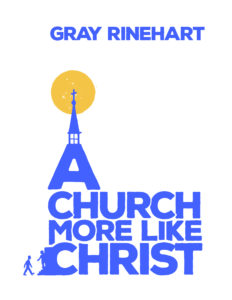
– My critique of modern Christian churches: A Church More Like Christ, awarded a Silver medal by the Military Writers Society of America
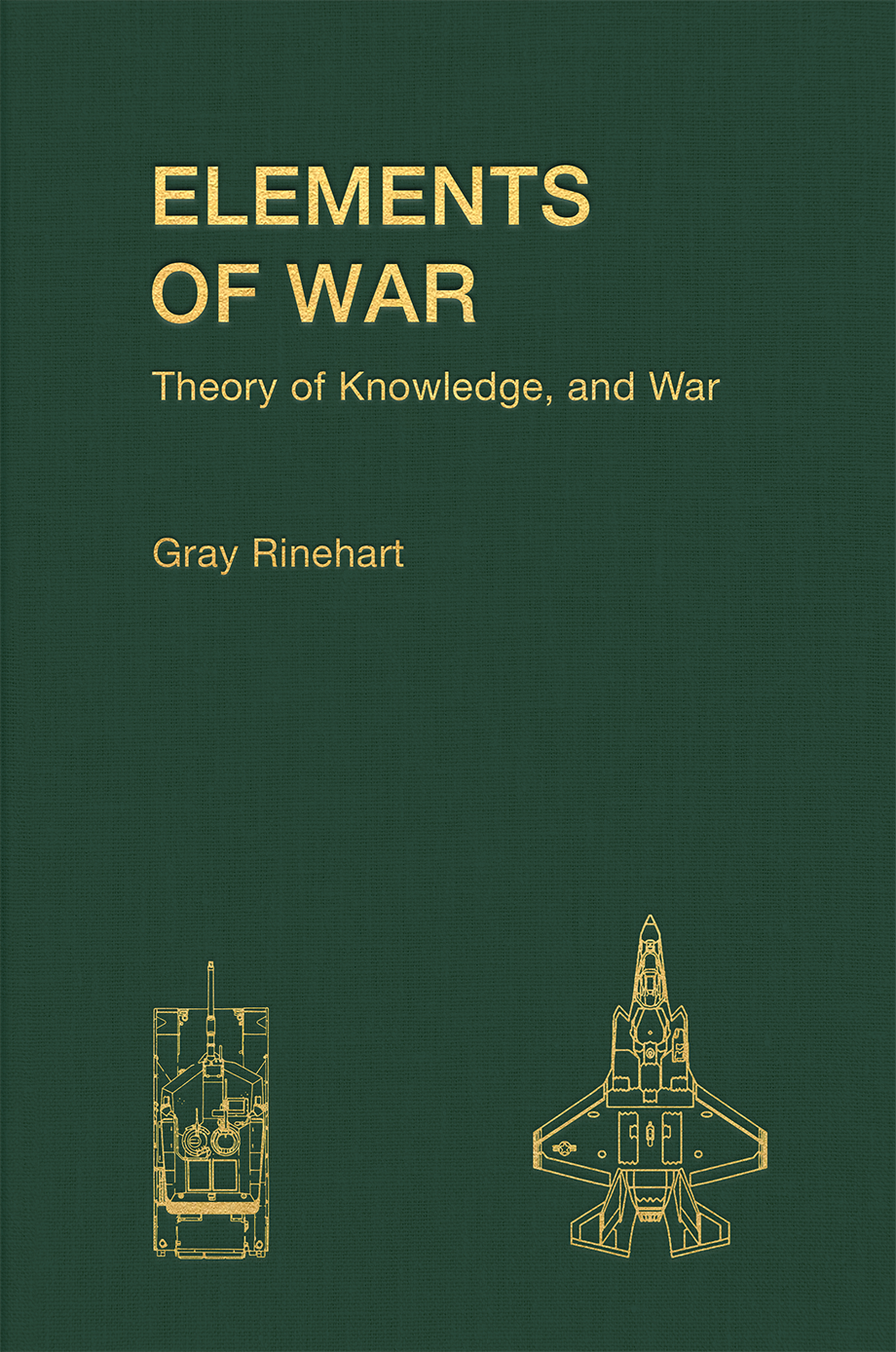
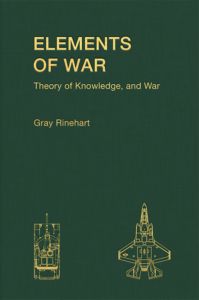
– My other MWSA Silver medalist, a nontraditional look at theories of war: Elements of War
– My science fiction novel, Walking on the Sea of Clouds

P.P.S. I’d be much obliged if you’d also subscribe to my newsletter (for which you get some free gifts!).

Facebooktwitterpinterestlinkedinmailby feather

Merry Christmas! Here’s a (FREE) Song

Merry Christmas to you and yours, and I hope your day is merry and bright! 🎄

My gift to the world is a new Christmas song, “Born to Make a Difference,” which I finally got into shape after several years of trial and editing. Here’s how it starts:

How many children were born that very night
And drew their first dramatic breaths under flickering lamplight
And wailed and were swaddled as the next day dawned
And rocked and nursed and comforted in their young mothers' arms?

(Chorus)
He was born to make a difference
He was born for mercy and for love
He was born to give the world a better way to live
He was born to show the truth of God with us

It's free for everybody, at either Bandcamp or on YouTube. If you like it, I hope you’ll share it with someone else who would!

I hope your holidays — whatever you celebrate, wherever you are — bring you joy and fulfillment, and that this year ends on a high note for you! I wish for you only good things, now and always.

___

P.S. For more detailed thoughts about the Christ we celebrate, take a look at my award-winning little book, A Church More Like Christ

Facebooktwitterpinterestlinkedinmailby feather

Knocking at Your Church Door

In a famous passage that most Christians will recognize — Revelation 3:20 — John the Revelator quotes the glorified Jesus as saying,

Behold, I stand at the door and knock; if anyone hears my voice and opens the door, I will come in and dine with him….

For most of my life, that verse was taught to me on a personal level: that Jesus stood at the door of my heart and knocked. From that perspective, it was my choice to respond, to “let Jesus into my heart” as the expression goes. It was a call to conversion, to salvation.

Of late, however, I’ve thought more of Scripture as being aimed at communities rather than individuals — that was one of the central ideas of A Church More Like Christ, after all — and in fact that section of Revelation was addressed to “the angel of the church in Laodicea.”

So, do you think your church — either the leaders or members — has ever read that passage as

Behold, I stand at the door of your church and knock….

?

And if they were to read it that way, how quick would they be to open the door?

I believe that a church that opens its door to the Lord, that lets him inside in a real and authentic way, has the potential (to paraphrase the back cover copy of my book) to be a force for good, a light in the darkness, and an outpost of God’s kingdom in this world. It has the potential to be a place where the wounded find comfort and healing, the broken find repair and restoration, and the vulnerable find help and hope.

I could be wrong, but that, I think, is what every Christian church should be.

___

For other musings and oddball ideas,
– Take a look at A Church More Like Christ, awarded a Silver medal by the Military Writers Society of America
– Or my other MWSA Silver medalist, Elements of War
– Or my Amazon Page, my Bandcamp Page, or just my website

Facebooktwitterpinterestlinkedinmailby feather

Human Rights Are Individual Rights

Sometimes it’s necessary to state the obvious, so here goes: People will not read this post, though a person might.

You can probably already see where I’m going with this. So let’s go there.

People — collectively — will not read this. Individual persons — singular people — might. (One possible exception is if a person were to read the post aloud to someone else, or even to an assembled group of people, but how often does that happen in the modern world?)

This idea of singularity rather than plurality applies regardless of demographic. Black people will not read this post, though a black person might. Ditto for white people, or any other racial label you might apply. Rich people will not read this post, though a rich person might. Et cetera.

My point here is that we make a mistake when we talk about “people” collectively, as if they are cells operating together in a huge body instead of entities operating individually as persons. It’s a failure of language, and maybe a failure of perspective.

We make the mistake whenever we lump people together into groups, especially groups we want to criticize or lionize: Democrats and Republicans; Christians and atheists; Carolina fans and Clemson fans (!). It is easier to treat them as groups we can point at as if “they” were amoebic, single-minded masses instead of individuals with their own attitudes, abilities, and dreams. (“They” collectively — and “we” collectively — make it hard when some individuals come together to make trouble, whether as not-so-peaceful protesters or sports hooligans, but even then some individuals stand apart and aloof, separate from the mob, and deserve not to be lumped in with the troublemakers.)


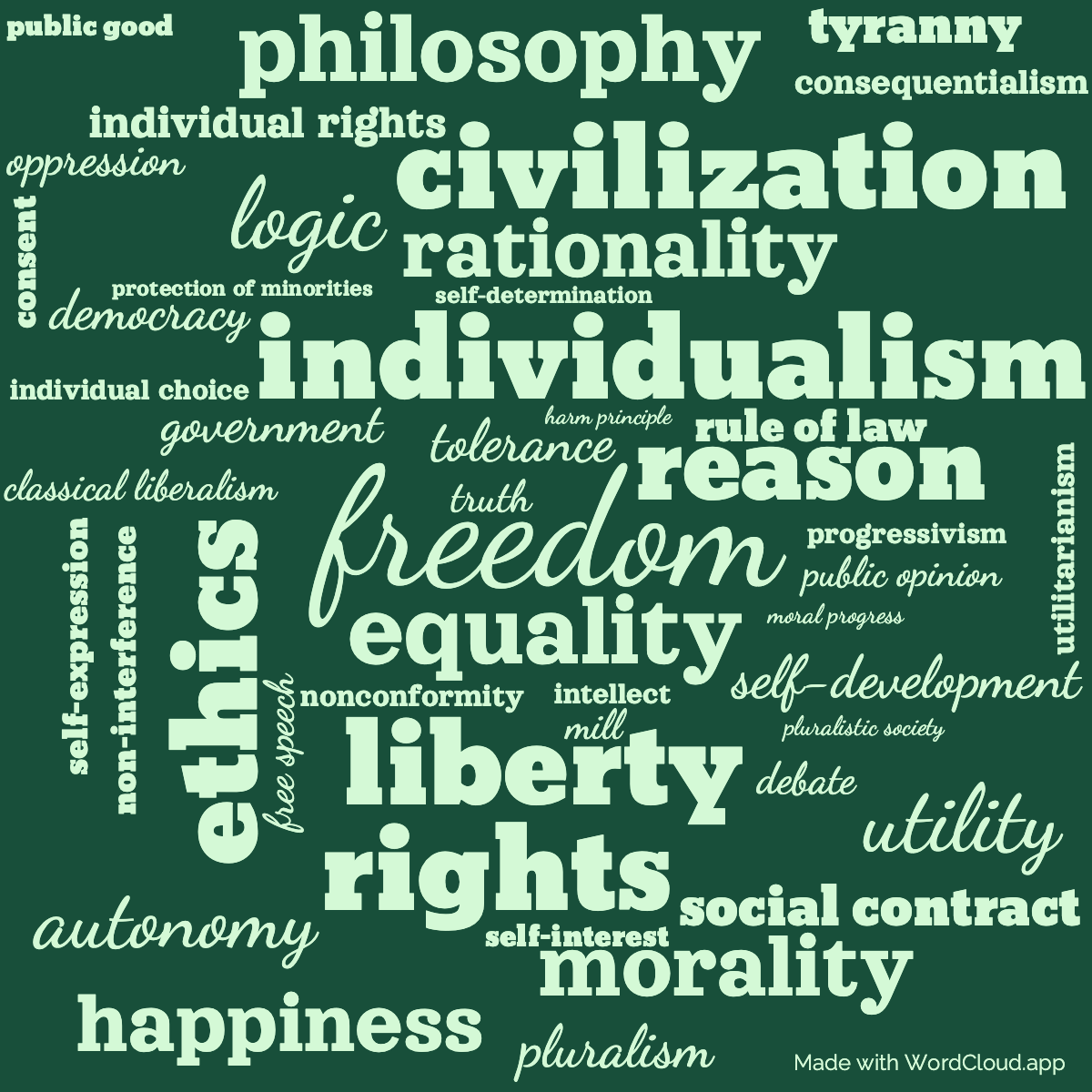
(Image: Word Cloud, “On Liberty by John Stuart Mill: An Important Book for Intellectual Thinkers,” by _, on WordCloud.app.)

Finally, now to the point of this post: Yes, we make a similar mistake with respect to rights. People do not have rights, though persons might. Groups do not have rights, only the individuals within those groups.

Why? Because rights are exercised individually, they belong to individuals. We err when we overemphasize rights with respect to groups and neglect the individuals who make up those groups. We can end up diluting those rights, acting as if they are only spread across large populations rather than held by singular people, and that is a dangerous step toward overlooking and even removing those rights.

Let’s not go down that road.

___

Maybe none of this needed to be said, but it’s done now. For other musings and oddball ideas,
– Take a look at A Church More Like Christ, awarded a Silver medal by the Military Writers Society of America
– Or explore my other MWSA Silver medalist, Elements of War
– Or even subscribe to my newsletter (and get some free gifts)

Facebooktwitterpinterestlinkedinmailby feather

Yearning to Breathe Free?

Most everyone in the United States and very many people in the world are familiar with the inspiring lines inscribed on a plaque in the pedestal of the Statue of Liberty:

Give me your tired, your poor,
Your huddled masses

The phrase comes from Emma Lazarus’s poem, “The New Colossus.” I’ve noticed that a few people seem to treat the poem as if it expresses some official policy of the USA, but it does not; it was written as part of a public effort to raise money to build the statue’s pedestal. And from some of the recent rhetoric about immigration, it seems that a few people leave out an important clause, treating the lines as if the statue is said to be welcoming any and all tired, poor, huddled masses as opposed to those “yearning to breathe free.”

It seems, then, that we need to re-emphasize that part.

First, what does it mean to yearn? Most of us know this in our bones, because we do so even if we may not use the word. We all have (or have had) things we yearn for, important things we earnestly desire with a depth so profound that to fail to achieve them would be a fate nearly as dire as death. Perhaps we yearn for love, or success, or a peaceful existence, but whatever it is, we wish for it with all our heart even if it may be beyond our reach.

Then what does it mean, really mean, to breathe free? Is it simply to be liberated from whatever persecutions or hardships we face, to be even momentarily out from under the boot of oppression or poverty or disease? Not quite. Temporary release would be a reprieve rather than a life. Breathing free may at first come by escaping from a previous situation, but continuing to breathe free comes at the price of the effort to maintain that freedom.

Yearning to breathe free, then–and particularly yearning to keep breathing free as time goes on–means not only the earnest desire to achieve freedom but also the deep commitment to hold on to and support that freedom by will and effort. I don’t pretend to know the situations of everyone, but that commitment seems to be lacking in some of the tired and poor who behave as if coming here is supposed to automatically and immediately confer rest and riches, as if the Declaration of Independence said happiness is to be granted rather than pursued. Admittedly, that same commitment seems to be lacking in some of those born here, who behave likewise as if they expect and are entitled to a lifetime of breathing free. Yearning to breathe free is not a wish to be released from toil, but a wish to enjoy the benefits of one’s toil; not a wish to be subjugated to a life of dependence on others, but a wish for a life of opportunity to survive … and maybe even to prosper.

How about you? Do you yearn to breathe free? If so, I bet you know that it entails more than just wishing for liberty: it requires working for it.


(Image: The Statue of Liberty, by AskALotl, on Wikimedia Commons.)

___

I would be remiss if I did not present the full poem, which contrasts the then-to-be-erected Statue of Liberty with the classical Colossus of Rhodes. It is in the public domain, and is deserving of close study:

Not like the brazen giant of Greek fame,
With conquering limbs astride from land to land;
Here at our sea-washed, sunset gates shall stand
A mighty woman with a torch, whose flame
Is the imprisoned lightning, and her name
Mother of Exiles. From her beacon-hand
Glows world-wide welcome; her mild eyes command
The air-bridged harbor that twin cities frame.

“Keep, ancient lands, your storied pomp!” cries she
With silent lips. “Give me your tired, your poor,
Your huddled masses yearning to breathe free,
The wretched refuse of your teeming shore.
Send these, the homeless, tempest-tost to me,
I lift my lamp beside the golden door!”

It’s a wonderful sonnet, and I appreciate Ms. Lazarus’s turns of phrase (especially “imprisoned lightning” to describe electricity). I may have read more into it than Ms. Lazarus intended, but that’s what we do with all writings, from the Bible to blog posts: interpret them in our own ways, and read between the words and lines for what they mean to us.

In the end, I wish for us all the opportunity to continue to breathe free.

Facebooktwitterpinterestlinkedinmailby feather

Not Faith, But Something Else?

What was it Jesus commended in Simon when he started calling him Peter? Here, paraphrased from Matthew chapter 16:

Jesus (to all the disciples): Who do you say that I am?
Simon: You are the Christ, the son of the living God.
Jesus: Simon, you’re blessed, because my Father in heaven revealed that to you rather than anyone of flesh and blood. And now I call you Peter,* and on this rock I will build my church.

*From petra, meaning “rock.”

Now, only Matthew 16 makes the distinction that this is where Simon became Peter. In Mark 8 and Luke 9, Jesus asks the same question and Peter gives the same answer, at which point Jesus tells the disciples not to tell anyone. We could say more about those differences, in terms of how the gospels were compiled and what their authors tended to emphasize, but that’s a subject for another day.

Today’s question, again, is: What did Jesus find so commendable? It had to be foundational to Peter’s statement, in order for Jesus to declare that Peter was solid enough to uphold his church.

I’ve been told, time and again, that Jesus here was commending Peter’s faith, and it was upon that faith–and the faith of all believers–that his church would rest. But was that it?

Reading the Matthew passage strictly, Jesus refers to revelation, not faith. Jesus didn’t call Peter’s identifying him as the Christ–the Messiah, the Anointed One of God–a matter of belief, something that Peter had come to believe, but rather something God had shown him.

Did he mean, perhaps, that the church is built upon revelation–or maybe just realization? That is, instead of being a place for the “faithful” that sometimes feels uncomfortable for those of us of lesser faith, could the church be a place for the “aware,” for those of us who have realized that Jesus’s life and mission are important and compelling enough for us to join him in it, however imperfectly we might do so?

Revelation, after all, is not about belief. It’s not a matter of faith. It’s a matter of being shown, which means it’s also a matter of having our eyes open to see.

___

For other musings and oddball ideas,
– Take a look at A Church More Like Christ, awarded a Silver medal by the Military Writers Society of America
– Subscribe to my newsletter (and get some free gifts)

Facebooktwitterpinterestlinkedinmailby feather

Beyond Imagination? I Think Not

In my work as the Slushmaster General (officially, “Contributing Editor”) for Baen Books, I look at a lot of submissions from budding authors. Sometimes I’m pleasantly surprised by the clarity and liveliness of their prose. Much of the time, I’m simply disappointed that what I read doesn’t live up to expectations or isn’t right for our publishing house.

At times, however, I run across something that beggars belief. One such is a phrase I’ve noticed a number of times in cover letters: “beyond imagination.”

Writer, you have penned a story using your imagination! By definition, it cannot be “beyond imagination”! How can you have written your story, if that were the case?


(Image: “Life in the minds of children,” by archanN.jpg, on Wikimedia under Creative Commons.)

And, more to the point, how do you expect your story to live up to such an extraordinary claim? This is why “less is more” is good advice when preparing a cover letter.

All we really need to know is the title of your novel, what kind of novel it is, and how long it is. When you start adding much more, you give yourself more opportunities to make mistakes–and sometimes those mistakes cast doubt in our minds about your ability to craft a compelling story.

As my Dad told me many times, “A word to the wise is sufficient”–and, yes, the fact that he had to say it so often proved that I was not wise. Likewise, then: Authors, be wise … as well as imaginative!

___

For some recent writings of mine that were clearly not beyond imagination, see
A Church More Like Christ, awarded a Silver medal by the Military Writers Society of America
Elements of War, also awarded a Silver medal by the Military Writers Society of America

Facebooktwitterpinterestlinkedinmailby feather

Kind Words About ELEMENTS OF WAR

I generally expect things I’ve written to get mixed reviews, because a) not everything is to everyone’s taste, and b) I have unusual and sometimes potentially controversial takes on subjects, especially in nonfiction. Thankfully, the positives usually outweigh the negatives, but it’s still nice when good reviews come in.

In this case, Military Writers Society reviewer Terry Lloyd had some nice things to say about Elements of War in this review.

Elements of War by Gray Rinehart is a comprehensive exploration of the theories and principles of war, and the evolution of various theories of war, from Sun Tzu to von Clausewitz to Mahan. The book is very technical in and in-depth, [so] this is not a casual read…. This book will be of interest to career military officers, academics and those that work in military-industrial research and “think-tank” enterprises.

In addition to being on the MWSA site, that review also got posted to Goodreads, so I popped over there and found a lengthy five-star review by Daniel Long, which includes (emphasis added):

Mr. Rinehart has done a good job of writing a book that is as enjoyable to read as is possible given the topic. This is NOT a knock on Mr. Rinehart. This is an acknowledgement that this is not a topic that one would choose to read about on a Sunday afternoon. The book is more of a textbook than a “pleasure” book, but the author did a very good job of taking a potentially dry subject and turning it into a book worth reading…. This is a book that is well worth the time to read, but it is not for the general public. Still, Mr. Rinehart should be commended on providing a thorough review of the theory of war.

Anyhow, it’s nice to know that some folks appreciate my work. And if you know anyone who might be interested in the book, I’d appreciate you telling them about it!

___

For other musings and oddball ideas, see
A Church More Like Christ
– My Amazon Page or my Bandcamp Page, or subscribe to my newsletter

Facebooktwitterpinterestlinkedinmailby feather

Life Metaphors: the Garden, the Tree, and the Fall

Many years ago, I learned to regard Scripture “literally” in a very specific sense: not in the sense that each word must be understood in a literal sense, but that the Bible contains very different types of literature and that it’s often best to treat each type separately. History as history, poetry as poetry, philosophy as philosophy, and so forth.

For some years now, I’ve come to understand more parts of Scripture as metaphor. I won’t go so far as to say I’m right in each case, but thinking of some parts as metaphorical helps me understand it a little better.


(The Garden of Eden, by Thomas Cole, 1828. Public domain.)

For instance, what can the story of the Fall tell us if it is more metaphorical than historical? I’ve begun thinking of it as representative of our human journey through life.

Here’s what I mean by that:

The Garden represents the innocence into which we are born. It represents our earliest breaths, our pure potentiality, and even our exploration of the wonders of the world. It is that state in our lives, before we have grown jaded and corrupted, when we don’t understand the pain we experience, in which we are closest to the God who made us. We walk in the cool shade, naked and unashamed.

Then we encounter the Tree.

The Tree, of course, represents knowledge — it is the tree of the knowledge of good and evil, after all — and possibly wisdom. It is larger than we are, and we can rest in its shade or climb its heights; though, if we climb, we run the risk of falling. And its fruit is not one fruit only, but many: often sweet, but sometimes unfortunately bitter — and even, perhaps, poisonous. As we eat of it, we grow out of the innocence of youth into adulthood (and hopefully into knowledge), but do we grow into wisdom? If we’re lucky, if we’re careful, perhaps, though we may only do so by climbing and falling and climbing again, over and over, despite the injuries we sustain.

Finally, we face the Fall — expulsion from not only the vicinity of the Tree but from the Garden entire. In this metaphor, the Fall represents death. No matter how much knowledge we attain or wisdom we develop, we are condemned to the grave.

But just as being expelled from the Garden opened up a wider world for humanity to explore, we may hope that death opens up new vistas, broader universes, and deeper knowledge of God and all of reality.

___

For other musings and oddball ideas, see
A Church More Like Christ
– My other recent release, Elements of War
– My Amazon Page or my Bandcamp Page, or subscribe to my newsletter

Facebooktwitterpinterestlinkedinmailby feather