Quantifying My Contribution, or, Picking Up After the House of Cards Fell

A few months ago, during my campaign for Town Council, I wanted to refer potential voters to a blog entry I wrote when I worked at NC State University. Unfortunately, when I searched for it, I found instead that nearly every post I had made to the Industrial Extension Service blog had been deleted when the outfit rebranded itself, changed its name, and revamped its website.

Specifically, of the 145 posts that I personally wrote for the blog, only 1 — an entry about a company joining the “Manufacturing Makes It Real” Network — was left online. Why that one was left is a mystery to me,* since the manufacturing network languished since my departure and now for all practical purposes appears defunct.

Although I missed the campaign opportunity to refer to my blog entry about North Carolina’s restrictive small business licensure requirements, I contacted IES — they still use the same acronym as when I worked there — to obtain a copy of the blog archive. It took some time, but eventually I got what appears to be a complete collection of the entries. One of my former colleagues had to piece the records together, since apparently IES’s effort to purge the blog did not include a concurrent effort to preserve its contents. That’s odd and disappointing, since as public records of the state — having, in at least a few cases, some historical value — their retention would seem to be important even if public access to them is no longer desirable.
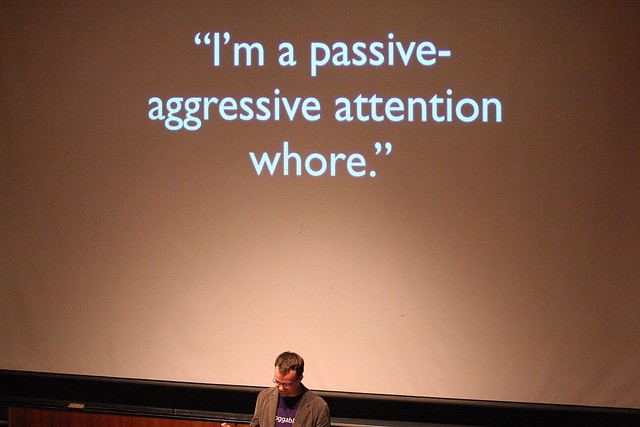
Why we blog
Yeah, that about sums it up. (Image: “Why We Blog,” by Duane Storey, on Flickr under Creative Commons.)

At any rate, I obtained the collection, and it was easy to see just how thoroughly the old blog was destroyed in producing the new one. Of the 546 entries that had been made prior to my April 2014 departure — I was made an offer I had to refuse — only 9 are still available as of this morning (1 of those being the mysterious MMIR Network reference I mentioned above).

It was also easy to see just how much I contributed to the old IES blog. My 145 solo entries accounted for over 25% of the blog’s content; not surprising, really, since I was employed as a writer and at the time we saw the blog as a viable platform for telling people about what IES did. (For the last couple of years I was actually in charge of the whole blog, and coordinated a team of folks who contributed other entries.) I also ghost-wrote some entries for people, and I’m not sure exactly how many of the remainder I either edited or posted on behalf of the authors, but it’s safe to say that I had a hand in producing at least 40% of the blog.

It was also disappointing, and a bit sad, to see what that platform has become. The numbers above show how active it used to be in terms of content, even if its readership was limited. But as of today there have been a grand total of 15 new entries made to the blog in the over 18 months since I left IES. (Add that to the pre-departure entries still extant and you’ll see there are only 24 entries on that blog currently … dating back to 2009.**) If IES maintains that rate — not even 1 new entry a month — it will take them until around 2057 for their blog to have as much content as it had when I left.

I could speculate as to how it came about that the IES blog was so completely scrubbed of content. At first I thought all the entries by people who had left IES had been purged; if so, they obviously missed a few. But entries by some people who are still IES employees were also dropped from the blog, so it seems the content removal was general as well as radical. I cannot discern any rhyme or reason in what was deleted versus what was retained; perhaps there was no rationale or philosophy behind it at all. That, unfortunately, would not surprise me.

But don’t be surprised if from time to time you see a “blast from the past” post here on my blog, in which I reprise some entry of mine from the old IES blog that still has some value or interest. Even if I’m the only one who thinks so.

___
*It may get deleted if they see this post.
**Specifically: 14 entries so far in 2015, including 3 each in October and November; 1 from 2014, after my departure; and, prior to my departure, 1 from 2013, 1 from 2012 (my MMIR Network post), 1 from 2011, 4 from 2010, and 2 from 2009.

Facebooktwitterpinterestlinkedinmailby feather

Where Did ’60 Minutes’ Get a Classified State Department Cable?

Last night on 60 Minutes, correspondent Lara Logan read part of what she described as a “diplomatic cable” to Hadi al-Amiri, the leader of “the largest Shiite force” in Iraq fighting against the false caliphate that we are now encouraged to refer to as “Daesh.”*

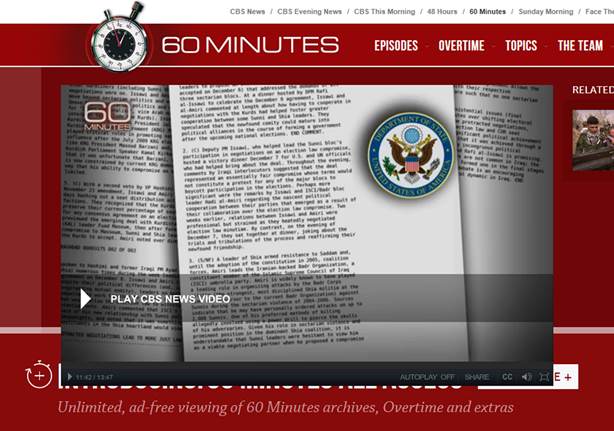
Admitting that it pains me to do this,** here’s a screenshot of the video on the CBS News page:


(Screenshot of “60 Minutes” segment entitled “A Common Enemy,” produced by Max McClellan.)

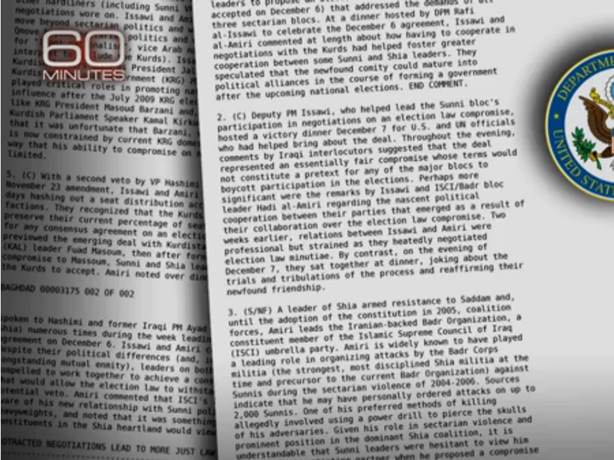
The banner line — the overall classification marking at the top of the document — isn’t visible, but do you notice anything about the paragraph markings on that page on top? It’s hard to see at this resolution, but there’s a parenthetical (C) after the number of paragraph 2. If you served in the military or some other national security posts, you will recognize that portion marking: it means that paragraph contains CONFIDENTIAL information, the lowest level of classified information.

Here’s a close-up:


(Screenshot close-up of “60 Minutes” segment entitled “A Common Enemy,” produced by Max McClellan. It’s evident that the image is not of a properly declassified document, because in that case the classification markings would have been crossed out.)

Paragraph 3 is even more interesting, as it is portion-marked (S/NF). (It is of minor interest that the classification marking appears to be formatted incorrectly; did the producers create their own facsimile of another document?) The S indicates that the paragraph contains SECRET information, and the NF is the release marking shorthand for NOFORN, which means information that is “not releasable to foreign nationals.”

It is at least possible that CBS News obtained a declassified document and then re-worked it to something like its original condition, but as presented it appears that they used a still-classified memo. If so, then the question is how did CBS obtain the document? Why did they feel obliged to display it so prominently? And, perhaps more to the point, did Lara Logan know when she read part of paragraph 3 that she was releasing information that the Government had deemed should not be released to any foreign national?

If that document was indeed classified, as it appeared to be, I hope the appropriate parties at the State Department and within the Intelligence Community are investigating how this information was passed to the producer and correspondent.

___
*”Daesh” is equivalent to the Arabic acronym for ISIL, but according to this article it “is nearly identical to the Arabic word ‘dais,’ meaning something that crushes or tramples. That’s an ominous definition on its own, but not the one this self-aggrandizing group wants in its quest for Islamic rule.”

**It goes against my training and long-ingrained experience for me to post screenshots that may contain classified information, but the images were already broadcast as part of a national news program. As the Operative said in Serenity, “Damage done.” However, if a US Government representative asks me to remove the images, I will gladly do so.

Facebooktwitterpinterestlinkedinmailby feather

Social Media is a Marvel

Social media has, in some ways, made the Internet itself ironic.

What we know as the Web began as the ARPANET, developed to let Advanced Research Projects Agency scientists share information with one another to advance their researches. It devolved into something much less edifying as it expanded. Today, online courses and encyclopedias and other resources may combine to provide great opportunities for enlightenment, advancement, and fulfillment, but the various social media platforms seem to be strongholds for the ever more banal and degenerate.

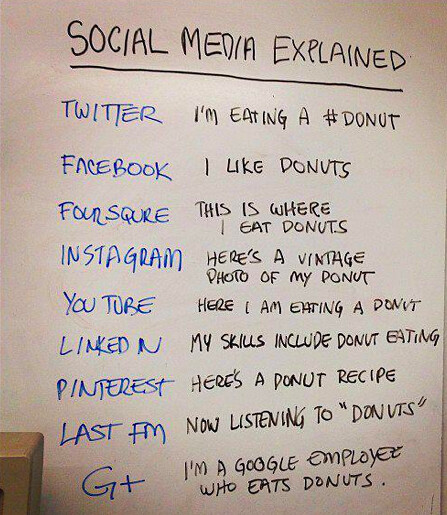
Social Media Explained (with Donuts)
(Image: “Social Media Explained (with Donuts),” by Chris Lott, on Flickr under Creative Commons.)

On social media, the irreligious can register expert opinions on religion and faith. People who never served a day in uniform or studied a fraction of military history, war, or conflict can share their supposed expertise on strategy, tactics, and military matters. Provincials who have never ventured beyond a comfortable distance from their birthplaces can claim authoritative knowledge on international affairs, those who have never run businesses or managed sums of money can pose as experts on economics, people who have never calibrated an instrument or written a computer model or conducted a designed experiment can proclaim scientific veracity, etc., etc. Add in striking graphics and a healthy dose of vulgarity, and social media enables the uninformed to substitute opinion for reason and feeling for fact.

In effect, by virtue of social media it is as if we have all become … politicians, bloviating and pandering rather than really listening or engaging in meaningful discourse. And only rarely do we step down from our ever-so-precarious soapboxes.

Facebooktwitterpinterestlinkedinmailby feather

Campaign Chronicle, 3 Weeks to Election: My Distant Cousin Founded This Town

As I began my run — okay, my ambling walk — for the empty Town Council seat, I was surprised to find that I am related to the man who founded Cary, North Carolina.

Back in 2011 I wrote about my family connection to the Pages of Williamsburg, Virginia, and at the time I didn’t give any thought to the possibility that those Pages might be related to the Page family here. But they are.

First, it’s important to point out what my friends have known for a long time: the Gray Man was adopted when he was young, which muddies the water a bit when it comes to tracing lineages and such. For those who don’t know the story: I was born Thomas Graham Lipscomb, and my father was Thomas Page Lipscomb. He died when I was three, and my mom later married Herbert Wade Rinehart. Shortly after moving to Georgetown, South Carolina — where I learned about the Gray Man and latched onto the legendary ghost as my alter ego — my stepfather adopted me and I became Graham Wade Rinehart. Or, as most of my friends know me, Gray Rinehart.

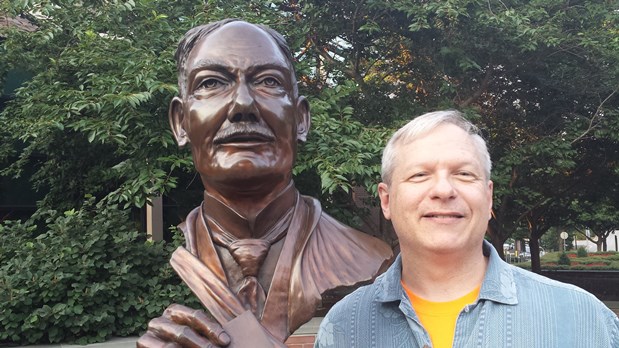
I first wondered about the connection when I was on Chatham Street in downtown Cary and noticed a historical marker about William Hines Page (with whose statue I’m pictured below). Oddly enough, before I thought about whether I might be related to him I thought about a friend of mine named “Hines” from grade school. But once the possible Page family connection came to mind, it was easy enough to check out.


(On the Cary Town Hall campus, I’m standing next to a statue of a distant cousin who was Ambassador to Great Britain and the son of the town’s founder. See any resemblance?)

William Hines Page, who was at one time Ambassador to Great Britain — itself something of a nod to the family history, since Colonel John Page originally came from Britain to settle at Williamsburg — was the son of Allison Francis (Frank) Page, who founded Cary and served as its first Mayor and postmaster. He built the Page-Walker Hotel, which stands behind the Town Hall building and is now an art gallery and focal point for local events. Frank Page’s father was Anderson Page, whose father was Lewis Page, whose father was Robert Edward Page, whose father was Mann Page II, whose father was the Honorable Mann Page.

The Honorable Mann Page, it turns out, is our nearest common ancestor.

The Honorable Mann Page had another son, about whom I wrote in that linked blog post: the Honorable John Page, who was friends with Thomas Jefferson at the College of William & Mary. The Honorable John Page’s son was Major Carter Page, whose son was Dr. Mann Page, whose son was Carter Henry Page, whose son was Carter Henry Page, Jr., whose daughter was Katherine Carlisle Page. She was my “Grandma Kate.” Her son was Thomas Page Lipscomb, my natural father.

Thus, as near as I can figure from looking at canon law relationships, Frank Page — Cary’s founder — was my fourth cousin, three times removed.

I doubt that makes anyone more or less likely to vote for me for Cary Town Council. But it’s an interesting coincidence!

___
Election Day for the Cary Town Council race is October 6th, but early voting begins on September 24th!

Have you told anyone about my campaign? It’s easy! Just share this post on social media or forward the link to anyone who lives in North Carolina (especially the Research Triangle area or the Town of Cary). Better yet, download a Print-It-Yourself Flyer in either color or black and white and put it up in your office or at your favorite hangout. For additional updates and info, sign up for my newsletter using the form in the right sidebar or visit the election page on my website. Thanks!

Spending Disclosure: As of this date, my campaign has spent a total of $84.

This blog post was “paid” for, at the cost of $0 and whatever time it took Gray to write and upload it, by The Gray Man: Service, Leadership, Creativity.

Facebooktwitterpinterestlinkedinmailby feather

How Much Do We Value Loyalty?

This blog entry is about sports, and more than sports.

This past week, my alma mater announced that our Hall of Fame coach (American Baseball Coaches Association HOF, to be exact) would no longer be leading our team. Jack Leggett, who coached the Clemson Tigers to the NCAA Tournament in 21 out of the past 22 seasons, will not be allowed to serve out the last year of his contract. He was not fired for coaching the team to a losing season; if anything, the team’s turnaround to avoid a losing season against a difficult schedule, and its reaching the NCAA Tournament at all, were quite remarkable. Nor was he fired for any misconduct, or misuse of resources. But he was fired nonetheless.

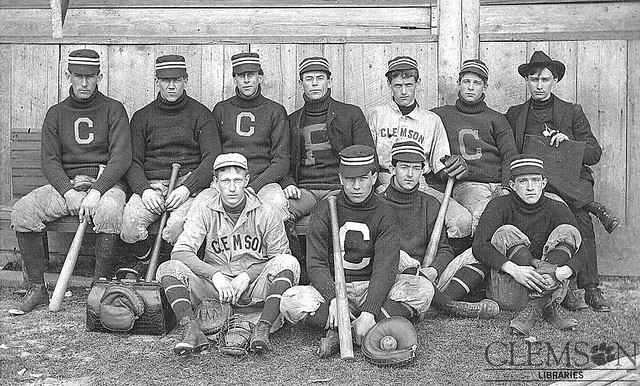
Clemson baseball team c1903
(I like how this picture captures the long tradition of Clemson University baseball — that’s Coach John Heisman, back row center. “Clemson baseball team, c. 1903,” from clemsonunivlibrary, on Flickr under Creative Commons.)

I recognize that the baseball program had not been as consistent in recent years as it has in the past, and that many fans were unsatisfied with its results. Most of us are unsatisfied when our teams — whether sports or corporate or political — don’t perform as well as we think they should. But I do not understand how otherwise reasonable people, who in their daily lives accept the ups-and-downs, setbacks and struggles they encounter, can act as if they expect coaches and teams to win every game.

After reading earlier in the week that Coach Leggett’s job might be in jeopardy, on Wednesday — the day before the announcement was made — I wrote a note to Clemson’s athletic director, Dan Radakovich, to say that I, for one, thought we should show loyalty to Coach Leggett commensurate with his long record of service to the university. I’m sure my message was one of many that Mr. Radakovich received over the past few months, with all manner of advice on how to proceed with the Clemson baseball program. I hope a significant portion, like mine, was supportive of Coach Leggett — not that it made any difference in the long run.

And it seems there was more at stake than simply the wins and losses. According to the TigerNet.com report on Mr. Radakovich’s Thursday press conference, Coach Leggett’s loyalty to his staff may have played a part in his own downfall:

Earlier reports hinted that Leggett refused to make changes to his staff … and Radakovich was forced to make the move to dismiss Leggett. Radakovich didn’t confirm that move but did hint at it.

Subsequent reports seem to corroborate that Coach Leggett’s refusal to fire members of his staff led to his own ouster. He might have been able to save his own job, had he agreed to sacrifice his assistants, but he chose to stand firm on their behalf. That is loyalty.

I would have preferred if we had kept Coach Leggett at Clemson, and given him the support needed to continue his record of success and take our program as far as it could possibly go. I would have preferred if we had let him decide when it was time to retire from the game, and that we had taken the opportunity at that point to honor him, celebrate his accomplishments, and give him a send-off worthy of a Clemson Tiger. It was not to be, but I wish him well, and thank him for all he did for our school and our student-athletes.

I am left to wonder if perhaps loyalty and commitment don’t mean as much today as they used to. But they still mean something to me.

___

One further observation:

In Mr. Radakovich’s press conference, he talked about the qualities he would seek in a replacement. He said he didn’t have an “exhaustive list,” but he rattled off a quick set of traits:

You want to have someone who has shown the ability to lead, to win games, to recruit quality student athletes, to be a great representative of Clemson.

It seems to me that Jack Leggett had accomplished all four of those things — leading, winning, recruiting, and representing Clemson well — for 22 seasons. In other words, we need not have looked beyond our own campus for the kind of coach we apparently want.

Facebooktwitterpinterestlinkedinmailby feather

Three Months Late, But There It Is

“The best laid plans,” and all that, eh?


(Admiring my handiwork. Photo by Paul Cory Photography.)

Originally I had wanted to update my website for the New Year … I even went so far as to put “Website Redesign Coming” front and center back in December. But, as with so many things, I got distracted by the exigencies of everyday life: things like work, and writing a story, and work, and recording music, and work, and conventions, and … you get the picture.

But, only 90 days behind schedule, the new website design is now live on the web!

The address is the same as it ever was, http://www.graymanwrites.com, but the look is completely different. It takes a bit longer to load, unfortunately; I may need to lower the resolution on some of the images, though the loading time may have as much to do with my Internet provider as anything. And the site loses some of the functionality if you look at it in Internet Explorer (grumble, grumble). It works pretty well in Chrome, on the regular computer and on the tablet. So, in the main I’m pretty pleased with it.

No doubt I will continue to tweak it, but further major improvements will have to wait until I can afford to pay someone to do it for me who really knows what they’re doing. That won’t happen for a long, long time.

Meanwhile, I hope you like it!

Facebooktwitterpinterestlinkedinmailby feather

The Difficult Necessity of Empathy

With whom do you empathize the most? And how hard do you try to empathize with others?

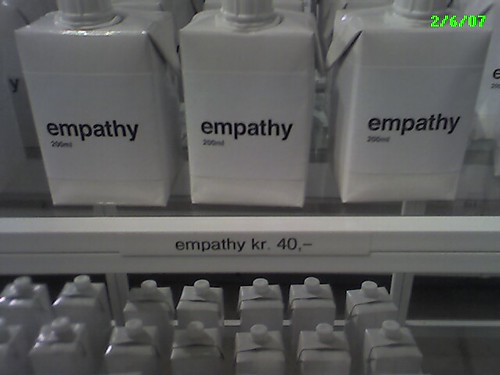
Empathy in a carton
(Have you taken your dose of empathy today? “Empathy in a carton,” by Geoff Jones, on Flickr under Creative Commons.)

I thought about empathy as I was watching the video of the NYPD takedown of Eric Garner. Mr. Garner was approached by and ultimately tackled by several policemen, which unfortunately resulted in his death.

As I watched, I tried to put myself in each person’s position to try to determine, if I had been them, what I might have been thinking and feeling at the time and whether I would have been able to act any differently. If I had been the first officer, would I have felt threatened when Mr. Garner started waving his arms around? If I had been the officer who approached Mr. Garner from behind, or any of the other officers, would I have felt that I had to resort to dangerous tactics due to his size advantage?

And, at the heart of the matter: if I had been Mr. Garner, would I have felt threatened by the officers present? Would I have thought it somewhat ridiculous that I was being harassed when the only danger I posed was that a few more people would risk slow death from cancer and some fewer dollars would make it into the city coffers, when those officers could be chasing violent felons who posed much greater threats to society? When I turned away from the first officer, would I have been thinking that my best course of action was to try to escape? When so many of them piled on me, would I have struggled to break free simply out of fear for my life?

I went through a similar exercise while reading the grand jury proceedings and looking at the crime scene photographs from Ferguson, regarding the Michael Brown case. Again, I tried to put myself in each person’s position.

If I had been __, would I have felt threatened? Would I have felt afraid? Would I have found it irritating or even maddening to be looked at, spoken to, or approached the way the other person did? Would I have felt within my rights to respond aggressively? Would I have had the self-control to stop before things went too far?

If you haven’t done so, try that exercise yourself. First put one party in the blank, and then the other. Do you come up with the same, or different, answers each time? And, more to the point of this post: do you find it easier to empathize with one party than with the other?

I think it’s human nature for us to find it easier to empathize with people with whom we share common bonds or common characteristics. Someone you know is easier to identify with than a stranger, and someone who is like you in some way is easier to identify with than someone who is very different from you.

But sometimes what is easy is not worthwhile, and what is difficult is most beneficial. Human nature aside, it seems important to go through the effort of trying to empathize to at least some degree with each party whenever we encounter a controversy or a tragedy — at the very least, it seems necessary to developing a fuller understanding of the issue, if not of the world. Failing to do so is not a vice, because it can be quite daunting, but refusing to make the attempt is no virtue.

Facebooktwitterpinterestlinkedinmailby feather

Considering an Unanswered Question about the Ferguson Events

I have not commented on the Michael Brown/Officer Darren Wilson case here on the blog. I preferred to wait until the grand jury had completed its investigation, which it did last week.

Justice
(“Justice,” by Don Sutherland, on Flickr under Creative Commons.)

Not that anyone cares much what I think about it, but I have a question that I have not seen raised anywhere.

Even after the grand jury’s results were released, I have continued to see reference to video and still images that “allegedly” show Brown robbing a store, or to the store itself as one that Brown “allegedly robbed,” but: if Michael Brown didn’t rob the store — i.e., if the person in the video is not him — then who did? Using the word “allegedly” may conform to some journalistic style manual, but continuing to say Brown was only “alleged” to have robbed the store seems at best naive and at worst, calculated.

We might give the press the benefit of its own supposed doubt. But if Michael Brown was the “gentle giant” his supporters believe he was, why didn’t his supporters track down the person who actually robbed the store? Why didn’t the hordes of sympathetic reporters roaming the streets of Ferguson and the greater Saint Louis area find and bring forward the actual perpetrator?

If someone else robbed that store, that would seem to be an important part of solidifying the image of Brown as a truly innocent victim on that August day. Given the lengths to which the press has gone to portray Brown in the best possible light, e.g., by selecting particular pictures to display, they might have been motivated to produce such a person. (The police would be under no such motivation, since they would have every reason to believe that the facts support the chronology that begins with Brown robbing the store.) In addition to the press, Michael Brown’s family and friends might be motivated to find the perpetrator, if such a person exists, in order to clear their son and friend’s name. But in the nearly 4 months since his death, I have not seen a single report that someone else committed that crime.

Why is that?

In fact, Dorian Johnson, who was in the store and later present at the shooting, testified to the grand jury that Brown not only stole Cigarillos from the store but did indeed shove the clerk — as seen in the video — in the process of leaving (see Volume 4 of the Grand Jury Proceedings, pages 32-7). We might consider the possibility that Johnson lied about the robbery — his testimony about the manner of Brown’s death did not match other witnesses’ testimony or the forensic evidence, for instance — but it seems likely that no one has come forward to confess to the crime or to identify someone other than Brown because no such person exists.
___

A Brief Aside on the Issue of Johnson’s Believability:

Both sides in the search for justice must be a bit disappointed in Dorian Johnson’s testimony. Johnson testified that Brown was shot while trying to surrender, casting doubt on Officer Wilson’s version of events, but his characterization of Brown’s interaction with the store clerk cast doubt on the “gentle giant” mystique as well. Should any one part of his testimony be taken as more accurate than another?

According to a new National Academy of Sciences report,

many factors influence the visual perceptual experience: dim illumination and brief viewing times, large viewing distances, duress, elevated emotions, and the presence of a visually distracting element such as a gun or a knife. Gaps in sensory input are filled by expectations that are based on prior experiences with the world. Prior experiences are capable of biasing the visual perceptual experience and reinforcing an individual’s conception of what was seen. We also have learned that these qualified perceptual experiences are stored by a system of memory that is highly malleable and continuously evolving, neither retaining nor divulging content in an informational vacuum. The fidelity of our memories to actual events may be compromised by many factors at all stages of processing, from encoding to storage to retrieval. Unknown to the individual, memories are forgotten, reconstructed, updated, and distorted. Therefore, caution must be exercised when utilizing eyewitness procedures and when relying on eyewitness identifications in a judicial context.

— Identifying the Culprit: Assessing Eyewitness Identification, by the Committee on Scientific Approaches to Understanding and Maximizing the Validity and Reliability of Eyewitness Identification in Law Enforcement and the Courts, National Research Council.

Certainly Johnson’s later observations involved larger distances than the encounter in the store as well as “duress, elevated emotions, and the presence of a visually distracting element such as a gun,” but that in itself would not be a reason to discount his testimony. This is where corroborating evidence comes into play, and unfortunately for Johnson (and for Brown’s supporters) the available evidence appears only to corroborate his version of events before he and Brown encountered Wilson.
___

Back to the main topic, this question — if Brown didn’t rob the store, who did? — brings up further, and more difficult, questions.

Can the press, and the family, and his most fervent supporters acknowledge that Michael Brown actually (rather than “allegedly”) robbed that store? If so, can they acknowledge the possibility that, flushed with the adrenaline and endorphin rush of a successful robbery that included a brief physical altercation, Brown might have either a) reacted out of fear of being arrested or b) considered himself capable of intimidating a police officer?

If Brown’s supporters persist in portraying him as completely innocent in this matter — indeed as some sort of paragon who was incapable of belligerence — then it is unlikely that they will ever be able to admit (or possibly even consider) that the other grand jury findings — that Brown was shot first while tussling with Wilson through the window of the police vehicle; ran away bleeding; turned around; and moved back toward Wilson — may be exactly as presented. I don’t know if that would be considered cognitive dissonance, or a refusal to think anything but the best about someone whose side they have taken.

But the “gentle giant” narrative seems to hinge on the lingering doubt among his supporters that Michael Brown actually robbed that store, in which case the unanswered question — if not him, then who? — seems to be apt, if not important.

Facebooktwitterpinterestlinkedinmailby feather

Refining My Position on Just About Everything: Don’t Punish Good Folks When Bad Things Happen

Often it seems to me that many of our laws — and quite a bit of the heated rhetoric I read and hear — derive from a tendency to try to correct or prevent bad things by punishing everyone, including those who aren’t responsible for the bad things. I’m against this.

Community Punishment Workshop
(“Community Punishment Workshop,” by amortize, on Flickr under Creative Commons.)

I first thought about this when I was writing my “If I Were My Own Representative” series, one of which was Part IV: My Touchstone for Voting:

My initial position would be to vote “no” on any bill that had a provision that would hurt some of our citizens, even if it helped some others. I would have to be convinced that the help was worth the hurt; i.e., that the hurt was along the lines as the necessary pain of surgery to correct a life-threatening condition.

If it wasn’t clear what effects some given legislation would have, whether it would hurt some people while helping some others, I would at least ASK. If no one could tell me, again my initial thought would be to vote against it.

I’m coming to believe this in more general terms than just politics: i.e., that in general we shouldn’t blame or punish good people when other people do bad things or allow them to happen. Let me lay out a few assumptions upon which I base this position:

  • There are some bad people in the world, who tend to do bad things. However,
  • Most people in the world are good or, if not actually good, at least not habitually bad.* Even so, some good people may occasionally do bad things (but, I think, usually by mistake or in extremis).
  • Bad things cannot be predicted with certainty, and sometimes not even with confidence.
  • When a person does a bad thing, and is considered likely to do more bad things, it is best to place that person in a position where it is more difficult for them to be able to do bad things.
  • When a person (good or bad) does a bad thing, and bad people may be inspired to follow their example, it is best to downplay the bad things rather than advertise or sensationalize them.
  • When a person (good or bad) does a bad thing, it is a mistake to assume that good people will follow the person’s example.
  • Because good people are the majority, and most good people are unlikely to follow the examples of people doing bad things, it is always a mistake to summarily limit the rights of good people (or strip rights from them) in response to bad things.
  • This approach will occasionally fail, because it is impossible to prevent all bad things or to identify all potentially bad people.

I don’t expect anyone particularly to agree with me on this (or anything else, for that matter), but that’s the way I’m approaching things right now.

___
*I offer this optional way of characterizing it for those for whom the doctrine of Original Sin, or Jesus’s “no one is good but God” statement (Matthew 19:17, Mark 10:18, Luke 18:19),prevents them from admitting that there may be good people in the world.

Facebooktwitterpinterestlinkedinmailby feather

When Does ‘I Want’ Become ‘You Must’?

I think it’s important that we remember that the Law of Supply and Demand does not state, “Someone else must supply what I demand.”

Economics Basics: Demand and Supply
(“Economics Basics: Demand and Supply,” by Fabio Venni, on Flickr under Creative Commons.)

We would do well to remember it when we “demand” anything, of anyone, whether we do so with a threat or simply without offering any recompense, and whether we do so to benefit ourselves or on behalf of others. It is one thing to make a request, or to suggest an exchange of value that someone else may consider, and quite another to make a demand.

The Rush song “Something for Nothing” comes to mind, e.g., “you can’t have freedom for free.”*

It seems to me like the most basic economics. We want (and even perhaps need) something that someone else has, and we either: request them to share it, offer to earn or purchase it, or demand to be given it. The first is mendicity, and meeting the request would be charity; the second is commerce and industry, and accepting the offer would lead to an exchange of value; the third may range from immaturity to larceny, and meeting the demand would seem to be little more than acquiescence and an invitation to further demands.

So far as I can tell, then, “I want” does not require or even imply “you must.”

___
*As much as I would like to quote more of the song, I’m not convinced a longer quote would be considered “fair use” and my respect for their copyright prevents me from doing so.

Facebooktwitterpinterestlinkedinmailby feather