Monday Morning Insight: Choosing Our Plan of Life

(Another in the continuing series of quotes to start the week.)


For no other reason than that I like the quote, here are some words from John Stuart Mill — from On Liberty — to consider this morning:

He who lets the world, or his own portion of it, choose his plan of life for him, has no need of any other faculty than the ape-like one of imitation. He who chooses his plan for himself, employs all his faculties. He must use observation to see, reasoning and judgment to foresee, activity to gather materials for decision, discrimination to decide, and when he has decided, firmness and self-control to hold to his deliberate decision.

Every day we have opportunity to choose our “plan of life,” even if only for that day. And we have it in our power to observe, to think and judge, to consider, to decide, and finally to act on the basis of that decision.

When we cede that power to others, when we allow them to choose our plan for us, we diminish ourselves.

Resolute

(Image: “Resolute,” by Kenoi Cabral, on Flickr under Creative Commons.)


I hope you will find truth and courage as you choose and implement the plan of your life.

Facebooktwitterpinterestlinkedinmailby feather

Thankful for All the Nouns

Good Thanksgiving morning to you and yours!

Every day I try to find things to be thankful for, but I’m glad our nation sets aside a special day for expressing thankfulness. In the spirit of the day, I sat down this morning to make a list of things for which I’m thankful, and realized that I could work for hours if not days trying to remember every individual person, place, or thing for which I could rightly say, “Thank you.”

I would never run out of nouns, and so I’d never run out of thanks.

I hope you can say the same.

Thanking God, 2016

(Image: “Thanking God, 2016,” by Martin LaBar, on Flickr under Creative Commons.)


Whoever you are, wherever you are, I’m thankful for you — and I hope you have a fantastic day!

Facebooktwitterpinterestlinkedinmailby feather

Monday Morning Insight: Service as Gratitude

(Another in the continuing series of quotes to start the week.)


Thursday is Thanksgiving here in the U.S., so I thought this Benjamin Franklin quotation about gratitude might be appropriate for this Monday morning:

When I am employed in serving others, I do not look upon myself as conferring favors, but as paying debts. I have received much kindness from men to whom I shall never have an opportunity of making the least direct returns; and numberless mercies from God, who is infinitely above being benefited by our services. Those kindnesses from men I can, therefore, only return on their fellow-men, and I can only show my gratitude for those mercies from God by a readiness to help His other children.

I hope you have opportunity to be thankful — today, on Thanksgiving, and every day. And if you choose to demonstrate your gratitude by serving someone else, whether in a grand gesture or a very small way, I hope it brings you joy and peace to have done a little good in this world.

Gratitude Road

There’s a road by this name in Bristol, UK, but it’s not a bad address for all of us, every day. (Image: “Gratitude Road,” by Bart Maguire, on Flickr under Creative Commons.)


As always, I thank you for your time and your attention. I wish you well.

Facebooktwitterpinterestlinkedinmailby feather

A Wish, in Iambic Pentameter

I wrote this quatrain on Tuesday evening, before the election results were known, because I knew whatever the result many people would blow up in either indignation or celebration and, as a consequence, drive even bigger wedges between us. I shared the little verse on the Book of Faces, and thought I’d inscribe it (virtually, that is) here as well:

I Wish …

That we might preen and posture somewhat less,
Account ourselves without regard to pride,
Fret not upon disaster or distress –
A humble, hopeful star our constant guide.

(Image: “Wish,” by Jessica Tam, on Wikimedia Commons.)


And as always, I wish you the best.

Facebooktwitterpinterestlinkedinmailby feather

Monday Morning Insight: My Country, Right or Wrong

(Another in the continuing series of quotes to start the week.)


Since the week starts with Election Day Eve, I thought this 1872 quote from U.S. Senator Carl Schurz (2 March 1829 – 14 May 1906) would be appropriate:

My country, right or wrong; if right, to be kept right; and if wrong, to be set right.

When we vote, we either vote to keep the country right or to set the country right. It depends on our point of view, whether we think the country is or isn’t moving in the right direction.

But the work goes on after we vote, too.

(Image: “2016,” by Gordon Johnson, on Pixabay under Creative Commons.)


Every day we have the chance to keep our little corner of the country right, or to set it right if it begins to go wrong. It’s harder work than voting (when we vote, we delegate the work to others), but it’s more direct.

And if more of us did the work, it would be far more effective.

The trouble is, recently so many people have put so much effort into tearing down each other, a lot of work needs to be done no matter who wins the election. I hope we’re up to it.

But, have a great week, no matter what happens tomorrow!

___
P.S. Don’t forget, if you’re not already sure who you want to vote for, you’re welcome to write in yours truly for any office, anywhere.

Facebooktwitterpinterestlinkedinmailby feather

Monday Morning Insight: A Ghost’s Report

(Another in the continuing series of quotes to start the week.)


Hey, it’s Halloween, so why not start the week with a famous report from a well-known ghost (not the Gray Man)? Briefly released from Purgatory to walk the earth, this ghost said,

… I could a tale unfold whose lightest word
Would harrow up thy soul, freeze thy young blood,
Make thy two eyes, like stars, start from their spheres,
Thy knotty and combined locks to part
And each particular hair to stand on end,
Like quills upon the fretful porpentine.
But this eternal blazon must not be
To ears of flesh and blood.

Many readers will recognize the source: Hamlet, Act I, Scene V.

The old haunted abbey - Whitby.

(Image: “The old haunted abbey – Whitby,” by Darren Flinders, on Flickr under Creative Commons.)


I hope you survive the horrors of the day — that they don’t harrow your soul or freeze your blood or make your hair stand on end — and that you have an awesome week!

Facebooktwitterpinterestlinkedinmailby feather

Monday Morning Insight: Good Manners, Part II (Heinlein Edition)

(Another in the continuing series of quotes to start the week.)


Last week in this series I presented a quote from Jonathan Swift on the meaning of mannerly behavior. This week I’m offering up a quote from Science Fiction Grand Master Robert A. Heinlein’s novel Friday (emphasis in original):

Sick cultures show a complex of symptoms … but a dying culture invariably exhibits personal rudeness. Bad manners. Lack of consideration for others in minor matters. A loss of politeness, of gentle manners, is more significant than is a riot.

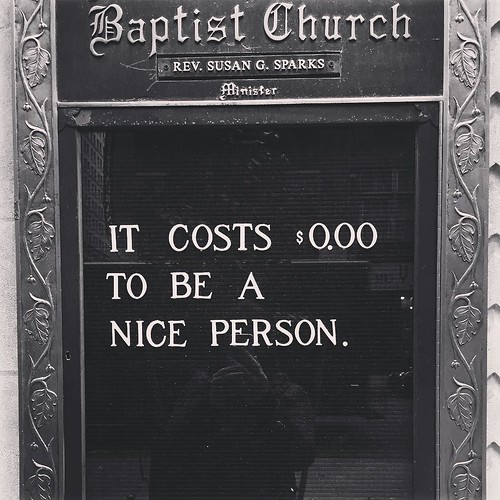
I’m not sure that needs much commentary, so I’ll just insert this relevant image:

Well, amen. #sundaythought #nice #beadecenthumanbeing

(Image: “Well, amen (etc.)” by Francesca Castelli, on Flickr under Creative Commons.)


Have a great week….

Facebooktwitterpinterestlinkedinmailby feather

Zombie Blog Post: ‘Making It Real’ in North Carolina

(Nothing Halloweenish here; this is a “zombie” post only in the sense of it coming back from the dead.)


I’m about to take a few hours off to visit the NC State Fair (it’s Military Appreciation Day, and I appreciate the military), but I thought I’d reprise an old blog post that I particularly like. It was published six years ago today on the old NCSU-IES blog,* though it had actually appeared on the Beyond Lean blog a little over a week earlier than that:

Because I’ve driven across the country several times, from one Air Force assignment to the next, I sometimes think in terms of the nation as a whole and forget just how big some states are. When I helped the NC State University Industrial Extension Service (IES) conduct the “Manufacturing Makes It Real” tour, covering over 1100 miles in 5 days, I realized very quickly that North Carolina is a pretty big state.

The central message of the tour was that manufacturing — the actual production of durable and consumer goods — matters to all of us, because it is the source of almost everything we have and almost everything we do. As Dr. Terri Helmlinger Ratcliff, IES Executive Director, wrote before the tour, “Manufacturing makes the difference between imagination and reality in ways that make modern life possible.” Invention creates new products, but manufacturing brings them into all our lives.

To spread the message about how much manufacturing matters, we went to every region of North Carolina: the piedmont, the mountains, and along the coast. As we traveled, we held rallies where manufacturers showed off their products and praised their workers. The host sites made the rallies truly “local” events: some had employees sing the National Anthem, some invited Junior ROTC or other school groups to perform, and one invited the local area’s apple orchards to bring some of their products for attendees to sample. Local, State, and even Federal elected officials attended various events, which usually included plant tours to show off the host sites’ capabilities in more detail.

Our convoy included a tractor-trailer with dozens of different “Made in NC” items that showed off the diversity of products made throughout the state. At each rally, people lined up to walk through the trailer to see their handiwork as well as others’. Many people expressed surprise at the variety of products made in the state: “from tortilla chips to microchips,” as IES Deputy Director Dr. David Boulay said.

I like to think the individual rallies were like “county fairs” for manufacturing, and we were pleased at the number of companies that attended, even though we didn’t have blue ribbons to award. And considering the weather we had — record levels of rain along the coast, making us travel on nearly-flooded roads** — we were very fortunate to make it to each stop and hold each rally on time.
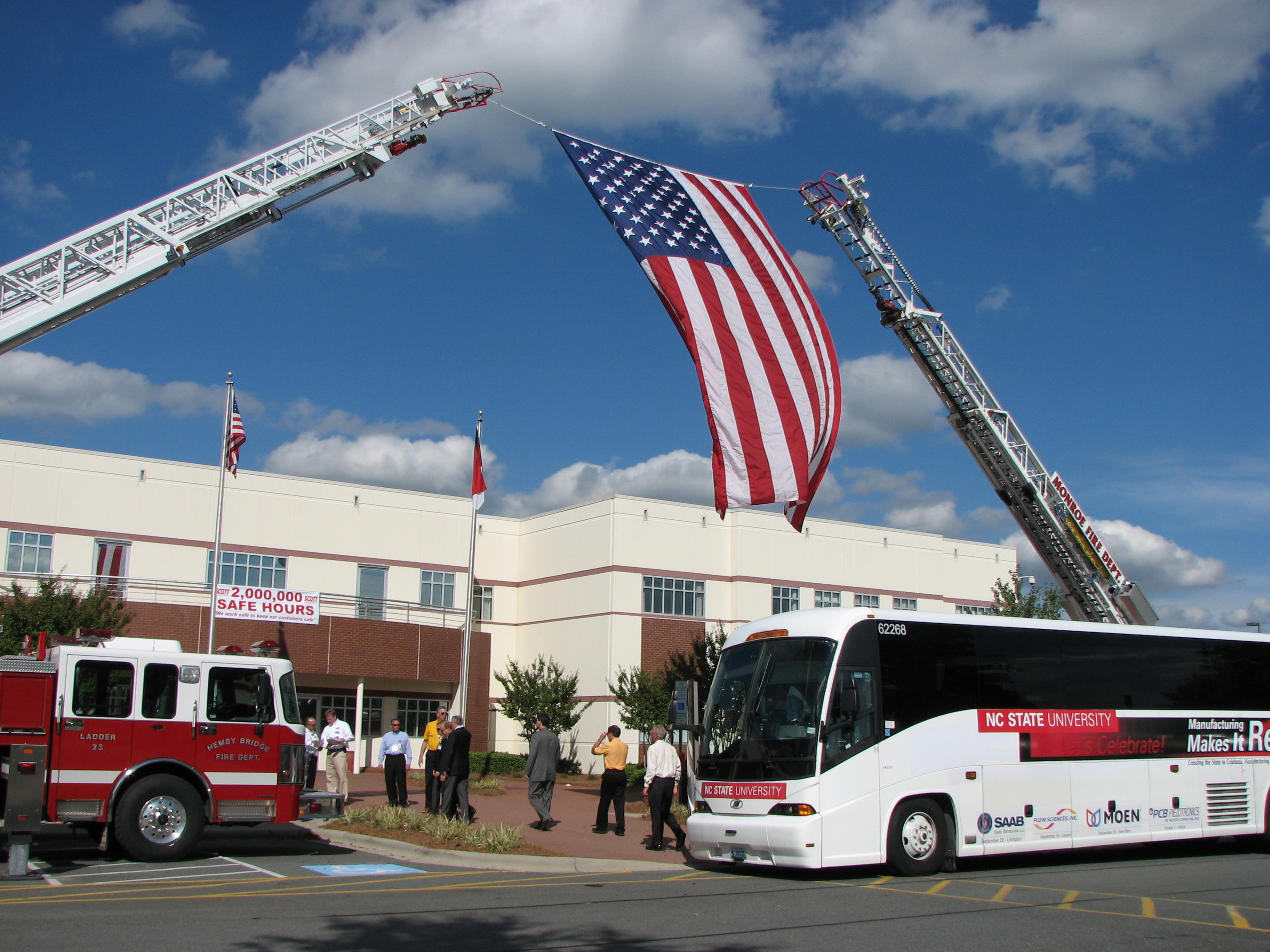
The MMIR Tour bus at Scott Health & Safety in Monroe. (NC State University image.)


The most memorable rally for me was held at Scott Health & Safety in Monroe (east of Charlotte). The Monroe Fire Department had set up two ladder trucks and suspended a huge U.S. flag to help the company demonstrate their “Made in the USA” pride. That pride-of-workmanship theme was repeated at every stop, but the Monroe event was special to me because I relied on Scott Air Pak breathing gear when I worked disaster response in the Air Force. Their workmanship can literally mean the difference between life and death in dangerous situations. (I wrote more about the Scott Health & Safety rally on the tour blog***).

All week long, from companies big and small and representing many different industry sectors, we heard stories of continuous improvement through lean and Six Sigma, expanded markets through ISO certification, and risk-taking through entrepreneurial ventures and new produc

Oops. What happened there?

What happened is that IES (now named “Industry Expansion Services” for some reason) destroyed its old blog and that’s all my former co-worker was able to recover. Seriously, the recovered portion they sent me ends right there, in the middle of the word “product.” (I contend that the blog was a historical record of the university and that doing away with it like that violated the rules for retaining official state records, but what do I know?) Thankfully, since this particular entry was cross-posted elsewhere and is still available there, we can include the rest of it as follows:

… new product development. Company leaders admitted to a lot of belt-tightening and uncertainty in the last couple of years, but seemed pleased that people were paying attention to the good work they do.

The tour ended with a final rally at the NC Legislative Building in Raleigh, where NC State Chancellor Randy Woodson symbolically presented the truckload of products to NC Secretary of Commerce Keith Crisco. The speakers at the final rally, along with the companies that sponsored and participated in the “Manufacturing Makes It Real” tour, testified that manufacturing is alive and well in North Carolina. We are all committed to keeping it that way.

It’s hard to believe that was six years ago now! We kept the momentum of the tour going for a few more years through the MMIR Network, but eventually the IES leadership found other interests and higher priorities. I consider that a little sad, but I’m still proud that for a while I was part of celebrating real people who make real things that we use every single day.

And just this week I suggested that an author friend of mine visit the Scott plant in Monroe, which I never would have known about had it not been for the MMIR Tour.

Anyway, if you’re of a mind I hope you’ll take note of something you use and think of the people who worked on producing it for you. And if you’re one of the thousands of people who make things for the rest of us, please accept my gratitude. Thanks for all you do!

___
* I’ve removed all links to the old NCSU-IES blog, since it doesn’t exist anymore. When I clicked on old links to it, they redirected to the College of Engineering page, which I find a bit ridiculous.
** The storms we drove through were pretty intense, though we didn’t mind because we needed the rain to counteract that summer’s drought. At least it wasn’t a full-blown hurricane!
*** I’m surprised that old tour-specific blog is still active, but it was a WordPress blog and not maintained by the University. They may decide to take it down, if they realize it’s out there. But at least for the moment you can find more from the tour, including pictures from most of the sites, at http://mfgmakesitreal.wordpress.com/.

Facebooktwitterpinterestlinkedinmailby feather

Monday Morning Insight: Good Manners

(Another in the continuing series of quotes to start the week.)


Given the rancor we observe and occasionally encounter online — and sometimes even encounter in real life — and the oft-repeated reports, accusations, and exhibitions of what can most charitably be described as boorish behavior by people in positions of power or prominence, manners seem rather a timely topic.

Many years ago I had the pleasure of hearing Tony Campolo speak at the National Youth Workers Convention in San Diego, and one of his topics was the importance of mannerly behavior. I often repeat part of what he told us, about a study conducted in the late 1930s in Britain and Germany. I’m not going to repeat that story here, or even quote from Mr. Campolo, but I thought about him while considering this quote from Jonathan Swift:

Good manners is the art of making those people easy with whom we converse. Whoever makes the fewest persons uneasy is the best bred in the company.

I think Mr. Campolo would appreciate that quote, which is the opening of “A Treatise on Good Manners and Good Breeding.” Swift’s essay has much to recommend it, despite it clearly reflecting the 18th century emphasis on gentility and class. The essay is nearly as much about the dangers of going overboard with setting out troublesome rules as it is about “ill manners” as opposed to “good manners.”

Good Manners

(Image: “Good Manners,” by Sharon Sinclair, on Flickr under Creative Commons.)


Swift insists (his word) “that good sense is the principal foundation of good manners,” and that rules for behavior have been developed because good sense is something very few of us have. Indeed, he lists “the three great sources of ill manners” as a lack of sense, an “ill nature,” and pride.

It’s an interesting exercise, when we encounter or observe poor manners, to speculate on whether the perpetrator lacks sense, is bad-natured, or suffers from an excess of pride. But ultimately that’s a fruitless exercise, as it serves more to puff up our own pride than to induce us to behave better.

And behaving better is the constant challenge. For if we display good manners, if we are able to set people we interact with at ease, we avoid making others speculate about us.

Facebooktwitterpinterestlinkedinmailby feather

The Power of a Single Thought

I had a dream last night, but I can’t remember anything about it because in that tenuous state between sleeping and waking I had another thought — specifically, an idea related to a short story I plan to write — and that thought drove every vestige of the dream from my mind.

And, in the process, it impressed upon me the power of a single thought: that it only takes one single thought to crowd out all other thoughts. One single thought, if we concentrate strong enough on it or if we find it sufficiently compelling, will color our perceptions and bind us in mental chains.

I admit that this observation is not really new or particularly profound — others have pointed out our tendency to hold on to and defend various ideas in the face of contrary evidence — but it hit me this morning in a powerful way.

Consider this: complete each of the following sentences with the first thing that comes into your mind.

  • Hillary Clinton is a __.
  • Donald Trump is a __.
  • Gary Johnson is a __.
  • Jill Stein is a __.

Locked and Loaded

What strong chains we forge to bind our thinking! (Image: “Locked and Loaded,” by Thomas Hawk, on Flickr under Creative Commons.)


Was your first thought about each of them positive, negative, or neutral? It likely depended on where you fall along the political spectrum and, in the case of the Libertarian and Green party candidates, whether you know much about them at all.

Now, consider each of the following statements that may be considered observable facts:

  • Hillary Clinton is a lawyer.
  • Donald Trump is a businessman.
  • Gary Johnson is a businessman.
  • Jill Stein is a doctor.

How do you react to those simple statements about the career paths of the candidates, based on your first thought about each of them? Do you find that the first thing that came to mind earlier influenced your reaction to the next thing that was presented?

It seems to me that those first thoughts become our filters, the lenses (rose-colored or otherwise) through which we see the world. The first thought, especially if it conveys a value judgment, becomes, if you will, a self-fulfilling mental prophecy.

This applies to more than just politics, of course, but the political example occurred to me this morning because it’s particularly timely. In some respects this tendency is wired into the way we think and learn: according to Theory of Knowledge, we form concepts and then test those concepts against reality, but sometimes our concepts affect how we perceive reality. As a result, I’m not sure any of us can (or if it would even be desirable to) remain completely objective, with neutral impressions of everything. We are not Vulcans, after all.

But maybe, if we recognize this mechanism in our own thinking, we can be a bit more accepting, a bit more forgiving, not by rejecting our first thought or convincing ourselves that our first thoughts are wrong, but simply by recognizing that our first thought may be incomplete.

Facebooktwitterpinterestlinkedinmailby feather