About My Hugo-Award-Nominated Story

I’m not going to talk about the Great Hugo Award Controversy in this post. If that disappoints anyone, then in the words of my former teacher, Dave Haasl, “For this I apologize, but this apology is in no way sincere.”

Hugo Award Logo

One additional note: This post is adapted from what I sent out today in my newsletter. Usually I give my newsletter friends a longer period of exclusivity, so to them I offer a sincere apology.

For family and friends who don’t follow science fiction and fantasy news, last Saturday the nominees for the 2015 Hugo Awards were announced, and my story, “Ashes to Ashes, Dust to Dust, Earth to Alluvium,” which appeared in Orson Scott Card’s InterGalactic Medicine Show online magazine last May, is a finalist for the 2015 Hugo Award for Best Novelette.

If you already know what the Hugo Awards are, you can skip this paragraph, but for family and friends who are not immersed in SF&F culture: the Hugo Awards are given for “excellence in the field of science fiction and fantasy,” and have been called the “most prestigious award in science fiction” — so this is a pretty big deal. You can think of the Hugos as something of a cross between the Academy Awards and the People’s Choice Awards, in that they’re voted on by a fairly small group (members of the World Science Fiction Convention) but anyone is welcome to join that group.

My first reaction to the nomination was a profound sense of gratitude, which I hope will become clear as I tell you a bit about the story and how it came to be.

My “novelette” — which simply refers to a story between 7500 and 17,500 words long — revolves around human settlers on a distant planet trying to end years of subjugation by an alien species. Here’s the opening:

The door leading to the Tephrist’s studio reminded Cerna of a clam’s shell turned on its side, except it was grossly oversized, indigo-painted, and steel.

“Let’s go back, Phil,” Cerna said. “Why do you want to go in there? They’re the ones making you sick.”

Keller would hear none of it. His hand shook a little as he pushed against the damaged identi-plate. The plate and the imperfectly patched wall around it bore the imprint of the only human revolt to have reached this far into town.

As the door-halves swung apart on smooth tracks, Cerna resisted the urge to pull his friend away. The interlocking flutes were sharp edged and equipped with heavy-duty pins as long as his forearm that secured it in the off-hours.

The front room was square, and stark in its simplicity. It smelled pleasanter than Cerna expected, faintly of cinnamon. Not like death at all.

The ceiling was mostly open to the afternoon sky, typical of Peshari construction, but buttresses rose from the corners that were interconnected with steel bars. Shadows from the bars made patterns on the rough, pale, orange tiled floor and the sand colored brick walls. A few bricks were adorned with dead Peshari in miniature bas-relief.

A heavy-beamed archway roughly opposite the entrance led back into the work area. In between, a holo-pillar took up about a square meter in the center of the room, but it was turned off. Otherwise, the room was bare, with not even a plant to break up the uniform color. Cerna guessed that a place devoted to death might not be the best environment for living things.

If you’re curious and want to read more, I’ll put the link at the bottom of this post.

So, then, why was gratitude my first reaction when the committee told me I’d been nominated? Because I give credit to a number of other people for the story’s success — and even for its very existence!

First off, I wrote the story as part of the annual Halloween contest in the Codex Writers Group, and the two “seeds” I started with came from fellow writers Aliza Greenblatt and Eric James Stone. The story took second place in the contest, and James Maxey liked it so much that he called it to the attention of Edmund Schubert, the editor of InterGalactic Medicine Show. Ed asked me to send it to him, which of course I did. Just a few months later the story went online.

So I am deeply grateful to each and all of them for their contributions to and faith in the tale.

The story of the story (if you will) might have ended there. IGMS’s readership is smaller than the traditional powerhouse magazines like Analog and Asimov’s, and while it’s nice to think that some of the readers liked my story, I don’t remember it being reviewed or getting any other attention. But as “award season” started warming up my friends Brad Torgersen and Larry Correia decided to recommend the story, and others followed suit. For my part, I was quite happy that a few more people might read the story than would have ever heard of it otherwise; even with the widespread attention Brad and Larry and their “Evil League of Evil” could give it, I doubted it would make the cut.

Turns out I was wrong.

So here I am, with a story nominated for one of the most significant science fiction awards. From the moment I opened the e-mail with the news, I’ve been and remain most grateful, to the people named above and to everyone who read my story and liked it enough to nominate it.

Voting will take place this summer. I’ll find out in August if my story passed muster with the voters.

Until then, as I noted above there is more than a little controversy over my nomination, because it was part of the recommendation list that was passed around. But I hope you’ll forgive me for leaving that discussion to another day.

Because all I really want to say today is: Thank you, one and all.

___

Here’s the promised link, if you’d like to read “Ashes to Ashes, Dust to Dust, Earth to Alluvium”.

Facebooktwitterpinterestlinkedinmailby feather

Reflections on the Second Day

Today is the second day. A day of doubt, despair, and fear.

Jesus Cross
(“Jesus Cross,” by Claudio Ungari, on Flickr under Creative Commons.)

I think of Jesus’s disciples on the second day. Those who knew him, loved him, followed him; who listened to him, questioned him, wondered about him. Those who believed in what they thought he would do, believed in what he said, believed in him. And saw him taken from them.

They were marked men (“Weren’t you with him?” “I don’t know him!”). Not so much revolutionaries without a leader as sheep without a shepherd.

The second day was a Sabbath day. A day of rest, when no work would be done. A day when the mind should be turned to God. A day of no distractions.

I imagine they prayed for distractions. For brighter memories of better days, instead of bitter images of the first day.

I imagine they did not think of the day as the second day, or the day before as the first. And I imagine they did not much anticipate what the third day would bring.

For them, it was just a dark and terrifying “today.”

Facebooktwitterpinterestlinkedinmailby feather

Heinlein Was Right: A New Look at His Rules for Writing

(Adapted from an article I sent out in my newsletter last November.)

Many writers have commented on the “rules” for writing that Science Fiction Grand Master Robert A. Heinlein put forth many years ago, but one rule in particular has tripped people up.

Finishing Room
(The boat is built, but it’s not yet finished. Image of “Merrimack Skiffs in the Finishing Room at Lowell’s Boat Shop in Amesbury, MA,” by Bruce Berrien, on Flickr under Creative Commons.)

For those who don’t know, Heinlein’s rules were included almost as an afterthought in a brief essay he wrote for Of Worlds Beyond: The Science of Science Fiction Writing (Fantasy Press, 1947). He wrote, “I shall chuck in as a bonus a group of practical, tested rules which, if followed meticulously, will prove rewarding to any writer.”

The rules, which he also called “business habits,” that concluded his essay were:

  1. You must write.
  2. You must finish what you start. (Sometimes rendered “you must finish what you write,” which I prefer, but “what you start” is what Heinlein used in his essay.)
  3. You must refrain from rewriting except to editorial order.
  4. You must put it on the market.
  5. You must keep it on the market until sold.

I’ve heard and read a lot of commentary complaining about rule 3, to the effect that Heinlein was not in favor of editing or somesuch. I think that’s nonsense, and results from a failure to read what the rules actually say.

Note that rule 3 doesn’t say “don’t edit,” or “don’t rewrite,” or even “refrain from editing” — it stays “refrain from rewriting.” That is, once you’ve told the story you wanted to tell, resist the urge to change it into a different story. This rule is not about cleaning up a story; it’s about gross revisions and restructuring.

How can I be confident that Heinlein was not referring to editing a story before trying to sell it? Because I interpret rule 3 in light of rule 2.

All the commentaries I found on the Web* indicate that rule 2 simply means pressing on with your writing until you type “THE END” into the manuscript; in fact, the most common complaint seemed to be that actually completing every story one starts may not be advisable. However, that reads more into it than is actually there, because Heinlein didn’t say to finish every story one starts, but rather to finish what you start. Failing to complete a particular story simply leaves one with an incomplete story; but eventually, to be successful as a writer, one must finish writing at least one story.

But there is another meaning to the word “finish” that people seem not to have considered. Heinlein, who was an engineer and a craftsman, certainly understood that the process of building anything proceeds in stages and the final stage of most projects is the finishing stage: the crown moulding, baseboards and paint applied to the house; the stain, sanding and varnish applied to the piece of furniture (or the boat, in the image above); the continuity, characterization, and setting details applied to the story.

Thus, “finishing” a story is more than completing it, more than typing “THE END” — it’s sanding off the rough edges, adding color or detailing, maybe installing hardware or accessories — to create a truly “finished” piece of work as opposed to the foundation or framework or, simply, unfinished form of a story.

I have no proof that Heinlein actually meant “finish” in this way, but I’m confident that he was familiar with the idea. Even before he introduced the rules/habits, Heinlein called spelling, punctuation and grammar the “word-carpenter’s sharp tools” — and he certainly knew that the tools are important to making (and finishing) a thing but they are not usually the thing itself.

So, finish your stories before you send them in (rule 2), but don’t rewrite them unless and until you have to (rule 3).

It is possible, however, that I’m reading too much into this and that Heinlein did mean “finish” only in the sense of “completion.” He concluded his essay with this sentiment:

The above five rules …. are amazingly hard to follow — which is why there are so few professional writers and so many aspirants, and which is why I am not afraid to give away the racket! But, if you will follow them, it matters not how you write, you will find some editor somewhere, sometime, so unwary or so desperate for copy as to buy the worst old dog you, or I, or anybody else, can throw at him.

But I maintain that if you “finish” your stories in the way I suggest — by cleaning them up, making them presentable, and making them as good as possible — then “the worst old dog” you write will be more likely to compare favorably with the vast majority of the stories put forward by the “many aspirants” who send out their stories before they are ready.

What do you think?

___
*I make no claim of having actually found all the commentaries on the Web.

Facebooktwitterpinterestlinkedinmailby feather

Three Months Late, But There It Is

“The best laid plans,” and all that, eh?


(Admiring my handiwork. Photo by Paul Cory Photography.)

Originally I had wanted to update my website for the New Year … I even went so far as to put “Website Redesign Coming” front and center back in December. But, as with so many things, I got distracted by the exigencies of everyday life: things like work, and writing a story, and work, and recording music, and work, and conventions, and … you get the picture.

But, only 90 days behind schedule, the new website design is now live on the web!

The address is the same as it ever was, http://www.graymanwrites.com, but the look is completely different. It takes a bit longer to load, unfortunately; I may need to lower the resolution on some of the images, though the loading time may have as much to do with my Internet provider as anything. And the site loses some of the functionality if you look at it in Internet Explorer (grumble, grumble). It works pretty well in Chrome, on the regular computer and on the tablet. So, in the main I’m pretty pleased with it.

No doubt I will continue to tweak it, but further major improvements will have to wait until I can afford to pay someone to do it for me who really knows what they’re doing. That won’t happen for a long, long time.

Meanwhile, I hope you like it!

Facebooktwitterpinterestlinkedinmailby feather

Advice from the Slush Pile: Start Short, if You Can

(This post is adapted from a newsletter article I sent out last October. If you’re not getting my newsletter, you can subscribe here.)

This advice may seem quaint, and like any advice it won’t apply to everyone, but if you’re thinking of writing as a pastime or a possible career, I suggest you consider starting with short stories and working your way into longer and longer pieces — because time is precious, and you want to use it to your best advantage. I offer this suggestion as the “slush” reader for Baen Books, having now examined literally thousands of submissions.

After the Edit
(I can honestly say I’ve never treated a manuscript like this. And thankfully never received one back with quite so strident a rejection. Image: “After the Edit,” by Laura Ritchie, on Flickr under Creative Commons.)

I am frequently surprised — and sometimes shocked — at submissions in which the author appears to have poured out their storytelling heart in 100,000 or more words without having practiced writing anything shorter. It’s not that they have a bad idea, or sometimes even that they write poorly (although this happens more than I’d like), but that they haven’t written enough to know how to tell a complete, coherent story.

It’s as if a would-be doctor tried to perform thoracic surgery without ever having dissected a frog.

That’s one reason I suggest that people start writing short stories and work their way to longer, more complex stories. But the other reason is even more basic: write short stories because you get to “THE END” faster.

Instead of taking months to produce a disjointed, confusing, lengthy text, learn how to write a smooth, straightforward narrative in days or weeks by limiting yourself at first to shorter forms. Then try longer forms that take weeks or a month to write. Learn to switch smoothly between points of view as your narratives grow in scope, and learn to tie up the threads of parallel narratives as your stories grow in length and complexity. Work your way up to forms that take months to write. Time is precious: spend it wisely!

And in keeping with the principle that time is precious, I’ll wrap this up. Thank you very much for spending part of your time here. Good luck to you!

Facebooktwitterpinterestlinkedinmailby feather

Bookstore Survives Governmental Charity by Resorting to … Charity

What do you do when you run a store that can’t remain profitable due to governmental regulations? Why, ask people to “sponsor” you!

Charities online
(“Charities online,” by HM Revenue & Customs, on Flickr under Creative Commons.)

A little background, for those who need it: There’s a specialty bookstore in San Francisco, Borderlands Books, that is well-known to the science fiction and fantasy community because it’s an independent SF&F bookstore. A few weeks ago it announced that it was closing because the city of San Francisco raised the minimum wage to $15 an hour and when they ran the numbers they couldn’t sustain operations for more than a few months. Their announcement prompted an outpouring of angst among the SF&F literati, such that the bookstore owners decided to ask people to bail them out and began selling annual “sponsorships” for $100. Now, having gotten the 300 sponsors they need, they’re going to be able to stay open for another year.

Am I the only person who finds this a little hard to follow?

1. The city raises the minimum wage, to the level specified by burger flippers and their loyal supporters.

2. A business announces that it can’t remain profitable and provide that wage, just as predicted by people who understand economics and the law of supply and demand. Actually, it said,

The change in minimum wage will mean our payroll will increase roughly 39%. That increase will in turn bring up our total operating expenses by 18%. To make up for that expense, we would need to increase our sales by a minimum of 20%. We do not believe that is a realistic possibility for a bookstore in San Francisco at this time.

3. In response to expressions of regret over its impending closure, the business asks good-hearted friends as well as total strangers to keep it afloat, not by providing goods or services in exchange for value (though they did offer some token items that few people are likely to redeem), but by begging people to just give it money, even though the owner admitted:

I didn’t think that it was right for a for-profit business to ask for a hand-out to continue operating.

4. The bookstore also stipulated that this trend of relying on charity will continue, year after year, into the future:

If next year we again reach our goal by March 31st, we will remain open through 2016. This process will continue each year until we close, either because of a lack of sponsorship or for other reasons.

5. People come out of the woodwork to give the business money.

To rephrase my previous question, Am I the only one who finds this passing strange?

Maybe I shouldn’t find it surprising or strange, in this age of “crowdfunding” that allows people to engage in commerce not by taking on the risk of an enterprise but by generating interest and spreading the risk around. I’ve backed several Kickstarter campaigns myself, and don’t get me wrong: I wouldn’t turn up my nose at anyone throwing money my way, and can even provide quick and easy ways to do so. But I can’t help but wonder about people far removed from San Francisco who decided that the best way to use an extra $100 was to prop up a failing bookstore there, rather than, say, help out real charities in their local areas.

And maybe I’m the only one to suspect that at least some of the people who donated to this for-profit business have no deep appreciation for capitalism and see no irony in having to make up for falling profits caused by a governmental edict that they agreed with in the first place.

Facebooktwitterpinterestlinkedinmailby feather

Next Convention Stop: MystiCon in Roanoke, Virginia

Who’s going to be in Roanoke next weekend? I am!

MystiCon is always a fun science fiction & fantasy convention, and this year features media Guest of Honor Sean Maher — Dr. Simon Tam from FIREFLY — and Literary GOH Peter David, author of many standalone and media tie-in novels as well as comics, video games, and television shows.

Here’s what I’m scheduled to do …

Friday:  Whatever I want!

Saturday:

  • 10am: Writing Workshop, Part 1
  • 2pm: Baen Books Traveling Road Show
  • 5pm: Reading … which, for me, will also include Singing

Sunday:

  • 9am: Signing … I’ll have copies of Truths and Lies and Make-Believe as well as “Another Romulan Ale” and “Tauntauns to Glory” bumper stickers
  • 10am: Writing Workshop, Part 2
  • Noon: Panel, “Making Politics Work in Fiction”
  • 1pm: Panel, “Honor in the Verse” … I’m moderating this panel
  • 2pm: Panel, “Bughunt” … I’m moderating this one, too

Travel safe, and hope to see you there!

Facebooktwitterpinterestlinkedinmailby feather

The Hugo Awards: Considering the Controversy

Of the dozen or so people who look at my blog with any regularity, there may be one or two who are interested in the current state of upheaval regarding the Hugo Awards, which, “presented annually since 1955, are science fiction’s most prestigious award.” The rest of you can feel free to ignore this post. Most people will.

The Hugos are conferred during the World Science Fiction Convention, and are determined by nominations submitted by and final votes taken of WorldCon members. They honor science fiction and fantasy works in categories such as Best Novel, Best Dramatic Presentation, and so forth. The categories themselves have changed over the years, and it could be an interesting exercise to examine the history of why the World Science Fiction Society decided to delete some categories and add others. But that would shed little light on the current controversy within the SF&F community over the awards.

That controversy — or feud, if you prefer — centers around what it means for a work to be considered the “best.” From one perspective, it’s a question of how well the method of selection reflects the community’s preferences; from another, it’s a question of the relative merits of any single work compared to all others.

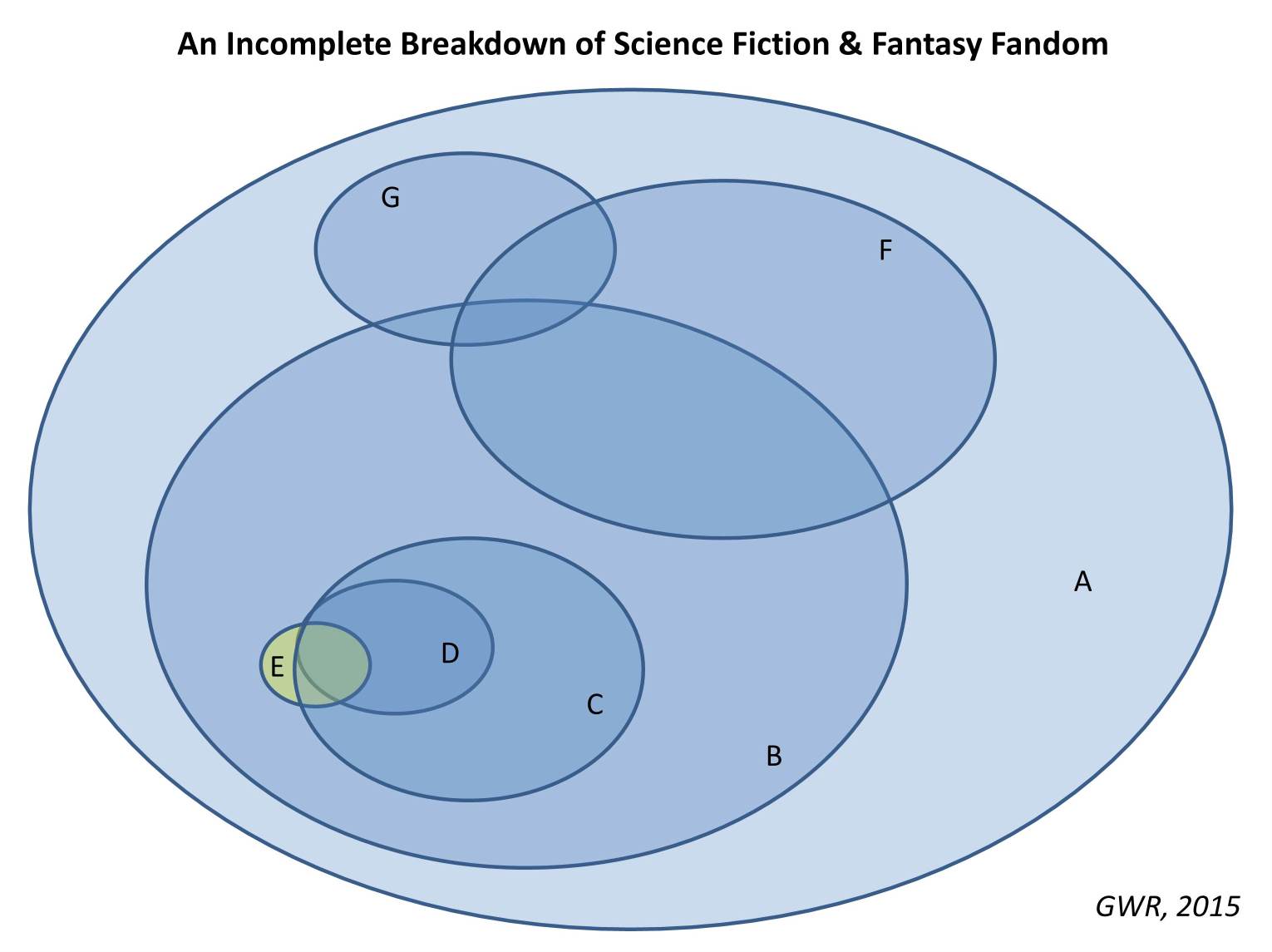
To the first question, my friend Brad Torgersen (who recently included a story of mine on the “Sad Puppies 3” slate of Hugo recommendations) used a Venn diagram (seen in this blog post) to illustrate the representational aspect of the Hugo Awards. Having thought about this for a while, I’d like to extend his diagram as follows:
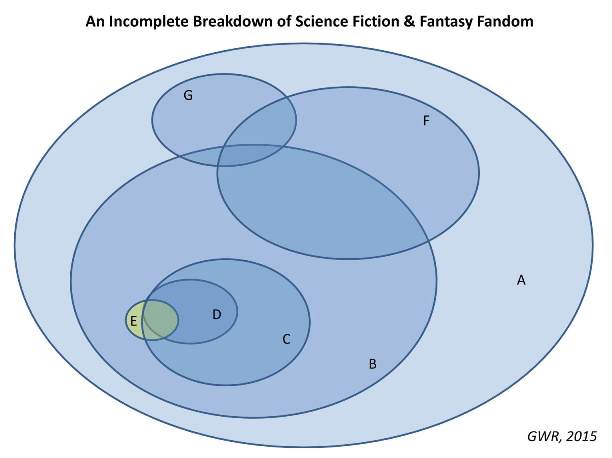

(SF&F Fandom Breakdown. Inadequate, I’m afraid, but a start.)

In my diagram, the ellipses correspond to:

  • A: Everyone who likes any kind of science fiction or fantasy story, whether presented as a movie, a TV show, a book, or in any other form
  • B: Those who consider themselves science fiction or fantasy fans
  • C: Those who attend SF&F conventions, whether general interest or fandom-specific
  • D: Those who attend the World Science Fiction Convention
  • E: Those who nominate or vote for the Hugo Awards — this ellipse extends beyond WorldCon because it includes “supporting members” who do not actually attend the convention
  • F: People who have heard of, but don’t care about, the Hugo Awards
  • G: People who, despite their consumption of science fiction or fantasy stories, would vehemently deny being science fiction or fantasy fans

I might have included people who have never heard of the Hugo Awards, if I could have figured out how to represent them. Also, I could have made the diagram more complete by trying to fit in SF&F professionals of one stripe or another, and even by trying to illustrate membership in the Science Fiction and Fantasy Writers of America and the nomination and voting for the Nebula Awards — but the picture seemed complicated enough so I stopped before it got too muddled.

At any rate, it should be clear that those who vote for the Hugo Awards are a small fraction of the “science fiction and fantasy community,” whether we consider that to consist of those who attend conventions or the larger group who consider themselves fans; indeed, Hugo Award voters are a miniscule portion of the very large group of occasional or even frequent SF&F consumers. Under the premise that the Hugo voting population has over time become less representative of the larger groups, one of the goals of the Sad Puppies campaigns has been to make ellipse E bigger by encouraging more people to become WorldCon members and to nominate and vote for their favorites.

We’ll return to this issue in a few moments.

For the second question — that of the merits of any single work compared to others — we should acknowledge that just as tastes differ from one person to another, tastes change over time. While I confess that my knowledge of the field’s history is lacking, I am given to understand that science fiction in particular used to be a literature of action as well as ideas, and that stories of characters’ accomplishments in the face of great peril or difficult moral choices were appreciated and honored. Thankfully, I can still find stories that depict moving encounters and risky endeavors; however, today those kinds of stories seem to garner less attention and fewer honors than (shall we say) more “refined” tales.

I, for one, do not seem to possess the sensibility to appreciate highly “literary” stories such as grew out of what was once considered the “New Wave” of science fiction, at least not to the degree that some of my friends seem to. Likewise, magical realism, avant garde, and “experimental” fiction leave me cold. I suppose my tastes are more pedestrian. For instance, I am unmoved by prose that is not narrative; no matter how brilliant or evocative the language is, if nothing happens in the text it will disappoint me and I will feel that the time I spent reading it was wasted. I more appreciate a story that involves interesting characters taking part in events that have consequences for themselves and others, that gives me the vicarious experience of escapades I will never attempt, in places I will never visit, with beings I will never encounter.

To select one example of how my tastes disagree with many of those who nominate and vote for the Hugo Awards, consider last year’s Nebula winner and one of the Hugo nominees for Best Short Story: “If You Were a Dinosaur, My Love.” Other than its lyrical quality, I found little to appreciate in it — and I confess to some confusion as to how it fit the definition of a story, since nothing much happens. It is barely a vignette, and since the science it discusses is all part of a “what if” postulation it seemed barely science fictional as well. If it were re-cast as “If You Were a Polar Bear, My Love,” it would carry the same emotional content and perhaps be more science fictional, since the bit about “reviving extinct species” would at least imply that it takes place in a future in which polar bears are extinct instead of the present when dinosaurs have been extinct for millions of years. In neither case would any clones have been created from extinct DNA, though, and the text would still be a stream-of-consciousness exercise in fevered imaginings rather than an actual story with characters who take actions and overcome obstacles in pursuit of particular goals. However, since that sort of thing apparently appeals to a significant cohort of SF&F fans, it might still be an award-winning “story” — though I wonder if an editor would have given either the real or this imagined version a second look if the author had been an unknown.*

While I am confessing my own literary shortcomings, I’ll add that such “stories” wear me out. When I finish reading one, I don’t feel the breathless exhilaration of stepping off a roller coaster, or even of dismounting a carousel; instead, I feel the out-of-breath exhaustion of setting down a snow shovel, or saying goodbye to unwanted houseguests. I wonder how many readers, upon completing some inaccessible text, think well of themselves for putting forth the effort, like feeling good for eating one’s peas, and transfer that feeling of accomplishment to the text when it comes time to nominate or vote for awards. I also wonder how many — some fewer, I’d wager — enthusiastically repeat the reading experience for the sheer joy of it, or go looking for seconds. And if a story does not induce a reader to read it again, or to seek out others like it or other works by the same author, can it truly be the “best” the field had to offer?

I acknowledge that stories that leave me empty may leave other people exhilarated, or inspired, or with some other positive feeling, and who am I to gainsay their opinions? So I am left to congratulate the winners — the “bests” — while I shake my head in wonder. I suppose that if a story that fit my preferences were to win, other readers would be able to find fault with it and shake their heads in wonder that anyone would select it. Such is the nature of all electoral contests.

Unfortunately for me, science fiction (and, to some degree, fantasy) literature has of late elevated the status of “literary” works while ignoring more action-oriented fiction; at the same time, sales of SF literature have either stagnated or declined. Correlation is not causation, however, so we cannot automatically conclude that the rise of “literary” SF has adversely affected overall sales. Other factors may be at play, such as the mainstream acceptance of technologies that were once the purview of science fiction, and thus the loss of appeal of technology-based stories; the declining confidence in the ability of science and engineering to solve pressing problems, likewise; or the migration of segments of the population who used to read for entertainment to other forms such as movies, television, and video games.

And that leads us back to the first question, whether the Hugo Awards adequately represent the preferences of the SF&F-consuming public.

If I had more free time, I might attempt a comprehensive statistical history of the Hugos. Maybe I can go back to school someday, pursue an advanced degree in the history of ideas, and write a thesis on the subject. For instance, I’d be interested in digging up the records starting with the first Hugos — when the best novel award, for example, went to The Demolished Man by Alfred Bester — and examining, year over year,

  • The complete voting results, both for nominations and awards, including numbers of nominations received and numbers of votes cast
  • The numbers of eligible works, e.g., how many science fiction and fantasy novels, etc., were published in the appropriate year
  • Reported sales figures for the nominated novels, both prior to and after their nomination and prior to and after the award announcement
  • Sales figures for other SF&F entertainments, e.g., box office receipts, for the same time period
  • Etc.

It might be interesting to examine other tidbits as well, like the numbers of ballots (nomination or voting) disqualified for any reason. Unfortunately, those kinds of figures may not even have been recorded.

Though I do not have actual figures to present, can we conjecture what they might be likely to show?

Over time, the percentage of novels receiving nominations would fluctuate, but we might expect it to be generally lower now as independent publishing has flourished in the Internet era. We might therefore expect the votes cast for, say, Best Novel to have declined as a percentage of total novel sales for any given year. If we could devise some estimate of genre consumption in the total SF&F community (ellipse A, above), we would certainly expect the vote ratios for Best Novel to have declined because of the permeation of science fiction and fantasy into the larger culture since the 1970s. If these expectations hold true, then it should be clear that the Hugo Awards today reflect only a tiny fraction of the SF&F community.

Is that, however, a status quo we should accept?

If we believe in science fiction and fantasy as worthy art forms, capable of helping us examine the human condition and cope with change in ways that other entertainments do not, then it seems that enlarging our community would be a good thing both from a pragmatic viewpoint — more customers can support more content producers — and from the standpoint of wanting to impact the world around us. To that end, encouraging people to support the World Science Fiction Convention and participate in nominating and voting for the field’s most prestigious award should be a good thing. I cannot think of a good reason for anyone to prefer for the field and its flagship award to be small and insular, because if that continues (and especially if the SF&F field shrinks too much) many more puppies of all breeds will be saddened.

It may be that what is needed is a new, more comprehensive award. I used to tell people that I thought of the Nebula Awards as equivalent to the Oscars and the Hugo Awards as equivalent to the People’s Choice Awards, but I think I was wrong in that assessment. It seems to me now that the Nebula Awards are more akin to the Screen Actors Guild Awards, the Hugo Awards are more akin to the Oscars (except that anyone can pay to participate in the Hugos), and that science fiction and fantasy do not have an award equivalent to the People’s Choice Awards. That discussion, however, will have to wait for another day.

Or maybe not. Even if awards multiplied like tribbles, they would still be only partly representative of the community as a whole. Those of us who nominate and vote will remain a self-selected cohort, and in the end the opinions we represent are only our own.

In closing, a personal note. I am neither the scholar nor the student of the SF&F field that I should be, but I respect it enough to have chosen it for my second career and I respect the Hugo Awards for their attempt to honor the best of the genre. And, yes, I would be quite pleased to count myself as a Hugo Award nominee or recipient. I imagine every author who has considered their work to be publishable and risked sending it to editors for possible rejection must at some time have thought of winning such an accolade, though some may not want the recognition (or the notoriety, as the case may be). For my part, I was quite happy when Brad Torgersen told me he was considering my novelette** for his slate of recommendations, if for no other reason than it meant that a few more people might read it than otherwise would. And if anyone liked my story enough to bestow on it a nomination, that would do my heart good.***

A final, really personal note. My blog posts are usually much shorter than this, and if you made it this far, and actually read this whole thing, I appreciate it. Thank you, sincerely, for your time.

___
*It may not be fair, but we (and by that royal “we” of course I mean “I”) do pay a smidgen more attention to works by authors whose names we recognize. We are, most of us, pretty human in that respect.
**Specifically, from the May 2014 issue of Orson Scott Card’s Intergalactic Medicine Show, “Ashes to Ashes, Dust to Dust, Earth to Alluvium.”
***I don’t have any illusions about actually winning. The one time an editor told me one of my stories was award-worthy it didn’t come close to making the list, and I can count on one hand, with fingers left over, the number of people who told me they nominated it.

___
RELATED POSTS ABOUT THE CONTROVERSY:
– From 2014, Larry Correia offers An explanation about the Hugo awards controversy
– Brad Torgersen, in January, Announcing SAD PUPPIES 3!
– Brad Torgersen presents his recommendations in SAD PUPPIES 3: the 2015 Hugo slate
– Brad Torgersen offers SAD PUPPIES: some responses to the fallout
– Larry Correia with a Sad Puppies 3 Update
– Sarah Hoyt discusses the matter at When Duck Noises Fail Me
– Brad Torgersen expounds on SAD PUPPIES: the march of the straw men

___
Edited to note that “If You Were a Dinosaur, My Love” won the Nebula and was nominated for the Hugo. I had mixed up its accolades. GWR

Facebooktwitterpinterestlinkedinmailby feather

My Friend Brad Torgersen Suggests One of My Works for Hugo Award Consideration

Award-winning author Brad Torgersen included my novelette, “Ashes to Ashes, Dust to Dust, Earth to Alluvium,” which appeared in the May 2014 issue of Orson Scott Card’s Intergalactic Medicine Show, as part of the Sad Puppies 3 campaign to encourage people to read and consider works that might otherwise be ignored.

I like the crew-patch-style logo:


(Sad Puppies 3 logo.)

Some Background, if You Need It. If you haven’t been following the recent controversy surrounding the Hugo Awards — and if you’re not a convention-going science fiction and fantasy fan, why would you? — bestselling author Larry Correia started the “Sad Puppies” campaign two years ago as a reaction to the tendency for the major genre awards to ignore (if not actually shun) popular works by conservative authors, with the result that nominees often represented highly “literary” works that were experimental or edgy or otherwise inaccessible to wide audiences, or “message” fiction that seemed more concerned with waving the flag for progressive issues than with being entertaining. In addition, there had there been reports of authors being blackballed and suspicions of vote-tampering by World Science Fiction Convention staff members.

Larry, who plied his trade as an accountant and auditor before he started writing full-time, saw that the threshold for making the Hugo ballot was relatively small — as low as a few dozen nominations in some categories — and encouraged people to nominate specific works. By comparing the numbers of people who reported their nominations to him with the figures reported by WorldCon, Larry showed that accusations of fraud were unfounded. The nomination and voting processes appeared to be operating above-board, which speaks well for the volunteers who organize and staff the conventions.

Tongue-in-cheek, Larry called his program the Sad Puppies campaign because some people love to be part of causes on behalf of the downtrodden. He wrote that

The ugly truth is that the most prestigious award in sci-fi/fantasy is basically just a popularity contest, where the people who are popular with a tiny little group of WorldCon voters get nominated and thousands of other works are ignored. Books that tickle them are declared good and anybody who publically deviates from groupthink is bad. Over time this lame ass award process has become increasingly snooty and pretentious, and you can usually guess who all of the finalists are going to be that year before any of the books have actually come out or been read by anyone, entirely by how popular the author is with this tiny group.

This is a leading cause of puppy related sadness.

Of course anything that is voted on is de-facto a popularity contest, and the fact is what I like may not be popular with very many people. The only way to make your vote count is to actually vote, and in the case of the Hugo Awards, not all of the people who buy books are interested in buying convention memberships or voting for awards. So it is that, just as with film awards in which movies that do well at the box office are often overlooked during award season, authors who are popular enough to sell thousands if not millions of books are often shut out of what has long been considered the premiere science fiction award.

Back to the Main Topic. I very much appreciate Brad including my story among his recommendations. You can see all of his suggestions at the Sad Puppies link at the top, where he wrote that he is carrying on the campaign to recognize

entirely deserving works, writers, and editors — all of whom would not otherwise find themselves on the Hugo ballot without some extra oomph received from beyond the rarefied, insular halls of 21st century Worldcon “fandom.”

Which is where YOU guys come in. Everyone who’s signed up as a full or supporting member of either Loncon 3 (last year’s Worldcon) or Sasquan (this year’s Worldcon) or MidAmeriCon II (next year’s Worldcon). If you agree with our slate below — and we suspect you might — this is YOUR chance to make sure YOUR voice is heard. This is YOUR award (as SF/F’s self-proclaimed “most prestigious award”) and YOU get to have a say in who is acknowledged.

I’m pleased that he considers my little story to be deserving! And even if folks find other novelettes to nominate, I’m pleased that some more people might read it now who otherwise may not even have heard of it.

If you’d like to read “Ashes to Ashes, Dust to Dust, Earth to Alluvium,” here’s a link to it on the IGMS site.* Hope you like it!

___
*If you can’t afford to buy the online magazine and still want to read the story, drop me a line and I’ll see about getting you a copy.

Facebooktwitterpinterestlinkedinmailby feather

What Do YOU Think is the Best Time-Related Filk Song?

This post is part 2 of a 2-part series related to the 2015 Pegasus Awards. You can read the first post at What Do YOU Think is the Best Adapted Filk Song?

Looking for more of your suggestions!

Pegasus Award Logo

As noted in part one, my first request for suggestions, the Pegasus Awards honor science fiction and fantasy-related music, and each year the organizers select two special categories for awards. This year the second of the special categories is the “Best Time-Related Song.”

Like the “Best Adapted Song” category, this one is wide open for nominations because the songs can “focus on anything related to time.” The Ohio Valley Filk Festival organizers picked the category because 2015 is OVFF’s 31st anniversary, and the 31st wedding anniversary is the timepiece anniversary.

The problem I’m running into is that I’m finding it hard to come up with time-related songs! So, a question for you: what do you think is the Best Time-Related Filk Song?

At present, I’m considering nominating:

  • “Beer-Powered Time Machine” by Mikey Mason
  • “Find Forever Gone” by Bella Morte
  • “One More Time” by Michael Longcor
  • “Welcome to the Age of Steam” by Jonah Knight
  • “’39” by Brian May / Queen

Can you think of other time-related songs I should consider for this category? You can actually suggest your own slate to the entire filk community by filling out the Pegasus Award Brainstorming Poll.* But at the very least, send me your suggestions!

___
*As always, if you’d like to hear some of my songs to consider, let me know. We’ll find a way to make it happen.

Facebooktwitterpinterestlinkedinmailby feather