Courtesy of Mark Hosford at Sugarboy Press:

(Please dismount your tauntaun sign by Mark Hosford.)
You can see more of his work here.
This public service announcement was brought to you by your local Tauntaun dealer. Get yours today!




 by
by 


Courtesy of Mark Hosford at Sugarboy Press:
(Please dismount your tauntaun sign by Mark Hosford.)
You can see more of his work here.
This public service announcement was brought to you by your local Tauntaun dealer. Get yours today!
by Today is my last day on the Industrial Extension Service staff, and it seemed appropriate to mark the day with the first “workplace ‘filk'” I wrote there, simply entitled “The I-E-S Song.”
I started in January 2008 as primarily the speechwriter for the Executive Director, and I filled my time between speeches with other — primarily marketing-related — writing and editing assignments. But along the way I had the opportunity to do a few unique and interesting things:
And along the way I wrote a few songs: “The I-E-S Song” in 2008; “The Economic Recovery Blues” and “Oh, How I Hate Groupwise” in 2009; “The 1B4NC Song,” “We Know Manufacturing Makes It Real” in 2010; “If You Want to Get Better” and “The Old, Old Days of Industry” in 2011; and “Dirty, Sexy Manufacturing” in 2012.
Note that none of my work-related songs made it onto my album, Truths and Lies and Make-Believe. The audience for my music is already pretty small, but the audience for workplace songs in particular is tiny.
Anyway, I wrote a little rhyme to mark my departure, too.
It’s been fun
I had a good run
And now I’m done.
Fare thee (or, fare me) well.

 by
by As the “Best Related Work” for the Hugo Awards, that is.
(FULL DISCLOSURE: I’m a Contributing Editor for Baen Books and have been on the Baen Free Radio Hour podcast. But so what? It’s related to science fiction and fantasy, so go ahead and nominate it!)
You have other choices, too, of course, if you’re nominating for the Hugos — but the good thing is that you can nominate more than one thing!
For instance, you could nominate the Monster Hunter International Employee’s Handbook and Role-Playing Game. That was a very successful Kickstarter project run by Steven Long. And if you hew to a rather expansive definition of “related work,” you could always nominate a certain science-fiction-and-fantasy-related album.
But whatever you do, do it soon! The nomination deadline is coming up fast.
___
P.S. This post was all about the “Best Related Work” category, but I’ll just add that I also have a novelette you could nominate if you have an empty slot in that category. “What is a Warrior Without His Wounds?” was in the July 2013 issue of Asimov’s. I can even e-mail you a copy if you like. GWR

 by
by Do you like comedy music? Would you like to nominate a funny song for an award?
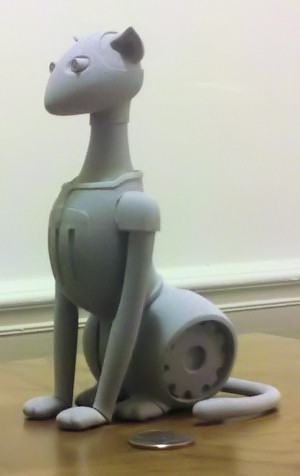
(The “Robot Cat” statuette, designed by artist Jamie Noguchi in honor of Logan Whitehurst’s song “Robot Cat.”)
The Logan Whitehurst Memorial Awards for Excellence in Comedy Music are presented by The Funny Music Project. The Awards will be selected by a jury and presented at “FuMPFest 2014” in Chicago, hosted by Dr. Demento.
The FuMP has presented the Logan Awards since 2011 for
If you want to nominate a song released in 2013 for the 4th Annual Logan Awards, use this handy nomination form. You can also see what songs have already been nominated.
The web site doesn’t say when the nominations will close, so nominate while you can — early and often!

 by
by Now THERE’S a headline I never thought I’d write, and I get to do it courtesy of Dr. Demento!
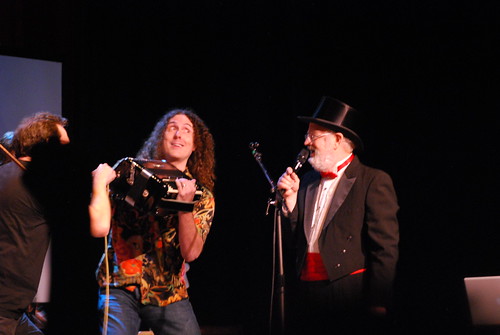
(“Weird Al” Yankovich and Dr. Demento. Photo by Genevieve, from Flickr under Creative Commons.)
I felt as if I was levitating when I learned that two — not one, but TWO — of my songs had been played on The Dr. Demento Show since the beginning of the year. (Sure, since then other things have brought me down, but when I think about this it still puts a smile on my face.)
“Another Romulan Ale” seems like an appropriate song for New Year’s, and Dr. Demento played it on his first show of 2014. And, sure enough, Frank Zappa and “Weird Al” Yankovich were on the playlist — along with Cheech & Chong and Bob Dylan. Quite a group!
Then on the 1st of March the Dr. did a show focusing on music related to science fiction:
This week Dr Demento presents The History of Science Fiction in Song…from “Stardrek” and “Banned from Argo” to “Tauntauns to Glory” in 80 minutes…plus “We Won’t Give ‘Em Sex,” “Winestoned Plowboy,” “There’s a Baby On the Plane”, more.
Folks familiar with science fiction and fantasy music (a.k.a. “filk”) know that “Banned from Argo” is arguably the most famous filk song of all time. So it’s one thing for Dr. Demento to decide to play “Tauntauns to Glory,” but for him to list it in the show description in the same breath as “Banned from Argo” … that took this whole experience over the line into surrealism, even before I realized I was on the playlist again with “Weird Al,” this time plus Devo, Nat “King” Cole, Frank Hayes, and Leslie Fish.
So, yeah, good times!
If you like “Romulan Ale” or “Tauntauns” or some of the other songs from Truths and Lies and Make-Believe, and think Dr. Demento should play more of them, he has a song request form you can fill out. That would be cool, or I’d be much obliged if you would post a review on Amazon or iTunes or CD Baby or elsewhere. That would be awesome!
Meanwhile, as the Dr. would say, stay “deeeee-mented”!

 by
by Wow, it’s already been more than a week since MystiCon! I can’t keep track of the days these days.

Anyway, a couple of weeks ago I trekked northwest to Roanoke, Virginia, for MystiCon, which in just a few years has become one of the hottest small convention tickets in the Southeast. The 2013 convention sold out during the event, and the 2014 convention sold out before it even started!
All of my panels went well. Author Guest of Honor Todd McCaffrey led a half-dozen of us through a humorous “Delphic Oracle” exercise in which we had to formulate answers to the audience’s questions but each of us could only say one word at a time. The “Science of Star Trek” panel I moderated covered a vast array of real and imaginary technology, though I was disappointed that Media Guest of Honor John De Lancie had not been scheduled to join us.
My reading was enjoyable for me, and presumably for my audience since they did not run screaming into the hallways. I mixed a few songs with the opening of my story “Lightweaver in Shadow,” which will appear in a Baen Books anthology this November. The Baen Traveling Road Show went as expected, though I wished it would have had a look at the cover art for that anthology.
The Baen Barflies organized a little soiree in the ConSuite on Saturday night, and Speaker-to-Lab-Animals invited me to bring my guitar — so I debuted my new song, “The Books We Call Baen” (sung to the tune of “The Hero of Canton”). It went over pretty well, and I followed up with a couple other filk songs including “The Monster Hunter Ballad.”
I had time to take in a couple of panels, including a songwriting panel with Bella Morte, and enjoyed several conversations with friends old and new. Finally, I found Sunday’s self-promotion panel to be interesting and a bit liberating, since I still cringe from time to time whenever I veer too close to crass commercialization.
Speaking of crass commercialization … I also sold a few copies of my CD. So, all in all, a good trip and another resounding success for the convention staff. Great work, everyone!

 by
by Next week I’ll head to Roanoke, Virginia for the MystiCon science fiction and fantasy convention.
On Friday, 21 February, I’ll be on a panel called “The Delphic Oracle” with author Guest of Honor Todd McCaffrey and some other good folks.
The Delphic Oracle is an improv-based panel wherein the panelists, one word at a time, one person at a time, answer the audience’s questions about the future (or summer camp) in an irreverent homage to the ancient Oracle of Delphi. Hilarity invariably ensues.
Saturday the 22nd will be a busy day. First up is “The Science of Star Trek” panel, with Baen Books author and editor Tony Daniel, et al, which I will moderate.
Star Trek props and gadgets are now a part of our real lives. You can see the influence of Star Trek communicators, daily logs and tricorders in the modern cell phone and tablet designs. Even the ability to replicate objects is becoming a reality through 3-D printing. Why has Star Trek influenced technological advances and what’s the next to become reality?
After that I’ll have a “Koffee Klatch” — reading a story, singing a song, talking with anyone who comes by — then in the afternoon we’ll have the “Baen Traveling Road Show & Podcast” featuring author Tom Kratman.
On Sunday I’ll be on a panel with Gail Z. Martin and other authors called “Tooting Your Own Horn.”
Done properly, self-promotion is an important part of building a career. Poorly executed, self-promotion can do more harm than good. Our panelists will discuss what works and doesn’t work along with these common questions: Do book signings really help a small author? Are bookmarks and/or postcards effective at garnering attention? Does a blog help or hurt an author? Does an author have to have a website?
Hopefully amidst all that we’ll have some folks interested in filking, and as always I’ll have a few copies of my CD for anyone who wants to buy one (or more than one!). And, since it looks as if we’re due for a warm-up over the next few days, my travel back-and-forth should be fairly easy.
If you’re going to be at the con, look me up!

 by
by Last Friday my Lord of the Rings-inspired song, “Mortal Men,” was played on the Baen Free Radio Hour, and two weeks before that the podcast included my song, “Steampunk Pirates.”
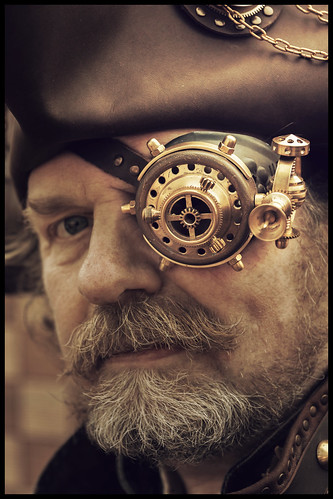
(Image: “Steam Monocle,” by -=Kip=-, on Flickr under Creative Commons.)
If you want to listen:
BFRH 2014 02 07: Sharon Lee and Steve Miller, David Weber’s Shadow of Freedom Part 47
Sharon Lee and Steve Miller discuss A Liaden Universe® Constellation Volume 2; “Mortal Men,” a song from Gray Rinehart; and David Weber’s Shadow of Freedom Part 47
BFRH 2014 01 24: Ring of Fire author Iver P. Cooper, David Weber’s Shadow of Freedom Part 45
Ring of Fire alternate history series author Iver P. Cooper discusses his new novel 1636: Seas of Fortune; Gray Rinehart’s “Steampunk Pirates”; and David Weber’s Shadow of Freedom Part 45

 by
by Strictly out of ego-boosting curiosity, if you happen to put one of my stories into an otherwise-unused spot on your Nebula or Hugo Award nomination form, I’d be interested to know about it.

(My best story of 2013 was in the July issue of Asimov’s.)
For readers who don’t follow the science fiction and fantasy field, the Nebula Awards are roughly equivalent to the Oscars or the Grammies, while the Hugo Awards correspond more to the People’s Choice Awards. Nebula nominations are due this Friday, and Hugo nominations are due the end of next month.
Of my eligible fiction published last year, I think my best story was definitely the novelette, “What is a Warrior Without His Wounds?”, which appeared in Asimov’s Science Fiction in July. It’s the story of a double amputee given the chance to have a whole, healthy body again — but at a terrible cost. (I also published two short stories last year: “A Star That Moves,” in LORE in April, and “The Entropy Box,” published in October in the Writers for Relief III anthology edited by Davey Beauchamp and Stuart Jaffe. Of the two, I think “A Star That Moves” is better.)
Of course, my other creative pursuit of 2013 was Truths and Lies and Make-Believe, but there’s no music category for the Nebulas or the Hugos. However, if you suggest any of my songs for a Pegasus Award I’d be interested to know that, too.

 by
by A few days ago, when I posted a reminder about nominating and voting for the Hugo Awards,* a friend asked if my album was eligible in the “Best Related Work” category.
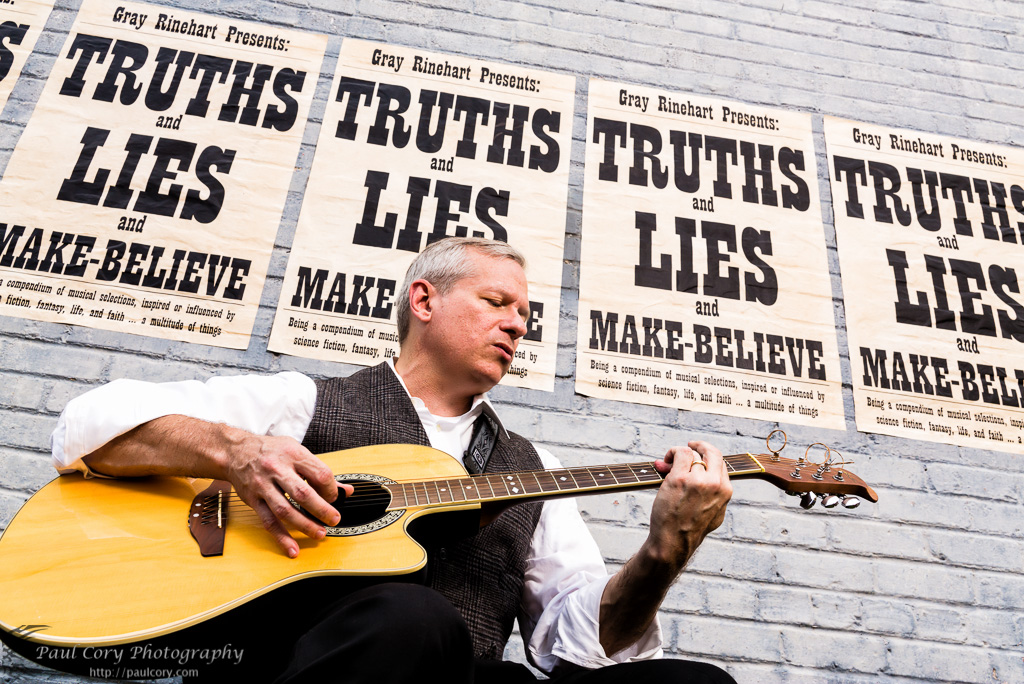
(Image by Paul Cory Photography.)
The answer, I’m afraid, is no.
At first glance it seemed as if Truths and Lies and Make-Believe (or one of the songs) might be eligible, since most of the songs on the album are science fiction or fantasy-related. The World Science Fiction Society constitution defines “Best Related Work” as
Any work related to the field of science fiction, fantasy, or fandom, appearing for the first time during the previous calendar year or which has been substantially modified during the previous calendar year, and which is either non-fiction or, if fictional, is noteworthy primarily for aspects other than the fictional text, and which is not eligible in any other category.
“Any work related to the field” might seem to include music, but I don’t usually think of music as “non-fiction” or “fictional.” So I looked around some more and found that over at the Hugo Awards site, the category description adds this:
The type of works eligible include, but are not limited to, collections of art, works of literary criticism, books about the making of a film or TV series, biographies and so on, provided that they do not qualify for another category.
By “collections of art,” they seem to mean printed volumes of visual art — collections of music or other arts apparently need not apply. There is that magic “not limited to” phrase, though, and the award is no longer limited to printed books, having gone last year to the Writing Excuses podcast that some of my friends put together. The Wikipedia entry explains the history.
The award was originally titled the Hugo Award for Best Non-Fiction Book and was first awarded in 1980. In 1999 the Award was retitled to the Hugo Award for Best Related Book, and eligibility was officially expanded to fiction works that were primarily noteworthy for reasons besides their fictional aspects. In 2010, the title of the award was again changed, to the Hugo Award for Best Related Work.
Looking over the list of nominees and winners, it appears that science fiction and fantasy music — known in the community as “filk” — has never been considered as a “related work” for the purpose of the award. Which makes me wonder what would happen if enough fans put in nominations for music, since the Hugos are fan-based awards; since the award is no longer limited to printed works, would the Hugo committee honor those nominations, or would they disqualify them? Unfortunately, I don’t have enough fans to test that hypothesis in the manner of Larry Correia’s Sad Puppies Campaign.
So, strictly speaking, neither my album nor my songs would be considered “related works.” But if you decide to write in one of my songs anyway, let me know!
___
*Want to Nominate and Vote for the Hugo Awards?

 by
by