Human Rights Are Individual Rights

Sometimes it’s necessary to state the obvious, so here goes: People will not read this post, though a person might.

You can probably already see where I’m going with this. So let’s go there.

People — collectively — will not read this. Individual persons — singular people — might. (One possible exception is if a person were to read the post aloud to someone else, or even to an assembled group of people, but how often does that happen in the modern world?)

This idea of singularity rather than plurality applies regardless of demographic. Black people will not read this post, though a black person might. Ditto for white people, or any other racial label you might apply. Rich people will not read this post, though a rich person might. Et cetera.

My point here is that we make a mistake when we talk about “people” collectively, as if they are cells operating together in a huge body instead of entities operating individually as persons. It’s a failure of language, and maybe a failure of perspective.

We make the mistake whenever we lump people together into groups, especially groups we want to criticize or lionize: Democrats and Republicans; Christians and atheists; Carolina fans and Clemson fans (!). It is easier to treat them as groups we can point at as if “they” were amoebic, single-minded masses instead of individuals with their own attitudes, abilities, and dreams. (“They” collectively — and “we” collectively — make it hard when some individuals come together to make trouble, whether as not-so-peaceful protesters or sports hooligans, but even then some individuals stand apart and aloof, separate from the mob, and deserve not to be lumped in with the troublemakers.)


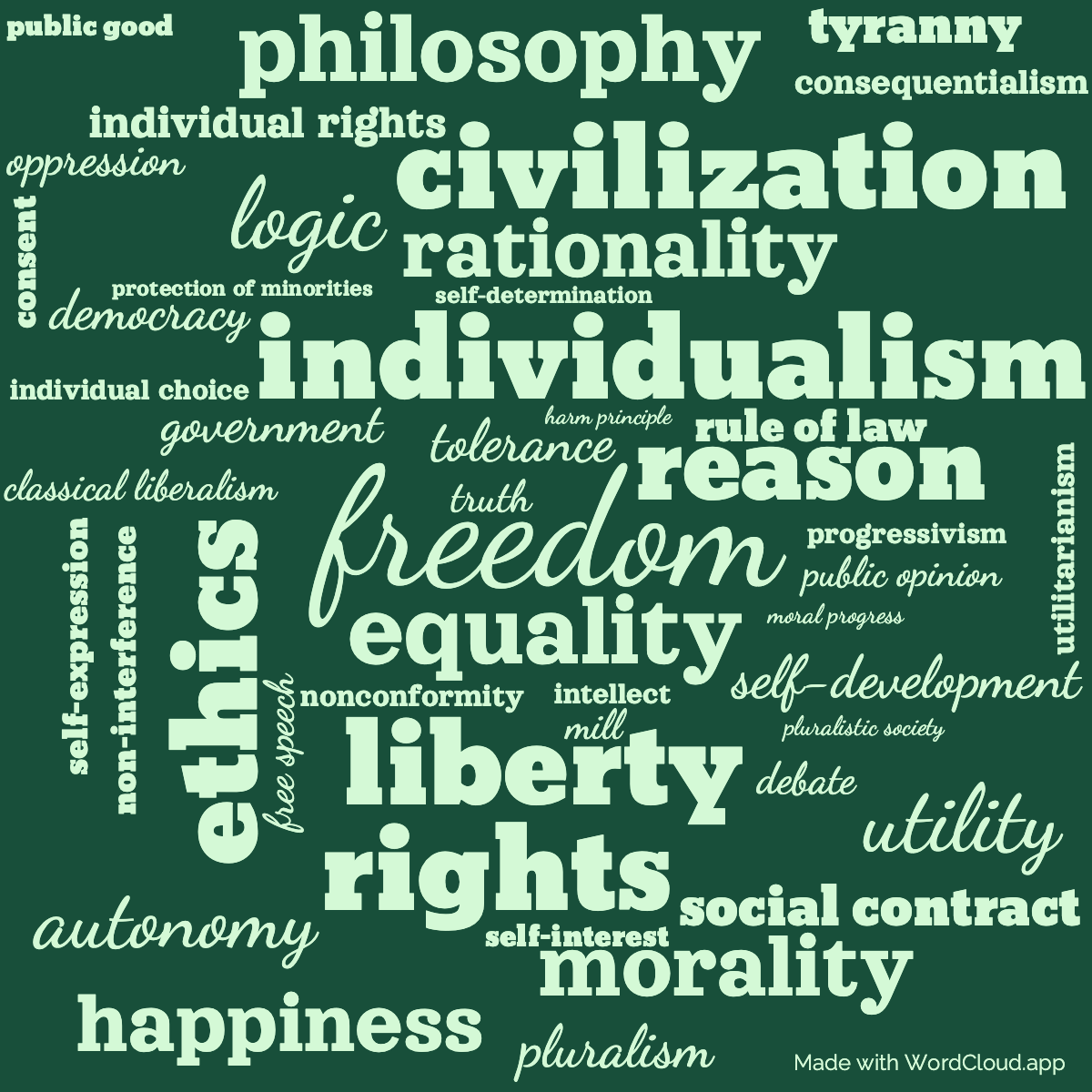
(Image: Word Cloud, “On Liberty by John Stuart Mill: An Important Book for Intellectual Thinkers,” by _, on WordCloud.app.)

Finally, now to the point of this post: Yes, we make a similar mistake with respect to rights. People do not have rights, though persons might. Groups do not have rights, only the individuals within those groups.

Why? Because rights are exercised individually, they belong to individuals. We err when we overemphasize rights with respect to groups and neglect the individuals who make up those groups. We can end up diluting those rights, acting as if they are only spread across large populations rather than held by singular people, and that is a dangerous step toward overlooking and even removing those rights.

Let’s not go down that road.

___

Maybe none of this needed to be said, but it’s done now. For other musings and oddball ideas,
– Take a look at A Church More Like Christ, awarded a Silver medal by the Military Writers Society of America
– Or explore my other MWSA Silver medalist, Elements of War
– Or even subscribe to my newsletter (and get some free gifts)

Facebooktwitterpinterestlinkedinmailby feather

Yearning to Breathe Free?

Most everyone in the United States and very many people in the world are familiar with the inspiring lines inscribed on a plaque in the pedestal of the Statue of Liberty:

Give me your tired, your poor,
Your huddled masses

The phrase comes from Emma Lazarus’s poem, “The New Colossus.” I’ve noticed that a few people seem to treat the poem as if it expresses some official policy of the USA, but it does not; it was written as part of a public effort to raise money to build the statue’s pedestal. And from some of the recent rhetoric about immigration, it seems that a few people leave out an important clause, treating the lines as if the statue is said to be welcoming any and all tired, poor, huddled masses as opposed to those “yearning to breathe free.”

It seems, then, that we need to re-emphasize that part.

First, what does it mean to yearn? Most of us know this in our bones, because we do so even if we may not use the word. We all have (or have had) things we yearn for, important things we earnestly desire with a depth so profound that to fail to achieve them would be a fate nearly as dire as death. Perhaps we yearn for love, or success, or a peaceful existence, but whatever it is, we wish for it with all our heart even if it may be beyond our reach.

Then what does it mean, really mean, to breathe free? Is it simply to be liberated from whatever persecutions or hardships we face, to be even momentarily out from under the boot of oppression or poverty or disease? Not quite. Temporary release would be a reprieve rather than a life. Breathing free may at first come by escaping from a previous situation, but continuing to breathe free comes at the price of the effort to maintain that freedom.

Yearning to breathe free, then–and particularly yearning to keep breathing free as time goes on–means not only the earnest desire to achieve freedom but also the deep commitment to hold on to and support that freedom by will and effort. I don’t pretend to know the situations of everyone, but that commitment seems to be lacking in some of the tired and poor who behave as if coming here is supposed to automatically and immediately confer rest and riches, as if the Declaration of Independence said happiness is to be granted rather than pursued. Admittedly, that same commitment seems to be lacking in some of those born here, who behave likewise as if they expect and are entitled to a lifetime of breathing free. Yearning to breathe free is not a wish to be released from toil, but a wish to enjoy the benefits of one’s toil; not a wish to be subjugated to a life of dependence on others, but a wish for a life of opportunity to survive … and maybe even to prosper.

How about you? Do you yearn to breathe free? If so, I bet you know that it entails more than just wishing for liberty: it requires working for it.


(Image: The Statue of Liberty, by AskALotl, on Wikimedia Commons.)

___

I would be remiss if I did not present the full poem, which contrasts the then-to-be-erected Statue of Liberty with the classical Colossus of Rhodes. It is in the public domain, and is deserving of close study:

Not like the brazen giant of Greek fame,
With conquering limbs astride from land to land;
Here at our sea-washed, sunset gates shall stand
A mighty woman with a torch, whose flame
Is the imprisoned lightning, and her name
Mother of Exiles. From her beacon-hand
Glows world-wide welcome; her mild eyes command
The air-bridged harbor that twin cities frame.

“Keep, ancient lands, your storied pomp!” cries she
With silent lips. “Give me your tired, your poor,
Your huddled masses yearning to breathe free,
The wretched refuse of your teeming shore.
Send these, the homeless, tempest-tost to me,
I lift my lamp beside the golden door!”

It’s a wonderful sonnet, and I appreciate Ms. Lazarus’s turns of phrase (especially “imprisoned lightning” to describe electricity). I may have read more into it than Ms. Lazarus intended, but that’s what we do with all writings, from the Bible to blog posts: interpret them in our own ways, and read between the words and lines for what they mean to us.

In the end, I wish for us all the opportunity to continue to breathe free.

Facebooktwitterpinterestlinkedinmailby feather

Home of the Scared

If I had a magic wand, I would make you less afraid. Not foolhardy, just less apprehensive of the world and the people around you.

I grew up learning that fear was a thing to be conquered, not a thing to which we should capitulate. FDR, for all his faults, famously said, “The only thing we have to fear, is fear itself.” Frank Herbert gave us the “Litany Against Fear” in his novel, Dune: “Fear is the mind-killer…. I will face my fear.” Yet, somehow, instead of learning courage in the face of fear, many people today seem to have become paralyzed by fear.

Some claim to be tolerant of others but demonstrate fear of opposing ideas when they shout down anyone who disagrees with them. Some claim to “speak truth to power,” but cower in “safe spaces.” And now, many not only hide away in fear of the SARS-CoV-2 virus but they demand that others sequester themselves as well. Fear has led some of us to become subjects of the state moreso than citizens of it: subject to the state, happy to trade our freedom for a little security … or the illusion of security.

Leaving off for the moment the unfortunate fact that some people regard the entire song as problematic, have we reached the point where these United States need to replace the last line of “The Star-Spangled Banner”?

In some respects, we reached that point a long time ago.
fear
(Image: “fear,” by Sean MacEntee, on Flickr under Creative Commons.)

This diatribe against fear, for instance, has been percolating in my brain for over a decade as I observed us, as a society, growing more and more fearful.

A dozen years ago, I read a book review entitled “Mill is a dead white male with something to say” in which Tessa Mayes interviewed Richard Reeves, a biographer of philosopher John Stuart Mill. The review began,

‘Harm’ is a political buzzword of our age. The spectre of harm is used to justify smoking bans in public places (to protect people from the harm of smoke), ‘anti-stalking’ measures against people who get involved in shouting matches with their partner or a workmate (in the name of protecting individuals from ‘emotional harm’), censorship (offensive words are said to ‘harm’ our self-esteem) and opposition to consumerism (apparently it ‘harms’ the environment).

All sorts of activities, from boozing to gambling to sexual relationships, are now said to involve harm – either to the person carrying them out or to people caught up in these whirlwinds of harmful behaviour. And thus, it is argued, government intervention into these intimate areas of our lives is not only justifiable, it is necessary.

To that list, we may now add such things as trading in non-state-approved items, traveling to non-state-approved places, congregating with non-state-approved people, and so forth.

The review pointed out that Mill

had a view of men as capable and energetic, who, when given the chance, could progress to become serious and even ‘heroic’ individuals. Thus, he had a quite narrow view of harm: in his view, it would take quite a lot to harm individuals who were possessed of free will and very often grit, and therefore he argued that only clear cases of harm could justify restrictions.

Today, by contrast, individuals are viewed as weak and vulnerable. The term ‘the vulnerable’ is used to refer to whole swathes of society. We are considered to be easily damaged and fragile creatures who must be mollycoddled by political leaders, social workers and health practitioners in order to keep our self-esteem intact. So almost everything is seen as ‘harmful’ to us today.

And how much more so when faced with something like SARS-CoV-2 that is demonstrably harmful? Something that mathematics predicted would harm millions, most especially “the vulnerable”?

It was not deemed sufficient to erect barriers to protect the “easily damaged and fragile” among us — the elderly, the infirm — when it seemed that medical facilities would be overrun with patients. Instead, political leaders and especially the media turned to a suasion tool that has proven far too useful: fear. Not that the fears associated with the SARS-CoV-2 virus were especially new. Fear was already rampant in our risk-averse society, albeit at something of a maintenance level, in terms of how tentative many people have become in their day-to-day lives. But people with vested interests applied the scary virus as if it were gasoline to more general fears that have smoldered for years. Carefully constructed and almost constantly negative reporting about the virus magnified those fears into quiet terror.

And people who are frequently (if not constantly) afraid are not likely to object to limitations on their liberties.

The difference between Mill’s view of harm and the popular view of harm today is the difference between a view of mankind as generally good and capable of freedom, and a view of mankind as weak and degraded. So where Mill emphasised the necessity of liberty, today many officials and commentators talk about the ‘dangers of unadulterated liberty’.

For Mill, any half-decent conception of the state had to be considered in line with individual liberty and social progress. As he writes in On Liberty: ‘A State which dwarfs its men, in order that they may be more docile instruments in its hands even for beneficial purposes, will find that with small men no great thing can really be accomplished.’

But why are we so afraid?

I submit that many of us are afraid because we abandoned faith. By abandoning faith, we abandoned hope in an afterlife, and by abandoning hope in an afterlife, we have come to fear death itself as the ultimate evil. Not to have a healthy respect for death, not to disdain it and to seek to postpone it because life itself is grand and glorious, but to fear it above all things.**

In his book The War of Art, Steven Pressfield noted that the Spartan King, Leonidas, said the highest virtue of a warrior was “contempt for death.” To count death as nothing, as unworthy of notice even though it is inevitable. Why is that important? Because if you don’t fear death, you won’t fear much of anything; in contrast, if you fear death too much, you will fear practically everything.

You may not admit it. But every fear stems from the fear of death. Believing in an afterlife is the surest way to overcome that fear, and such belief was the root of the fearlessness of mankind throughout history. But when more and more people began to disbelieve in an afterlife, once they came to fear death and to dread the very idea of it, they naturally began to shy away from anything too risky.

And those who deeply fear death do not understand those with contempt for it.

Not everyone can muster true contempt for death, can master that ultimate fear, but that ability in the face of predatory threats made relationships and status and roles much clearer in the past. We lack that kind of tangible threat these days. The SARS-CoV-2 virus, as dangerous as it is, does not pose such a threat — if for no other reason than that we cannot sense it directly.

When predators lurked outside, when their eyes shone in the dark beyond the firelight, when the dawn revealed the blood and mutilated corpses of the unwary, the weak and fearful naturally appreciated the strong and brave. We have been so long without a real existential threat that the weak have become less fearful, and the strong seem to have become less necessary. Some of the strong and good still protect the tribe, and we ought to be thankful for them. But we seem to have reached the point that the weak have grown comfortable enough that they feel justified in mocking the strong. That, I suppose, they may consider enlightenment.

Many years ago a popular brand of clothing featured the words “No fear.” That sentiment is lacking these days. Not only does almost everyone seem to be afraid, but many of us express our fears quite openly and surround ourselves (virtually) with those who share or at least bolster our fears. In some respects we appear to be a generation steeped in fear — and whereas our society used to wrestle with tangible fears like those of nuclear annihilation, we have given free rein to so many ephemeral fears that now a moderate danger like SARS-CoV-2 has brought some people to the point of near panic.***

Previous generations cultivated what the British called the “stiff upper lip,” but today we might well be a culture of quivering lips. Perhaps rather than the age of information, what we live in is the age of angst. Enemies need not bother terrorizing us anymore. We are already afraid. Not all of us, necessarily, but enough of us.

And, as I said at the start, if I had a magic wand to wave, I would use it to decrease our collective fear so we might once again lay claim to being the “land of the free, and the home of the brave.”

___
*It is probably prudent to note that some people have been laying claim to rights without any emphasis on assuming the responsibilities that go with those rights. But, that’s a topic for another post.
**I recognize some degree of irony in my talking so blithely about death and having contempt for it, while still subject to deep and sometimes soul-wrenching grief.
***In a future post, I hope to look at the SARS-CoV-2 virus through the lens of risk management, in hopes of showing that there is less need for panic than some people think.

___
P.S. While on the subject of the virus, don’t forget to order your Proximity Avoidance T-Shirt….
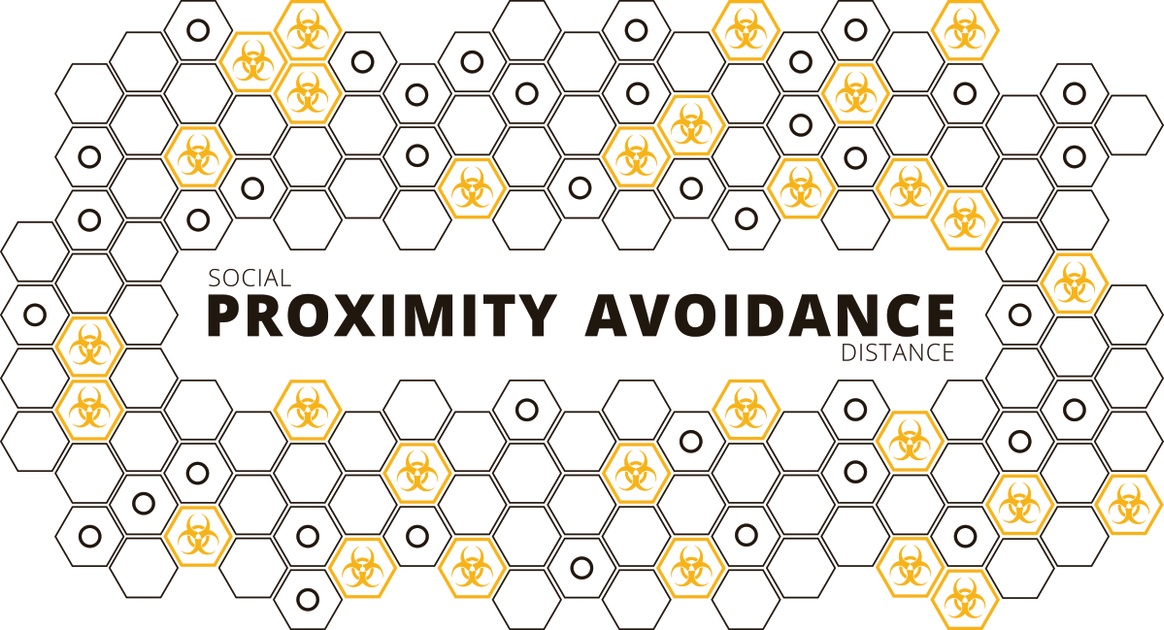
(Proximity Avoidance logo, designed by Christopher Rinehart.)

Facebooktwitterpinterestlinkedinmailby feather

Maybe We Need a Freedom Gauge

I had the idea, probably months ago now, and set it down in my long list of strange, passing thoughts, for something called the Freedom Gauge, or Freedom Meter. I think that might be helpful in making political decisions and informing political opinions.

Why? Because, at root, every government restricts citizens’ freedoms in some way(s) — after all, we accept certain limitations on complete, anarchic freedom as part of the social compact — and every law that is passed curtails some freedom(s). The question is, how much?

My first thought was that of being a watchdog over legislatures so that, in the process of new laws being proposed, debated, and enacted, the bills’ effects on personal freedom might be shown on the Freedom Gauge. Different legislative proposals could be compared in terms of their “Freedom Quotient” or something. The idea was to present in graphical form how much particular legislation would curtail freedoms. (And, in a flight of the wildest rose-colored-glasses fancy, I thought legislatures themselves might make use of the gauge to show how little impact their proposals would have on the average citizen.)

Hypocrisy Meter, Pegged
Yes, something like that … (Image: “Hypocrisy Meter, Pegged,” by Kaz Vorpal, on Flickr under Creative Commons.)
My second thought was an international comparison of some sort: a monitor of the freedom(s) afforded — or denied — by different countries. Basic data might come from the CIA World Factbook or other trustworthy sources, and might include socioeconomic figures, crime statistics, human rights abuse reports, and whatnot. But I think the local version, the what-law-are-they-passing-today version, may be more useful.

If I had the wherewithal — the time, money, and know-how — I think I would register a website called “freedomgauge.com” or “freedom-meter.com” (both domains were available as of noon today) and build a site that would “measure” — somehow — and report infringements on freedoms: infringements in existence now, and ones that are being proposed. Alas, that seems like a monumental task. I suppose it would have to be crowd-sourced in some way, reliant on contributors the way online encyclopedias are. And that’s far beyond my level of expertise.

So, no, I don’t see myself making a “Freedom Gauge” happen, though I think it might be a good thing.

With that said: if you think the idea has merit, feel free to run with it and see what you can do!

Facebooktwitterpinterestlinkedinmailby feather

The Day Between

(Another in the series of quotes to start the week series.)

I imagine that on this date in 1776, most people in the colonies were not yet aware that their representatives had voted to declare independence from Great Britain. The vote had been taken on the 2nd, and not until the 4th would the delegates present to the world at large the final form of those immortal words,

We hold these truths to be self-evident …

The rest, as they say, is history. But I wonder, at this point in history, if all of us still hold the same truths to be self-evident.

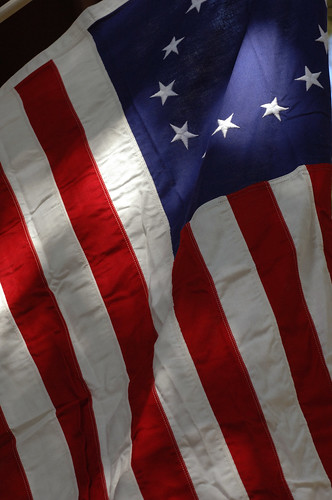
Betsy Ross Flag (1)
(Image: “Betsy Ross Flag,” by Ed Uthman, on Flickr under Creative Commons.)

Something to think about while we celebrate Independence Day.

Have a great week!

Facebooktwitterpinterestlinkedinmailby feather

The Inescapable Conclusion About Freedom

(Another in the continuing series of quotes to start the week.)

Today marks the thirtieth anniversary of President Ronald Reagan’s speech at the Brandenburg Gate in Berlin, made famous by his challenge to Soviet Union General Secretary Mikhail Gorbachev: “if you seek peace, if you seek prosperity for the Soviet Union and Eastern Europe, if you seek liberalization: Come here to this gate! Mr. Gorbachev, open this gate! Mr. Gorbachev, tear down this wall!”

Earlier in that speech, Reagan contrasted the “free world that has achieved a level of prosperity and well-being unprecedented in all human history” with “the Communist world, [where] we see failure, technological backwardness, declining standards of health, even want of the most basic kind–too little food.” And he said

There stands before the entire world one great and inescapable conclusion: Freedom leads to prosperity. Freedom replaces the ancient hatreds among the nations with comity and peace. Freedom is the victor.

We could make the same observations today about the benefits of freedom. Where people are free to associate, to collaborate, and to trade, more of them prosper than do not. But where people are not free, whether they are forced to comply with others’ demands or restrained from acting in their own best interests, fewer of them thrive and more of them suffer.


President Reagan speaking in Berlin, 12 June 1987. (Image from Wikimedia Commons.)

I hope you exercise your freedom well and wisely this week! And don’t let anyone take it from you.

Facebooktwitterpinterestlinkedinmailby feather

We Must Be Strong

Much of what I observe in our polity today — and over the past several years, frankly — seems calculated to weaken the United States. Sometimes it appears to be for short-term financial or political gain, by people who want to cash in before everything goes Tango Uniform.* Sometimes it appears to be for ideological gain, by people for whom the U.S. represents something terrible.

In contrast, I believe we must not allow ourselves to weaken, to diminish, or especially to disappear. The U.S. must be strong: economically, diplomatically, and most especially militarily. I hold that an enfeebled, chastened, toothless United States would be a prelude to disaster for the world.

"If You're Not Outraged...You're Not Paying Attention!"
Our national symbol, making its voice heard. (Image: “‘If You’re Not Outraged…You’re Not Paying Attention!’,” by Kenny P., on Flickr, under Creative Commons.)

Why? Because for all our faults, for all our failings, for all our missteps and miscalculations, we have done more than any other nation in history to protect and preserve the weak by virtue of our strength. The way I see it, in terms of the sheer power at our disposal, we have wielded our strength more judiciously and with less outright malice than pretty much anyone.

If you believe otherwise, I will not attempt to dissuade you in this brief missive. But I will not let your negativity become my prophecy or your perception become my reality. I will not let reports of our decadence and decay or predictions of our doom and decline dash my hope in a better future, or my belief that our systems are the best systems under which people can be free to live and produce and thrive.

We must be strong. I would rather we could demonstrate our strength in ways that build rather than break, heal rather than harm, and even when — not if, in this imperfect world — we need to use our strength to defend ourselves and those we treasure, I would prefer that we do so swiftly, cleanly, with as much restraint as possible. But we must be strong in the first place.

We are not perfect, and we will make mistakes. In spite of our imperfections, however, we are in general a shining example of what is good in the world: freedom of thought, freedom of action, freedom of association. If we are to remain so — both free, and an exemplar of the best that freedom conveys — we must remain strong.

___
*A technical term.

Facebooktwitterpinterestlinkedinmailby feather

Up or Down

(Another in the continuing “Monday Morning Insight” series of quotes to start the week.)

Today is President Ronald Reagan’s birthday (6 February 1911 – 5 June 2004). Before serving as President, Reagan served as Governor of California; and before he was Governor, he delivered a speech called “A Time for Choosing” that thrust him into the political spotlight.

This section of the speech seems to relate as much or more to us today as it did to his audience then:

You and I are told increasingly that we have to choose between a left or right, but I would like to suggest that there is no such thing as a left or right. There is only an up or down — up to man’s age-old dream; the ultimate in individual freedom consistent with law and order — or down to the ant heap of totalitarianism, and regardless of their sincerity, their humanitarian motives, those who would trade our freedom for security have embarked on this downward course.

I like that a lot. Not left or right, not progressive or conservative, but up or down.

Arrows up down
Which direction shall we go?. (Image: “Arrows up down,” by Counse, on Flickr, under Creative Commons.)

Reagan gave that speech on 27 October 1964. I don’t know if my parents watched it on television; I certainly don’t remember, since I was just over four months old at the time. But it resonates with me, and I remain committed to moving “up” — toward greater freedom within the bounds of the law, rather than down toward more constraints on our lives.

Who’s with me?

Facebooktwitterpinterestlinkedinmailby feather

How I Want to Relate to You

A while back I was thinking about our tendency to generalize: to take specific instances and apply them broadly. Our ability to make such mental associations may help us make sense of the world, so long as the associations make sense, but sometimes they fail to represent the whole (or even a large part of the whole). In particular, our generalizations often fail when we observe the actions or hear the words of specific people and act as if they apply to an entire cohort of people.

I don’t want to do that to you. I’d prefer it if you didn’t do that to me, either.

I want to relate to you on the basis of your individuality, your own unique nature, and whatever we might find we have in common.

  • Perhaps we have in common a shared experience in school or work or recreation.
  • Perhaps we have in common a shared appreciation for music or some other art.
  • Perhaps we have in common a shared belief in the founding principles of the United States.
  • Perhaps we have in common a shared faith, or a similar enough faith that the differences are not as important as the similarities.
  • Perhaps we have in common something more basic, more primal, like geography or heritage or history.
  • Perhaps the only thing we have in common is our shared humanity. Perhaps that could be enough.

Jackie Treehorns (The House on the Rock)
Surely we have something in common; if nothing else, maybe we can relate to one another based on a mutual appreciation of something simple, like a book. (Image: “Jackie Treehorns (The House on the Rock),” by Justin Kern, on Flickr under Creative Commons.)

I want to relate to you on the basis of who you are as a person — an individual, whole, complete person. And I would like you to consider who I am as a person, rather than any particular association I may represent.

If you permit me, I will try to overcome negative associations you may have. I will try not to come at you only from the perspective of my political viewpoint, my creed, my race, my sex, and so forth — I will not deny them, but neither will I flaunt them. Likewise, I don’t want to relate to you solely on the basis of your political viewpoint, your particular creed, your race, your sex, or anything of the sort. Our politics, our races, etc., are parts of us, but not the sum total of who we are. I am not my politics, you are not your race, and so forth, unless one of us insists on treating the other in that way. I do not so insist.

In other words, I don’t want to relate to you only as a representative of any group, or sect, or party, or biological construct. So, if we can, let’s just meet as two people, and look for something — maybe for anything — that can unite us.

And then, if we can, let’s move forward.

Facebooktwitterpinterestlinkedinmailby feather

Monday Morning Insight: 230 Years of Religious Freedom

(Another in the continuing series of quotes to start the week.)

On this date in 1786, the General Assembly of the Commonwealth of Virginia enacted the “Virginia Statute for Religious Freedom” into law. Thomas Jefferson had drafted the statute in 1777, and it was first introduced in the assembly in 1779. Jefferson considered the statute so important that he asked for it to be included as one of three accomplishments listed on his tombstone, along with the Declaration of Independence and founding the University of Virginia.

I love the way it begins:

Whereas, Almighty God hath created the mind free

Indeed, and God wants us to use our minds well! There’s a reason the prophet Isaiah says, “Come, let us reason together.”

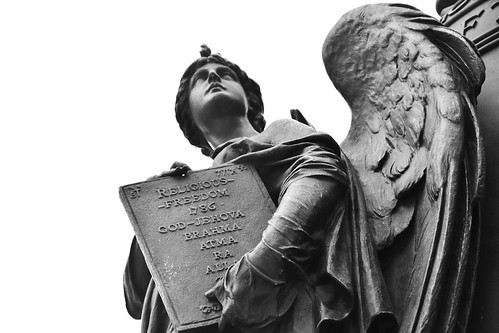
Religious Freedom
Detail on a monument to Thomas Jefferson in Louisville, Kentucky. (Image: “Religious Freedom,” by Don Sniegowski, on Flickr, under Creative Commons.)

The statute declares that punishments or burdens enacted to try to influence people’s thinking

tend only to beget habits of hypocrisy and meanness, and therefore are a departure from the plan of the holy author of our religion, who being Lord both of body and mind yet chose not to propagate it by coercions on either, as was in his Almighty power to do

“Hypocrisy and meanness.” Lord knows that often we cannot help but be hypocritical, but I pray God will forgive us if we persist in it and if our religious practice is either unkind or shabby.

As someone who believes that science and faith agree more than they disagree, I find this clause amusing:

… our civil rights have no dependence on our religious opinions any more than our opinions in physics or geometry

And given the unfortunate antagonism we face from time to time, no matter which side of whatever divide we find ourselves upon, this part is encouraging:

And finally, … Truth is great, and will prevail if left to herself, … she is the proper and sufficient antagonist to error, and has nothing to fear from the conflict

Unless we disarm Truth by restricting “her natural weapons, free argument and debate.” Let’s try not to do that, shall we?

And, finally, the act declared that

… all men shall be free to profess, and by argument to maintain, their opinions in matters of Religion, and … the same shall in no wise diminish, enlarge or affect their civil capacities.

Religious freedom: It’s a marvelous thing. I hope you have opportunity to practice yours this week.

Facebooktwitterpinterestlinkedinmailby feather