Measurement, Knowledge, Management, and Science

(Another in the series of quotes to start the week.)

Nearly everyone who has studied science knows the name “Lord Kelvin,” if only for the absolute temperature scale which bears his name. William Thomson, 1st Baron Kelvin (26 June 1824 – 17 December 1907) was a physicist and engineer from Belfast, Ireland, who did foundational work in thermodynamics and electricity at the University of Glasgow in Scotland. He was knighted by Queen Victoria in 1866 for his contributions to the transatlantic telegraph. In 1892 he was the first British scientist to receive a noble title and a seat in the House of Lords. As noted above, “Kelvin” was part of his title, rather than his actual name; it referred to a river which flows by the University of Glasgow.

In 1883, when he was still Sir William Thomson, he gave a lecture on “Electrical Units of Measurement” in which he said,

I often say that when you can measure what you are speaking about, and express it in numbers, you know something about it; but when you cannot measure it, when you cannot express it in numbers, your knowledge is of a meagre and unsatisfactory kind; it may be the beginning of knowledge, but you have scarcely, in your thoughts, advanced to the stage of science, whatever the matter may be.

This quote is nicely precise, as we might expect of a 19th century man of science. As such, it contrasts with one of the pernicious lies of modern management that still traps well-meaning but poor-thinking people today: specifically, the idea that “you can’t manage what you can’t measure.” That quote is often (but wrongly) attributed to Peter Drucker, and it may be that no one knows who originated it. But it is, as Dr. W. Edwards Deming frequently pointed out in his seminars, a myth.

The truth is, every day we encounter situations involving variables that we cannot measure. Sometimes they are things that could be measured if we had sufficient instruments and time to devote to the effort; sometimes they are things that are ineffable, and for which devising a measurement would be folly. We still have to manage those situations and navigate our way through them; we cannot throw up our hands in despair simply because the situation did not come with a convenient set of measurements and statistics attached to it.

Sometimes the people who proclaim that measurement is necessary to management are in the business of selling measurement practices or techniques. And they may take advantage of managers who have never had to measure things in the real world. Those managers would do well to apply a little skepticism and heed the words of William Bruce Cameron, who said in the 1958 article “Tell Me Not in Mournful Numbers,”

Counting sounds easy until we actually attempt it, and then we quickly discover that often we cannot recognize what we ought to count. Numbers are no substitute for clear definitions, and not everything that can be counted counts.

In 1963, Cameron elaborated by writing, “not everything that counts can be counted, and not everything that can be counted counts.” How many managers would benefit from understanding that!

Often when managers decry the lack of measurements to justify the decisions they wish to make, they do so without any real appreciation for the difficulty of measuring things with accuracy and precision. Their bathroom scale works, though they may not like what it reports; the gauge in their car indicates its fuel status with some reliability; these and other experiences lead them to expect to receive similar reports of progress or status on whatever aspect of the business is under their scrutiny that day.

Which brings us back to Sir Thomson, Lord Kelvin, and his observation about measurement. He wisely allowed for the possibility of not being able to measure something — thus, that late 20th century management aphorism, whatever its source, was invalidated roughly a hundred years before it was spread! While he then said that our knowledge of a thing may be stunted by lacking measurements for it, that does not mean we have no knowledge of it at all; even “the beginning of knowledge” is knowledge of a sort. But what was Kelvin’s interest in measurement? Was it management? No! It was science.

And, though managers may like to claim otherwise, management is not science.


(Image: JPL imagery from the Jason-2 satellite, showing “Kelvin Waves” — named after Lord Kelvin, who discovered them — moving eastward along the equator.)

That’s all I have to say on the subject, at the moment, but I’d be happy to discuss it at length if you like. Meanwhile, I hope you have a good week!

___
P.S. Last week I mentioned possibly ending this series, and I’m still undecided on that point. Let me know if you have feelings about that, one way or another.


Facebooktwitterpinterestlinkedinmailby feather

New Video: Of, By, and For the People

Have you thought much about the placement of the prepositions in Lincoln’s Gettysburg Address? Does their placement — “of the people, by the people, for the people” — matter much in understanding what they imply for our government?

In this video, I suggest that their placement is pertinent … and proper:

___
Related:
– Video: The Verbs in the Preamble
– More videos: My YouTube channel

Facebooktwitterpinterestlinkedinmailby feather

In Defense of a Breadth of Knowledge

(Possibly the last in the quotes to start the week series?*)

I had this week’s quote all picked out on Sunday, but got busy and didn’t write and post this yesterday as I should have.

Why should I have posted it yesterday? Because yesterday was the birthday of Blaise Pascal (19 June 1623 – 19 August 1662), whose quote I wanted to focus on (or “on whose quote I wanted to focus,” if we’re feeling more grammatically pedantic this afternoon). Pascal was a renowned mathematician, invented a series of calculating machines, and was also a prominent Catholic theologian. In his Pensees (1669; literally, “thoughts”), he wrote,

Since we cannot be universal and know all that is to be known of everything, we ought to know a little about everything. For it is far better to know something about everything than to know all about one thing. This universality is the best. If we can have both, still better; but if we must choose, we ought to choose the former.

I like that a lot. It’s one thing to develop some sort of expertise, and even to be recognized as an expert, but life is so grand and glorious that to stay cloistered in one thing — no matter how expansive and rewarding that one thing might be — would be to miss out on so much more that the universe has to offer.

At the very least, knowing a little bit about a lot of things makes it easier to converse with a wider variety of people; and that in itself can expand our personal horizons.


(Image: “Knowledge-sharing,” from Wikimedia Commons.)

So, let’s learn something new this week!

___
*This series has been running a little over a year. It was fun when it started, and I’ve enjoyed finding quotes that I thought were interesting, but I’m not sure how much value it has for other folks. If it has any value for you, let me know, because I’m considering moving on to different things. Thanks! GR

Facebooktwitterpinterestlinkedinmailby feather

New Video: “Stand Up, If You Can” (a Public Speaking Tip)

It may seem a bit self-evident, but standing up to give your formal presentation can make a lot of difference in how your audience receives it — especially if the points you’re making are at all important.

One-on-one, or speaking only to a few people? Sitting down is often fine. But speaking to a bunch of people at once? You’re better off standing up, if you’re physically able to do so.

Unless you don’t care that much about your message, in which case go right ahead and sit on your butt to give your speech, or your presentation … or your sermon.

___
Related:
– Video: Public Speaking Tip: The Value of Inflection
– More videos: My YouTube channel

Facebooktwitterpinterestlinkedinmailby feather

The Inescapable Conclusion About Freedom

(Another in the continuing series of quotes to start the week.)

Today marks the thirtieth anniversary of President Ronald Reagan’s speech at the Brandenburg Gate in Berlin, made famous by his challenge to Soviet Union General Secretary Mikhail Gorbachev: “if you seek peace, if you seek prosperity for the Soviet Union and Eastern Europe, if you seek liberalization: Come here to this gate! Mr. Gorbachev, open this gate! Mr. Gorbachev, tear down this wall!”

Earlier in that speech, Reagan contrasted the “free world that has achieved a level of prosperity and well-being unprecedented in all human history” with “the Communist world, [where] we see failure, technological backwardness, declining standards of health, even want of the most basic kind–too little food.” And he said

There stands before the entire world one great and inescapable conclusion: Freedom leads to prosperity. Freedom replaces the ancient hatreds among the nations with comity and peace. Freedom is the victor.

We could make the same observations today about the benefits of freedom. Where people are free to associate, to collaborate, and to trade, more of them prosper than do not. But where people are not free, whether they are forced to comply with others’ demands or restrained from acting in their own best interests, fewer of them thrive and more of them suffer.


President Reagan speaking in Berlin, 12 June 1987. (Image from Wikimedia Commons.)

I hope you exercise your freedom well and wisely this week! And don’t let anyone take it from you.

Facebooktwitterpinterestlinkedinmailby feather

New Video: The Dickensian Duo

The beginning of June seems an odd time to hearken back to Charles Dickens’ A Christmas Carol, but that’s where Dickens sets out a pair of conditions that I call “The Dickensian Duo.” In this video, I introduce them, consider the relationships between them, and discuss the importance of education in addressing them.

Let me know what you think!

___
Education-Related Stuff:
– Video: The Musashi-Heinlein School
– Text: Quality Education: Why It Matters, and How to Structure the System to Sustain It

Facebooktwitterpinterestlinkedinmailby feather

The Author and Politics

(Another in the continuing series of quotes to start the week.)

This past Saturday, at the ConCarolinas science fiction and fantasy convention, I was part of a panel called “Author and Politics” which was both well-attended and well-run. We agreed on some points, we disagreed on some points, but we did so like grown-ups — respectfully and without rancor.

It was, in the end, quite refreshing.

So when it came to figuring out a good quote to start the week, I thought of this one from Aleksandr Solzhenitsyn, which I copied out of The Gulag Archipelago many years ago.

Is it not true that professional politicians are boils on the neck of society that prevent it from turning its head and moving its arms? And why shouldn’t engineers have political views? After all, politics is not even a science, but is an empirical area not susceptible to description by any mathematical apparatus; furthermore, it is an area subject to human egotism and blind passion.

That quote has always resonated with me, mostly because of the imagery in the first sentence but also because I was trained as an engineer and still to a small degree think of myself as one. And it hasn’t lost any of its power: certainly we saw in our most recent election plenty of instances of “human egotism and blind passion.”

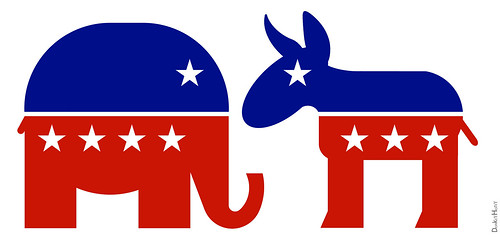
Republican Elephant & Democratic Donkey - Icons
The parties don’t often see eye to eye, do they? (Image: “Republican Elephant & Democratic Donkey – Icons,” by DonkeyHotey, on Flickr under Creative Commons.)

But when I have experiences like the panel on Saturday, and I recall the adage that “all politics are local,” I am a bit more hopeful that if we conduct ourselves well we can avoid (at least in the small circles of our friends) the worst excesses of either side, and chart a course that’s mutually beneficial.

I admit that I may be hopelessly naïve about such things.

After all, I’m The Anti-Candidate, and I approved this message.

___
Related Items:
– Listen to “I Think I’ll Run for Congress”, from the album Truths and Lies and Make-Believe
– Listen to “The Anti-Candidate Song”, from the album Distorted Vision

Facebooktwitterpinterestlinkedinmailby feather

New Video: Perspective and Self-Improvement

I’m not big into self-help or self-improvement — a little goes a long way in that regard — and I’m certainly not in any position to be a “guru” to anyone, but in this video I share some thoughts on what kind of perspective helps or hinders our efforts. Plus, I get to unpack another of my favorite quotes from samurai warrior Miyamoto Musashi.

___
Related Stuff:
– More Musashi, of course, in The Musashi-Heinlein School video
– Not a “self-help” book, but a helpful book: Quality Education: Why It Matters, and How to Structure the System to Sustain It

Facebooktwitterpinterestlinkedinmailby feather

Liberty, and Remembering

(Another in the continuing series of quotes to start the week.)

Memorial Day 2017 happens to fall on the birthday of two key patriots in American history: Patrick Henry (29 May 1736 – 6 June 1799) and President John F. Kennedy (29 May 1917 – 22 November 1963).

Henry is perhaps best known for a 1775 speech he gave at the Second Virginia Convention, in which he famously said

Give me liberty, or give me death!

Today we remember those who made just that sacrifice, “who more than self their country loved,” as “America the Beautiful” puts it, and who, we might imagine, loved liberty “more than life.” The price they paid is beyond reckoning, as is the gift of liberty they bestowed upon each of us.

Kennedy, of course, was a renowned orator and as President took advantage of many opportunities to stir crowds with his speeches. In a speech at Amherst College less than a month before his assassination, Kennedy said:

A nation reveals itself not only by the men it produces but also by the men it honors, the men it remembers.

Though he said it to honor the poet Robert Frost, Kennedy’s sentiment holds true as we honor our fallen warriors … among whom no doubt there were more than a few warrior-poets.


(US Defense Department Image, 26 May 2017.)

May we never, never, forget.

All together now: “To absent friends ….”

Facebooktwitterpinterestlinkedinmailby feather

New Video: The Dimensions of Sphericity

A follow-up to last week’s video about “sphericity” as a metaphor for helping students grow and develop in multiple dimensions. What dimensions might we choose?

Let me know what you think!

___
Related Stuff:
– Last week’s Two-Dimensional Characters, and Education video
– The Musashi-Heinlein School video
– And, for good measure, Quality Education: Why It Matters, and How to Structure the System to Sustain It

Facebooktwitterpinterestlinkedinmailby feather