Want to Brainstorm about the Pegasus Awards?

Okay, music fans, what do you think the best SF&F music of 2013 was?

Pegasus Award Logo

The awards cycle has started for the annual Pegasus Awards, which honor science fiction and fantasy-related music. Unlike other awards, the Pegasus Award cycle begins with a wide-open “brainstorming” phase.

Pegasus Awards are given out in four permanent categories, as well as two categories which rotate from year-to-year:

  • Best Filk Song
  • Best Classic Filk Song — a song at least 10 years old that has “entered filk community public consciousness”
  • Best Performer
  • Best Writer/Composer
  • 2014 Rotating Category: Best Adapted Song — which can include adapting or parodying a mundane song or a filk song, but can also mean adapting a poem or book
  • 2014 Rotating Category: Best Song of Passage — which can relate to any kind of passage (e.g., passage to adulthood or some other life stage, travel, etc.)

Anyone who has an interest in filk — which, as noted, is science fiction and/or fantasy-related music — is considered part of the “filk community” and can participate in brainstorming possible nominees. The award by-laws define “exhibiting interest” using examples such as filking at SF&F conventions, attending filk conventions or “house sings,” taking part in related on-line forums, and just “discussing filk and filk related issues with other filkers.”

If you made it this far in this post, you can probably claim to have exhibited interest and therefore would be qualified to participate in the Pegasus Award process. So if you have a favorite you’d like to suggest, fill out the Brainstorming Poll Form. There’s only space for five suggestions in each category, but you’re allowed to fill out as many brainstorming forms as you like.

The nomination phase will start in the spring, and voting takes place in the late summer. The Pegasus Awards are awarded at (and administered by) the Ohio Valley Filk Fest in October.

Facebooktwitterpinterestlinkedinmailby feather

illogiCon Wrap-Up

It took longer than anticipated to recover from illogiCon, because it was such an enjoyable convention. It took longer than expected to post this wrap-up, too — no excuse!


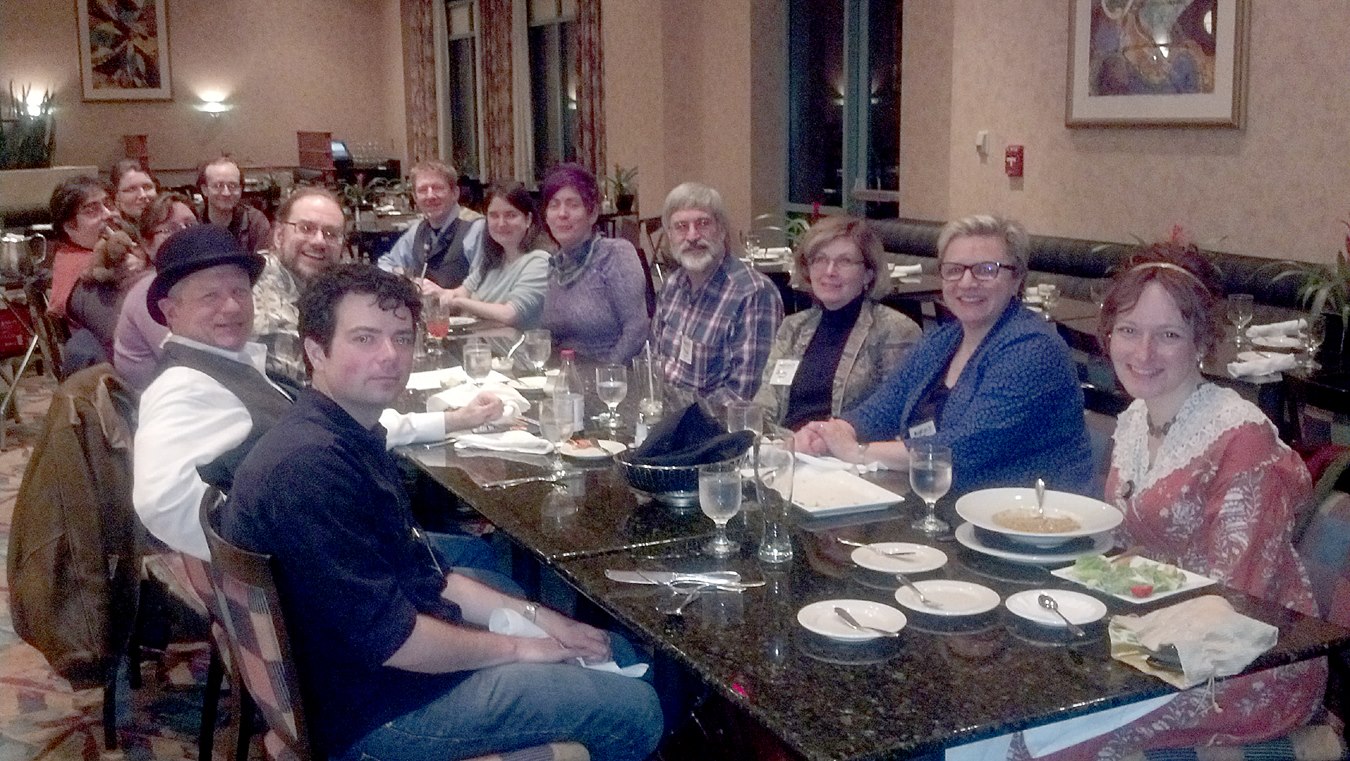
(At dinner with many of my writing friends. I’m the one in the hat. Photo courtesy of James Maxey.)

As with other conventions, the best part was hanging out with my friends. illogiCon featured two Guests of Honor, Mary Robinette Kowal and Lawrence M. Schoen, both of whom are terrific folks, as well as many of our local North Carolina authors who are among my favorite people in the world.

But, holy moly, illogiCon was BUSY!

On day one of the convention, last Friday, I was on two panels: one a serious discussion about how technologies such as robotics and smartphones are impacting our lives, and then “Lies With Words,” in which GOH Lawrence Schoen led five of us through a game similar to Balderdash. (Yours truly came in third; Baen Books author Mark Van Name took the prize.) The evening ended, as most of my convention evenings do, with filk — though the filking was pretty subdued.

Saturday was a whirlwind of activity in more ways than one. First was a panel discussion about whether social media and rapid communication are fragmenting society into “A Million Nations,” followed by an enjoyable discussion about science fiction from the perspective of social scientists. A few of my friends came to my reading, which was followed by a recording of the Baen Free Radio Hour — though right about that time we had two tornado warnings in quick succession! (The storm was close enough that it damaged trees just up the street from my house.) Once things calmed down, and after the podcast recording, we put on the Baen Books Travelling Roadshow, after which I had a delightful dinner with my friends (as seen above). I split the rest of the evening between attending other friends’ events, visiting with folks in the lounge, and finally more filking.

Sunday started with a panel that examined “Hard SF vs. Soft SF,” and ended with a discussion of “New Trends in Speculative Fiction.” In between I again attended some of my friends’ events, and afterward I came home and, frankly, crashed pretty hard.

I think I went to work on Monday, but I don’t remember much of it. But that’s probably another indication that illogiCon was a pretty good convention!

Facebooktwitterpinterestlinkedinmailby feather

Another Panel for illogiCon: Baen Free Radio Hour

I got my final illogiCon schedule, and in addition to my other panels I get to be part of the Baen Free Radio Hour on Saturday afternoon!

The “Baen Free Radio Hour Live Q&A” will be a live recording of the Baen Books weekly podcast. The recording will take place at 2 p.m., right after my reading.

The other panelists will be Baen author and editor Tony Daniel, Baen author and “chief technologist” Mark Van Name, the “Chainmail Chick” Allegra, and Nebula (and other) award-winning author (and NC State professor) John Kessel. I’ve been on panels before with each of them, so it should be fun!

If you want to see what else is happening at illogiCon, check out the full program schedule.

Facebooktwitterpinterestlinkedinmailby feather

Want to Nominate and Vote for the Hugo Awards?

The nomination period for the Hugo Awards opens this week, and you can still sign up to nominate and vote!

Hugo Award Logo

The Hugos are roughly equivalent to the People’s Choice Awards, in that the awards are determined by science fiction and fantasy fans rather than professionals in the field. The categories include Best Novel, Best Short Story, Best Related Work, Best Dramatic Presentation, and so forth.

Anyone with an Attending or Supporting membership in last year’s, this year’s, or next year’s World Science Fiction Convention can submit nominations. Supporting membership in this year’s Worldcon, Loncon 3 — to be held in London in August — run about $60 $40 (depending on the exchange rate), for which you receive electronic copies of nearly every nominated work, including portfolios from the nominated artists. Only members of the current Worldcon can vote for the Hugos, and you have until the end of January to join the convention in order to nominate and vote.

Anyway, even though this page says you can nominate now, the Loncon3 front page says the Hugo nomination period opens later this week, which seems to be the case since the nomination form wasn’t working as I prepared this blog post. In the meantime, you can find general information on this Hugo Awards page, and nomination-specific information here.

The nomination period closes at the end of March, but remember: if you want to nominate, you need to join Worldcon before the end of January!

Facebooktwitterpinterestlinkedinmailby feather

If You Come to illogiCon, This is What I’ll Be Doing

illogiCon, the Research Triangle area’s science fiction and fantasy convention, will convene next weekend for its third installment.


(The illogiCon mascot, “Professor Schrodington.”)

Subtitled “The Search for Schrodington’s Gold” in honor of its mascot, pictured above, illogiCon is a small, fan-run convention being held here in Cary at the Embassy Suites Raleigh-Durham/Research Triangle. The guests of honor this year are my writing friends Mary Robinette Kowal and Lawrence M. Schoen, and many of my other writing friends will be part of the convention, too.

I’ll be on several panels, and will also present a reading (which in my case is always a “singing,” too):

Friday, January 10th

  • 4:00 PM — Our Cyborg Futures…Today! Paralyzed veterans are now starting to test exoskeletons that allow them to walk again. Robotic hands are becoming more nimble, robotic legs more responsive and balanced. On a more subtle level, smartphones today can augment human brains and bodies in fundamental functions such as managing hunger and sleep, and expand intelligence in ways unimaginable just a few decades ago. Are we living in the dawn of the age of machine-men? (With James Maxey and Justin Andrews.)
  • 9:00 PM — Lies With Words: The panelists are given a list of obscure and/or obsolete words in advance. All but one of them composes a false definition of the word, long or short, simple or complex, as they please. One panelist has the true definition. Can the audience tell which is which? Points are Awarded to each panelist for every audience member who buys into his/her lie. (Hosted by Lawrence M. Schoen. Other panelists: Mark Van Name, Michael Williams, Ed Schubert, and Bill Ferris.)
  • 10:00 PM — Open Filk

Saturday, January 11th

  • 11:00 AM — A Million Nations:: There was a time when where you lived was the primary determining factor of the culture you were raised in. But with the interconnectivity of the modern era, many of us get to build virtual neighborhoods of friends to socialize with online while never needing to bother with learning the names of people living next door in the real world. Is there anything resembling a common culture anymore? Or do we face a future of ever increasing cultural fragmentation as humanity sorts itself into a million different segments, all with differing values, myths … and even facts? (With James Maxey, Samuel Montgomery-Blinn, and Ed Schubert.)
  • 12:00 PM — Social Scientists’ Science Fiction: There’s no shortage of science fiction written by authors with Ph.D.s in the “hard sciences” (biology, chemistry, physics), and their expertise show up in everything from world building to alien physiology. But what about authors with doctorates in Psychology, Sociology, Anthropology, Linguistics, Economics, and so on? Is the SF experience redefined when it comes from social scientists instead? (With Lawrence M. Schoen, Samuel Montgomery-Blinn, Michael Williams, and Bill Ferris.)
  • 1:00 PM — READING … and singing!
  • 5:00 PM — Baen Books Travelling Roadshow: Come find out whatʼs new from Baen Books. There will be an exploding spaceship.
  • 11:00 PM — Open Filk

Sunday, January 12th

  • 10:00 AM — Hard SF vs. Soft SF: From near-future thrillers so hard they could cut diamonds to allegories less-than-concerned about literal realism, science fiction covers a broad spectrum. How do they play together in the genre of ideas? (With Metricula and Samuel Montgomery-Blinn.)
  • 5:00 PM — New Trends in Speculative Fiction: Speculative fiction often rides on the next big thing — the New Wave, Cyberpunk, Steampunk, Urban Fantasy, the Singularity, the New Weird. Where are we headed right now? Are there undiscovered movements just waiting for their central works? (With Samuel Montgomery-Blinn, Ada Milenkovic Brown, Bill Ferris, and Natania Barron.)

So if you’re in the Research Triangle area next weekend, and you need to get your fantasy and science fiction fix, stop by and see us!

Facebooktwitterpinterestlinkedinmailby feather

On Reaching the Ten Percent Point

All told, at the end of 2013 sales of my CD had reached the 10% point.


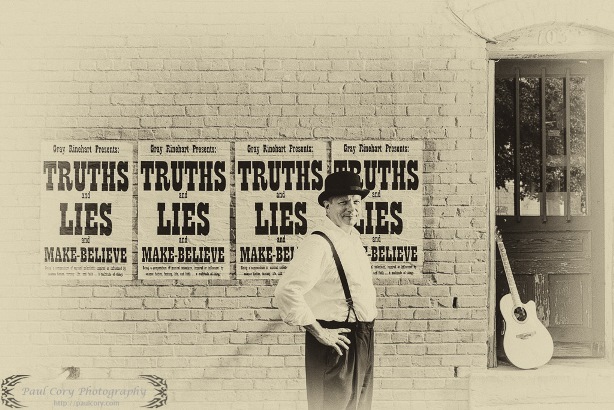
(Image by Paul Cory Photography.)

Ten percent of what? Ten percent of what it cost to write, record, engineer, produce, and market the thing.

I released the CD at the end of August, so it took 4 months to get to this point. If sales continue at the rate of 10% every 4 months — an optimistic estimate, since usually sales drop off after the initial surge — then it will take me another 36 months, or until January 2017, to break even on this project.

This, ladies and gentlemen, is what we refer to as a “labor of love.” Or sheer lunacy; take your choice.

Facebooktwitterpinterestlinkedinmailby feather

The Social Peril of Asking a Difficult Question

So, I was “unfriended” by someone on Facebook yesterday.

facebook like button

Those readers who have dealt with me on the Book of Faces probably aren’t surprised, since I can be even more of a jerk online than I am in real life. But it took me by surprise.

A little context: The gentleman (whom I like and am happy to consider a friend, though I suppose it’s more like we’re just acquaintances now) posted a graph showing an international comparison of the U.S. and a couple dozen other rich nations. He didn’t originate the graph, he “shared” it, so I was surprised by his reaction when I questioned the mathematical choices of the people who put it together.

(As an aside, I should explain that it seemed to me that the graph was contrived to make the U.S. look bad, since we were next-to-last in the select group of nations. I withheld that judgment. I also had questions about the actual data presented, including what operational definitions had been used and whether they were consistent across all the nations represented; from research I’ve done, I understand this can be a problem with international comparisons.)

I was most curious about why the researchers had selected “50% of the median household income” as the cutoff point for the comparison. Knowing the median value of a data set — the middle value when all the data are arranged in ascending order — can be useful, but less so when the mean (the arithmetic average) is not presented, but I wondered specifically why 50% of the median was significant.

So I asked the question. I didn’t phrase it as a question, which was probably a mistake; instead, I said something along the lines of “someone will need to explain to me why it makes sense to use 50% of the median.”

What followed was a confusing illustration of the fragile bonds of social media.

My correspondent posted a couple of links purported to show that the value in question was some kind of standard for defining poverty. Even if that were true — I eventually found other references that showed alternative values — one of the references had nothing to do with median income, and neither explained the rationale behind selecting the specific fraction of the median.

So I asked the question again — and in the form of a question this time. I asked why 50% of the median was selected, as opposed to 50% of the mean, or 50% of the mode, or some other percentage of the median. I hoped that someone who saw the exchange might be able to answer the question.

Instead, the next time I tried to look at the thread I found that I no longer had access to it. Following up, I discovered that he had terminated our FB friendship.

Surprised at his reaction, I contacted him off-line — because I’m just that kind of jerk — and apologized if I had offended him. The details of our subsequent exchange are unimportant, but suffice it to say that I got the impression that he had grown tired of my questioning (let alone challenging) sources he considered unassailable.

I wondered, in all of this, about my own motivation when posting particular news items or research results. Do I do so for the “echo chamber” effect, to collect “likes” and positive comments from friends who think the way I do? If I claim to do it in hope that it might educate or enlighten friends who think differently, am I fooling myself? Do I really post such things for the “poke ’em in the eye” effect? And, no matter my motivation, should I be surprised that provoking thought might lead to provoking responses, including responses that disagree with my own?

I am still disappointed that my question about the statistic wasn’t answered, and my own brief research into the matter hasn’t been very enlightening. But I’m even more disappointed that asking the question wasn’t met with a simple, “Hey, I don’t know, you’ll have to ask someone else” but instead was given the coldest of shoulders. Because if we can’t ask questions and engage in a sincere give-and-take, how can we expect to learn?

Facebooktwitterpinterestlinkedinmailby feather

Welcome 2014! Looking back and looking forward …

Last year was … strange … but in a good way!


(This New Year, too, will eventually be washed away. Image from MyrtleBeach.com’s Facebook feed.)

I had three stories published in 2013:

And, of course, I released my album, Truths and Lies and Make-Believe, in August. (If you haven’t bought a copy yet, the download is $7 and the physical CD is $10.)

So far I have one story slated for publication in 2014: “Lightweaver in Shadow,” which will be part of the Shattered Shields anthology edited by Jennifer Brozek and Bryan Thomas Schmidt. It will come out from Baen Books in November.
I need to finish editing another story that’s been provisionally accepted, and I’ve got other songs in work that may eventually be part of another album. Here’s looking forward to another creative year!

Facebooktwitterpinterestlinkedinmailby feather

What Media Bias? This Media Bias

CAUTION: Political Post Ahead.

The pro-Obamacare slant in major media came home to Raleigh, NC, this week.

The local CBS affiliate, WRAL-TV, aired a story — Some have success signing up for health coverage online — that chronicled how a self-employed graphic designer who had a $176 per month insurance plan got a new plan “on HealthCare.gov with the help of a federally trained navigator.”

Without going into the question of why Internet-savvy people (who can presumably purchase all manner of goods on commercial websites) would need a “navigator” to guide them through the Federal health care maze, let’s get to the obvious spin WRAL put on the story.

The lady’s original plan, which she categorized as “bottom of the barrel” (whatever that means; no specifics were offered on the plan’s supposed deficiencies or how long she had been dissatisfied with it), was replaced with a better one:

She took about a week to compare plans and enrolled in one that provides better coverage than her current plan. With federal subsidies, her monthly premium for her new insurance will be $91 a month – a 48 percent decrease.

In case you missed it, the bias comes by way of the quickly passed-over phrase, “with federal subsidies,” in the information that’s missing about how much the new plan costs and how much the subsidy is. That information is not in the audio or the transcript, but it shows up on screen at about the 1:30 point, as seen below:


(Screenshot of the WRAL-TV story.)

From this we see that the premium on her new, Obamacare-approved policy is actually $344.46 per month, nearly twice what she was paying before. We might hope this new policy would be better than the one she had, if it costs that much more.

But she’s only paying $91 and change for that policy, because the silent graphic shows that over $250 of that monthly cost is listed as a “premium tax credit.” That’s more than her original policy cost, for an annual total of over $3000, paid by the enforced generosity of the U.S. population and the borrowing habits of the Federal Reserve.

Remember, this was a “success story” in the eyes of WRAL: not what I often hear touted about an uninsured person or someone with a preexisting condition getting coverage, but that someone who had health insurance and was paying for it on her own has now been forced by law into dependence on the government. Yet in preparing their approved narrative, they chose not to call attention to those facts.

I thought I felt a breeze, that story spun so fast. But I’m a failed engineer, so what do I know about journalism?

Facebooktwitterpinterestlinkedinmailby feather